
How Do Fish Have Intercourse?
Fish have intercourse in different ways depending on the species, showcasing a variety of fascinating reproductive strategies. Many fish release eggs and sperm into the water for external fertilization, often without any physical contact between the male and female.
Others use specialized organs like claspers or gonopodia to transfer sperm directly inside females during internal fertilization. Some fish can even change sex or reproduce without males through parthenogenesis.
Environmental and social factors also influence their mating choices. If you want to understand these fascinating methods and unique adaptations, there’s much more to explore.
How Does External Fertilization Work in Most Fish?
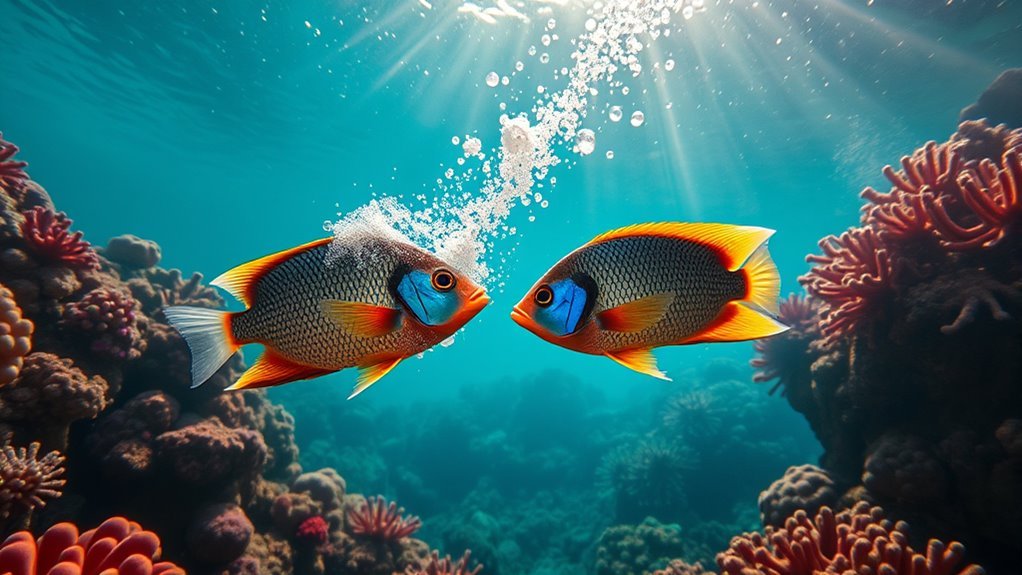
When fish reproduce through external fertilization, females release eggs into the water while males simultaneously release sperm nearby.
During spawning, you’ll see females lay eggs either attached to substrates or freely in open water.
Females lay eggs attached to surfaces or freely drifting in open water during spawning.
Males then discharge sperm over these eggs, allowing fertilization to occur externally as sperm swim to and penetrate the eggs.
This reproductive strategy relies on environmental cues like water temperature, light, and chemical signals to synchronize spawning, increasing fertilization success.
Since external fertilization is a passive process, males and females don’t make physical contact during reproduction.
Understanding these reproductive strategies helps you appreciate how fish maximize the chances of survival for their offspring in diverse aquatic environments.
How Do Fish Sperm and Eggs Travel During Reproduction?
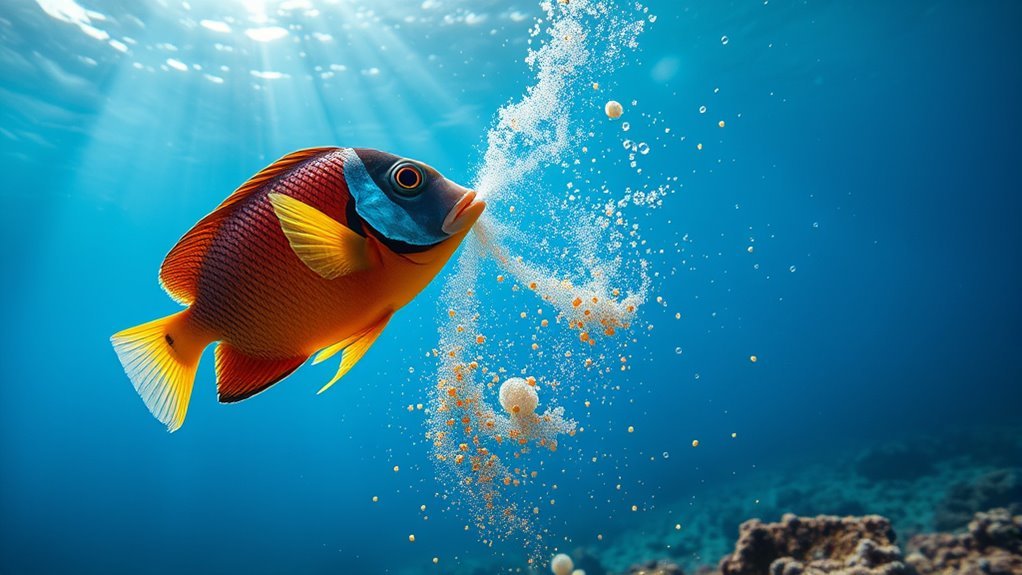
When fish reproduce, sperm often travel through water to reach eggs released nearby, relying on currents to help them meet.
In species with internal fertilization, sperm move directly into the female’s reproductive tract using specialized organs.
You’ll see that how sperm and eggs travel depends on whether fertilization happens inside or outside the body.
Fish Sperm Pathways
Although fish reproduce in various ways, their sperm and eggs follow distinct pathways depending on whether fertilization occurs externally or internally.
In species with external fertilization, males release sperm into the water, where it swims toward eggs released by the female. This method relies on sperm dispersing freely to meet eggs.
However, during internal fertilization, males use specialized structures like claspers or copulatory organs to transfer sperm directly into the female’s reproductive opening. The sperm then travels through the female’s reproductive tract, increasing the chances of successful fertilization.
This direct sperm transfer guarantees a more controlled environment for fertilization.
Understanding these pathways highlights how fish adapt their reproductive strategies to different environments and mating behaviors.
Egg Release Mechanisms
How do fish guarantee their sperm and eggs meet during reproduction? They rely on precise egg release mechanisms involving their reproductive organs and ducts.
In species practicing external fertilization, females release eggs through reproductive ducts directly into the water, while males simultaneously release sperm nearby. This synchronized gamete release boosts fertilization chances as sperm and eggs meet externally.
For internal fertilization, males use specialized reproductive organs like claspers to transfer sperm directly into the female’s reproductive tract. This *assures* sperm travel efficiently to the eggs inside her body.
Both strategies often depend on environmental cues such as water temperature or lunar cycles to time gamete release perfectly. By coordinating these processes, fish maximize reproductive success, whether fertilization happens inside or outside their bodies.
What Are Intromittent Organs and How Do They Work?
You’ll find that intromittent organs come in different forms, like claspers in sharks and gonopodia in guppies, each adapted to specific species. These organs help males transfer sperm directly into females during copulation, boosting fertilization success.
Understanding their function and variations reveals how fish have evolved unique reproductive strategies.
Types of Intromittent Organs
When male fish reproduce, they often use specialized intromittent organs to deliver sperm directly into the female’s reproductive tract. These reproductive structures vary widely but all serve the vital role of enabling internal fertilization.
Here are some common types of intromittent organs you’ll find in fish:
- Claspers: Paired pelvic fins in sharks and rays that channel semen into females during mating.
- Gonopodia: Modified, often elongated fins in livebearers that help inseminate internally.
- Priapium: A unique head-mounted organ in species like Phallostethus cuulong used for direct sperm transfer.
- Other modified fins: Some fish evolve distinct fin shapes to assist in internal fertilization.
These adaptations guarantee sperm reaches the female efficiently, improving reproductive success in challenging environments.
Function During Copulation
Why do intromittent organs play such a crucial role in fish reproduction? These specialized male reproductive organs allow males to deliver sperm directly into the female’s reproductive tract during copulation, enabling internal fertilization.
Unlike external fertilization, where eggs and sperm meet outside the body, internal fertilization increases the chances of successful reproduction, especially in environments where external fertilization might be risky or inefficient.
For example, sharks and rays use claspers—paired, rod-like intromittent organs inserted into the female’s cloaca.
Male livebearers like guppies rely on gonopodia, modified fins that function similarly.
Even more unusual, species like Phallostethus cuulong use a priapium on the head to grasp and inseminate the female.
Species-Specific Adaptations
Intromittent organs come in a variety of forms tailored to each species’ reproductive needs. These specialized reproductive adaptations enable internal fertilization by delivering sperm directly into the female’s body, increasing the chances of successful reproduction.
When you explore fish anatomy, you’ll notice unique structures evolved for this purpose:
- Claspers: Modified pelvic fins in sharks and rays that insert into the female’s cloaca.
- Gonopodia: Adapted anal fins in livebearers acting as intromittent organs.
- Priapium: A head-mounted organ in species like Phallostethus for attachment during mating.
- Other species-specific intromittent organs: Various designs crafted by evolution to suit reproductive strategies.
Understanding these organs helps you appreciate the diversity and complexity of fish reproductive adaptations.
How Do Sharks and Rays Mate Using Claspers?
Although shark and ray mating might seem complex, it relies on specialized organs called claspers, which males use to deliver sperm directly into the female’s cloaca. These claspers are modified pelvic fins that serve as essential reproductive organs for sharks and rays.
During copulation, the male inserts one clasper into the female’s cloaca, using grooves and hooks on the clasper to anchor himself securely.
To maintain position, the male often bites or grasps the female. This precise method guarantees internal fertilization, as sperm is directly deposited inside the female’s reproductive tract.
After mating, the male withdraws the clasper, completing the process.
This unique adaptation in sharks and rays assures effective sperm transfer and increases the chances of successful fertilization.
Unique Reproductive Organs in Fish: The Priapium and Beyond
When you look closely at fish reproduction, you’ll find some surprising adaptations beyond claspers. Some fish species have evolved unique reproductive organs that make internal fertilization possible, enhancing fish mating success.
For example, the priapium—a specialized organ found on the chin or head of fish like Phallostethus cuulong—helps males grasp females firmly during mating.
Meanwhile, claspers in sharks and rays serve as paired cartilaginous tools to transfer sperm internally. These specialized organs highlight the diversity of fish reproductive anatomy and strategies.
Claspers in sharks and rays enable internal sperm transfer, showcasing diverse and specialized fish reproductive adaptations.
- Priapium enables direct organ-to-organ contact during mating
- Claspers facilitate sperm transfer inside the female’s body
- Internal fertilization improves reproductive efficiency
- Unique reproductive organs showcase evolutionary innovation in fish
Understanding these organs offers insight into the fascinating world of fish mating.
How Do Hermaphroditic Fish Change Sex and Reproduce?
If you’ve ever wondered how some fish adapt their reproductive roles, hermaphroditic species offer a fascinating answer by changing sex in response to their environment. Hermaphroditic fish undergo sex change through hormonal shifts, adjusting estrogen and androgen levels to develop or regress reproductive organs. Protogynous hermaphrodites start as females and switch to males, often triggered by social dominance or size.
Some species even possess both sets of reproductive organs simultaneously, allowing flexible mating roles. External fertilization remains their common reproduction method, with social hierarchy influencing who changes sex or self-fertilizes.
| Type | Initial Sex | Trigger for Sex Change |
|---|---|---|
| Protogynous Hermaphrodites | Female | Loss of dominant male |
| Protandrous Hermaphrodites | Male | Size or age |
| Simultaneous Hermaphrodites | Both | Mate availability |
| Self-fertilizing | Both | Isolation or mate scarcity |
How Does Parthenogenesis Let Fish Reproduce Without Males?
Hermaphroditic fish change sex to adapt their reproductive roles, but some species take a different route by reproducing without males altogether. Parthenogenesis lets female fish produce offspring without fertilization, developing eggs into embryos on their own. This reproductive strategy creates clones—genetically identical to the mother—bypassing the need for male involvement.
Here’s what you should know about parthenogenesis in fish:
- Eggs develop without fertilization, enabling reproduction in male-scarce environments.
- Offspring are clones, so genetic diversity stays low.
- Species like the Amazon molly rely entirely on this method.
- While efficient, this reproductive mode limits adaptability due to reduced genetic variation.
Unique Reproductive Modes in Fish: Sexual Parasitism and More
Although fish reproduction often involves familiar methods like egg-laying or live birth, some species have evolved truly unique strategies to guarantee their survival in challenging environments. For example, sexual parasitism in deep-sea anglerfish lets tiny males permanently attach to females, ensuring reproductive access despite scarce encounters.
Fish reproductive modes also include both internal fertilization—using specialized organs like claspers or gonopodia—and external fertilization, where eggs and sperm meet outside the body.
Fish reproduce through internal fertilization with specialized organs or external fertilization where eggs and sperm meet outside.
Some species exhibit hermaphroditism, possessing both male and female reproductive organs to maximize mating opportunities.
Others use hybridogenesis, producing genetically uniform offspring by discarding paternal DNA.
These diverse strategies highlight how fish adapt their reproductive modes to their environment, ensuring successful reproduction even under extreme or unique conditions.
Environmental and Social Factors Affecting Fish Mating
Because environmental and social factors directly influence fish behavior, they play a crucial role in determining when and how fish mate. You’ll notice that fish adjust their reproductive behaviors based on cues from their surroundings and social structure.
Environmental factors like temperature and oxygen levels affect spawning timing and success, while social hierarchies decide which fish get to reproduce.
Sometimes, fish even change sex to maximize mating chances, responding to social or environmental triggers.
Here are key influences on fish mating:
- Temperature, oxygen, and food availability shape spawning events
- Social hierarchies control access to mates and reproductive opportunities
- Population density can trigger or suppress spawning aggregations
- Habitat features like nesting sites impact reproductive behaviors
Understanding these factors helps you see how fish adapt to ensure reproductive success.
Frequently Asked Questions
How Do Fish Actually Mate?
You watch males release sperm over eggs externally, or in some species, use clasper organs for internal fertilization.
You’ll see courtship, nest building, or grasping, and some fish even change sex to mate directly.
Does a Fish Feel Pain When It’s Hooked?
You should know fish have nociceptors similar to mammals, so yes, they feel pain when hooked. Studies show their stress responses, like rapid gill movement, confirm their discomfort during injury or capture.
Do Fish Have Peins?
Fish don’t have penises like mammals, but many males develop specialized organs like claspers or gonopodia to transfer sperm internally.
How Do Fish Feel Pleasure?
You might be surprised that some fish, like cichlids, perform intricate dances that likely feel pleasurable. Their synchronized movements and gentle touches during courtship suggest they experience sensations that reinforce bonding and reproductive excitement.
Conclusion
Just like an intricate dance beneath the waves, fish reproduction weaves together diverse strategies—from external fertilization to the clasps of sharks and the surprising twists of hermaphroditism. Whether drifting eggs or intimate clasper grips, nature’s choreography guarantees life continues in watery domains.
So next time you watch a ripple or shimmer, remember: beneath the surface, a complex, beautiful ballet of survival and connection unfolds, proving love and life take many unexpected forms in the deep. Fish reproduction shows that the ways fish have intercourse are as varied and fascinating as the oceans themselves.