How to Identify What Makes a Pistol an SBR
To identify what makes your pistol an SBR, start by focusing on the barrel length. Any barrel shorter than 16 inches qualifies as an SBR under federal law. This is a key factor in classification, so it’s important to measure carefully.
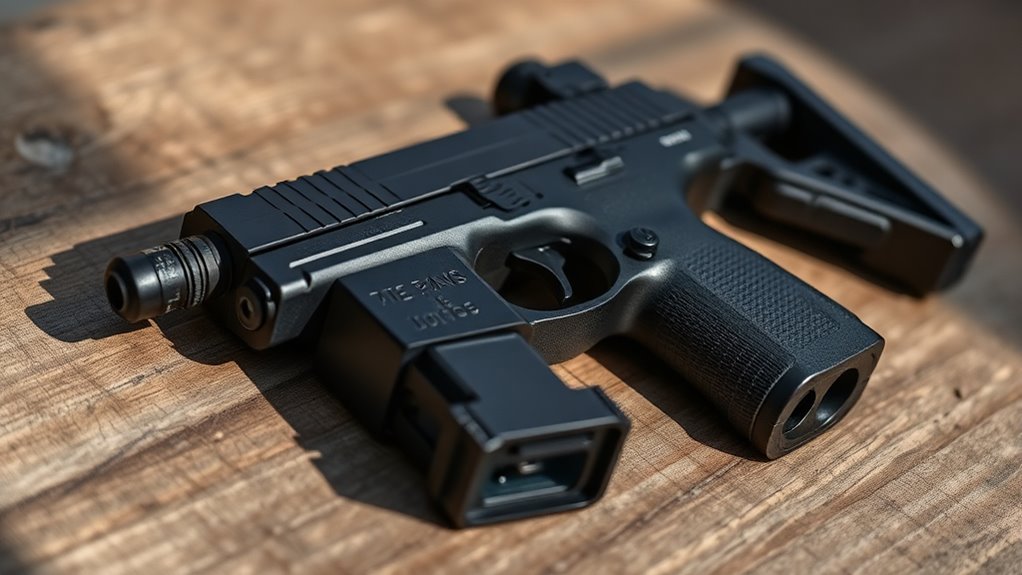
Next, check if your pistol has a shoulder stock or a brace that’s used like one. Shouldering it can change its legal status, so that’s something to watch out for.
Also, if your pistol can be easily converted to shoulder-fire with available parts, that’s another red flag to keep in mind.
Understanding these design and use factors helps you stay compliant with regulations. There’s more to know about measurement specifics and the legal steps involved, so keep digging into the details before making any changes.
Key Takeaways
- A pistol becomes an SBR if its barrel is shorter than 16 inches and it is designed or configured for shoulder firing.
- Attaching a stock or stabilizing brace used as a shoulder stock can reclassify a pistol as an SBR.
- Shoulder firing capability, not just labeling, determines if a firearm is classified as an SBR by the ATF.
- Firearms “readily convertible” to shoulder firing with available parts require ATF Form 1 approval before modification.
- Barrel length is measured from the closed bolt face to the barrel’s end, with overall length also considered for classification.
What Defines a Pistol vs. a Rifle Under Federal Law?
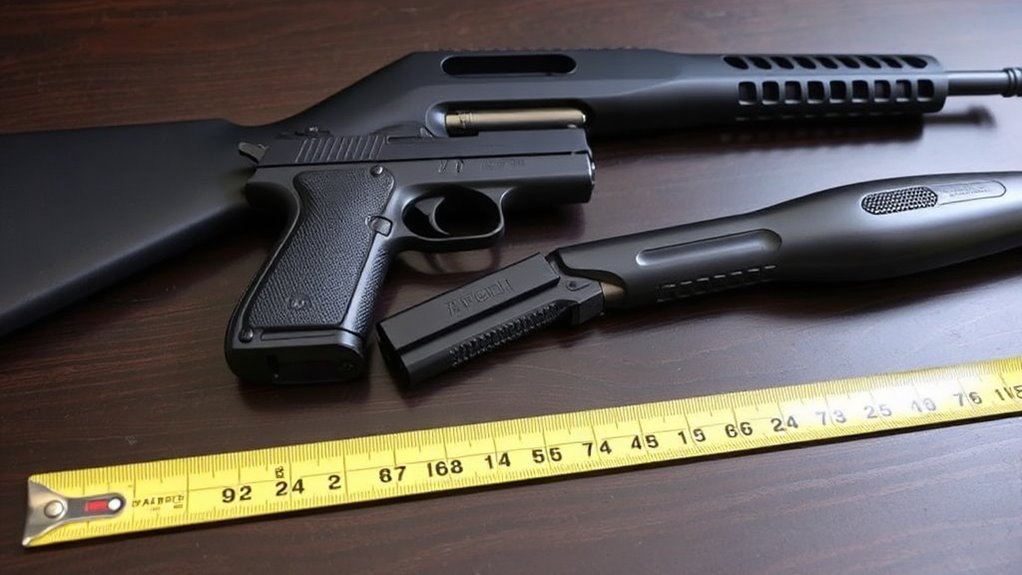
Several key factors determine whether a firearm is classified as a pistol or a rifle under federal law, and it mostly comes down to how the firearm is designed to be fired.
You need to make sure the firearm’s design intent is clear—rifles are made to be fired from the shoulder, while pistols are not.
For a long time, the ATF has emphasized features like the presence of a shoulder stock or how the brace is mounted on your make and model.
For example, if your firearm has a stabilizing brace positioned and used like a shoulder stock, the ATF may classify it as a rifle or even an SBR.
How Does Barrel Length Affect SBR Classification?
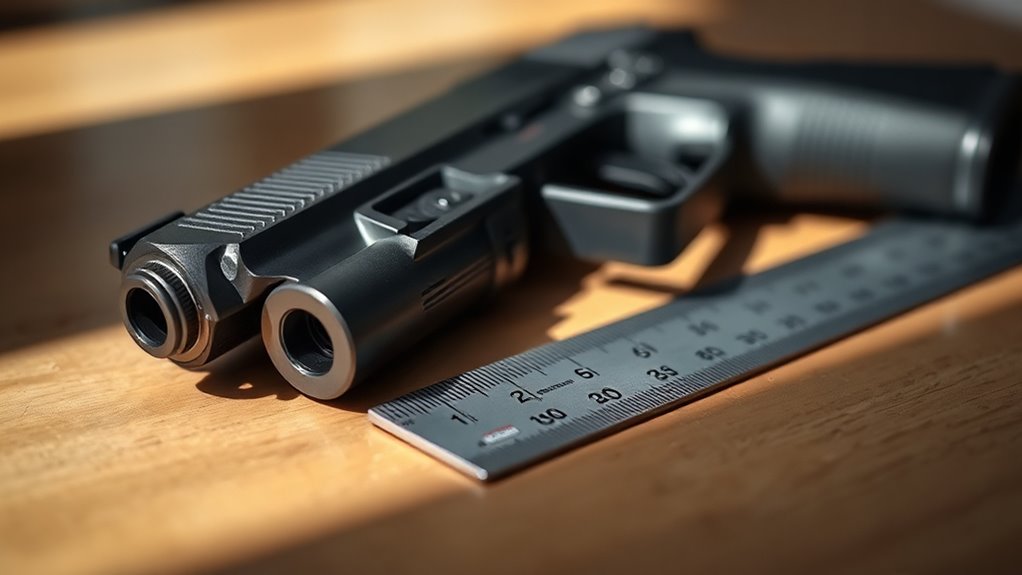
You need to know that barrel length plays a key role in SBR classification, with 16 inches being the legal minimum for rifles. If your barrel is shorter than 16 inches, your firearm might be regulated as an SBR. This is especially true if the overall length is under 26 inches.
Measuring barrel length means going from the muzzle to the bolt face. Even changes to stocks or braces can affect how your firearm is classified. So, it’s important to consider all parts when figuring out your gun’s status.
Legal Barrel Length Limits
When determining if a pistol crosses into Short-Barreled Rifle (SBR) territory, barrel length plays a critical role. Under U.S. federal law, any rifle or pistol with a barrel shorter than 16 inches generally qualifies as an SBR.
If your AR-style firearm has a barrel under 16 inches and is equipped with a stock or considered a rifle, it’s legally classified as an SBR, regardless of its original pistol designation. The ATF requires precise barrel length and overall length measurements when filing Form 1 for SBR registration, highlighting their importance.
For example, a 10.5-inch barrel on your P-415 EDGE concept falls well below the 16-inch legal limit, triggering SBR status. So, always verify barrel length carefully to understand your firearm’s legal classification.
Short Barrel Implications
A pistol with a barrel length under 16 inches automatically falls under the Short-Barreled Rifle (SBR) classification according to federal law. Even if you intend to use your AR pistol, say with a 10.5-inch barrel like the P-415 EDGE, it still qualifies as an SBR.
Barrel length is measured from the closed bolt face to the barrel’s end, excluding certain muzzle devices. However, suppressors and muzzle devices can affect the firearm’s overall length, which is another factor in classification.
If your configuration meets the SBR criteria based on these dimensions, it’s wise to file ATF Form 1 before proceeding. Understanding these implications helps you avoid accidental violations and ensures your build complies with federal regulations.
Measurement Methods Explained
Understanding how barrel length is measured is essential for determining whether a firearm qualifies as an SBR under ATF rules. You measure from the closed bolt face (or chamber end) straight to the barrel’s end, excluding any permanently attached muzzle device that ATF doesn’t count as part of the barrel.
Use a straight, hard measuring rod and measure along the barrel’s longest straight-line length. Contours or threaded extensions can complicate this, so follow ATF’s specifics carefully.
If your barrel measures 16 inches or longer, it’s generally not an SBR. But if it’s under 16 inches, like a 10.5-inch barrel, your firearm may be classified as an SBR depending on its configuration.
How Does Attaching a Stock or Brace Change Your Firearm?
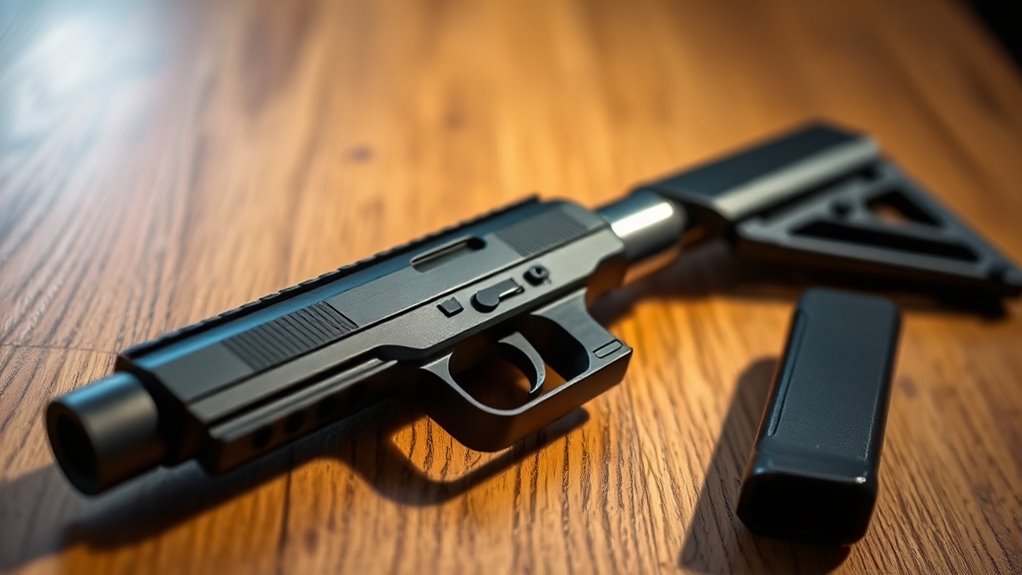
When you attach a stock or brace that lets you fire your pistol from the shoulder, the legal definition of your firearm can actually change. It might be considered a Short-Barreled Rifle (SBR) by the ATF.
This reclassification means you’ll have to follow certain rules to stay legal. For example, you’ll need to file a Form 1 and pay any required taxes.
Knowing these changes is super important if you want to avoid any costly penalties. It’s all about staying on the right side of the law.
Legal Definition Changes
Although your pistol may start as a non-NFA firearm, attaching a stock or using a brace in a way that lets you shoulder-fire it can legally transform it into a short-barreled rifle (SBR). The ATF’s January 2023 brace rule focuses on how the firearm is used, not just what it’s called.
If your brace or stock setup allows shoulder firing, the ATF can classify it as manufacturing an SBR, requiring you to file a Form 1. This rule applies even if your pistol began life as a handgun.
The key is the intended function—shoulder firing triggers the change. If you owned the firearm before January 31, 2023, you had a 120-day window to get it registered without paying the $200 tax.
Impact On Classification
Because attaching a stock or certain braces changes how you handle your pistol, the ATF may reclassify it as a short-barreled rifle (SBR). The key factor isn’t the pistol’s original label but how it functions once you add the brace or stock—especially if it’s configured to be fired with shoulder support.
According to the ATF’s 2023 brace guidance, adding a brace to certain pistols can be treated as making an SBR, requiring you to file Form 1 unless an exception applies. So, you should carefully measure and configure your firearm.
If it’s deemed an SBR, it must be registered under the NFA, usually with a $200 tax. It’s important to treat adding stocks or braces seriously to avoid unintended legal consequences.
Compliance Requirements
Attaching a shoulder stock or brace to your pistol fundamentally changes how the ATF views your firearm. It often reclassifies it as an SBR.
When you add a stock or configure a brace for shoulder firing, the ATF treats the firearm as a short-barreled rifle if the barrel is under 16 inches. This means you have to comply with federal regulations by filing ATF Form 1 before continuing to use it that way.
If you owned the firearm with the brace before January 31, 2023, you had a 120-day grace period to register it without paying the $200 tax. Filing Form 1 requires submitting photos, markings, and measurements through an ATF eForm account.
Skipping this process risks legal consequences for possessing an unregistered SBR. So, it’s really important to follow the rules to stay on the right side of the law.
What Does “Readily Convertible” Mean for Your Firearm?
How quickly and easily can you convert your pistol into a short-barreled rifle (SBR)? “Readily convertible” means your firearm can be changed into an SBR with parts and steps that are simple enough for you to do without specialized manufacturing.
The ATF checks if you already have compatible braces, stocks, and hardware, how easily they attach, and if you only need common tools. They consider time, cost, and complexity—like whether it’s just attaching a part versus needing extensive machining.
Even if your pistol isn’t currently set up as an SBR, having the parts and ability to make it shoulder-fired might make it “readily convertible.”
To stay safe, don’t make changes that could be seen as easily converting your pistol without proper Form 1 approval.
How Do Suppressors and Short Barrels Impact SBR Laws?
Understanding what makes a pistol “readily convertible” into an SBR naturally leads to questions about how accessories like suppressors and barrel length affect its legal status. Suppressors don’t automatically change a pistol’s classification; it’s the barrel length—under 16 inches—and overall configuration that matter.
Suppressors don’t alter pistol classification; barrel length and overall configuration determine legal status.
If your pistol has a barrel shorter than 16 inches or a shoulder-stock setup, the ATF treats it as an SBR, requiring proper registration. Suppressors mainly impact function by increasing backpressure, which can alter cycling timing.
That’s why adjustable gas systems like the POF-USA 10.5″ P-415 EDGE’s five-position settings help maintain reliability. Even if you attach a suppressor within ATF’s brace grace period, it won’t change your firearm’s legal status.
You must still comply with barrel length and configuration laws to avoid SBR classification.
What the ATF Brace Ruling Means for AR Pistols
Because the ATF’s January 2023 Rule 2021R-08F focuses on brace use, you need to diligently consider how you configure your AR pistol. If you attach a brace in a way that indicates it’s meant to be fired like a rifle—such as shouldering it—you could unknowingly create an SBR.
This means you’d have to file Form 1 and pay a $200 tax unless your firearm was possessed before January 31, 2023. That date gave you a 120-day grace period for tax-free registration.
The ATF looks at your pistol’s overall configuration, not just barrel length. So, the same AR pistol can be legal or an SBR depending on how you set up the brace.
To stay compliant, always make sure you complete Form 1 approval before using any rifle-like brace configuration. It’s better to be safe than sorry!
How to Legally Convert an AR Pistol Into an SBR
If you want to convert your AR pistol into a short-barreled rifle (SBR), you’ll need to follow the ATF’s legal process carefully. First, file an ATF Form 1 (“Application to Make and Register a Firearm”) for your specific serialized receiver before adding any SBR features.
If your pistol qualifies under the 120-day tax waiver for firearms owned before January 31, 2023, you can skip the tax but still must submit the Form 1. You’ll create an ATF eForm account, upload a passport-style photo, and photos of the receiver’s serial number and markings.
Plus, you’ll need to provide details like the manufacturer and barrel length. After submitting fingerprints and the application, wait for approval. Only then can you legally configure your AR as an SBR, retaining the approved Form 1 for compliance.
3 Key Measurements That Define an SBR Under Federal Law
Three critical measurements determine whether your firearm qualifies as a short-barreled rifle (SBR) under federal law: barrel length, overall length, and the firearm’s current configuration.
First, measure the barrel length on the assembled firearm—from the barrel’s start to its closed end. If it’s under 16 inches, your firearm meets one SBR criterion.
Measure barrel length on the assembled firearm; under 16 inches meets a key SBR criterion.
Next, check the overall length (OAL) with the firearm fully extended, since a short OAL can also define an SBR.
Finally, consider how the firearm is configured during measurement; braces or stocks affect this. The ATF evaluates the functional setup, not just advertised specs.
Confirming these three key dimensions—barrel length, overall length, and configuration—helps you accurately identify whether your pistol classifies as an SBR under federal law.
Frequently Asked Questions
What Does It Mean to SBR a Pistol?
To SBR a pistol, you modify it so it legally counts as a short-barreled rifle by attaching a stock or altering its length.
You’ll need ATF approval before making these changes to stay compliant. It’s important to follow the rules to avoid any legal trouble.
What Three Guns Should Everyone Own?
You should own a reliable compact 9mm pistol for versatility. It’s great for everyday carry and self-defense.
A dependable 5.56 or 300 BLK rifle is also a must-have. These rifles offer modularity and work well with suppressors.
Plus, having a quality 12 or 20 gauge shotgun rounds out the trio. Shotguns are perfect for diverse defensive and sporting needs.
What Is the Difference in Barrel Length Between a Pistol and a Rifle?
Think of barrel length as the firearm’s stride—pistols usually stay under 16 inches, while rifles stretch beyond.
You’ll notice rifles have longer barrels, helping with accuracy and velocity compared to the pistol’s compact snap.
It’s like comparing a quick step to a long, steady stride. Longer barrels give rifles an edge in performance.
How to Buy an SBR in 2026?
To purchase an SBR in 2026, you’ll need ATF-approved Form 1 or Form 4 before possession. Always confirm approval, guarantee proper registration, and review current ATF rules to remain compliant before purchasing or building your SBR.
Conclusion
Think of your firearm like a recipe—change one key ingredient, like barrel length or adding a stock, and you’ve got a whole new dish classified differently by law. Just like a chef must follow exact measurements, you must follow federal rules to avoid turning your pistol into an SBR unintentionally.
Remember, a 16-inch barrel isn’t just a number—it’s the line between legal and regulated. Stay informed, or you might find yourself cooking up legal trouble. Understanding what makes a pistol an SBR is crucial to staying compliant with firearm laws.
Keep in mind, the barrel length and the presence of a stock are the main factors that define an SBR. So always double-check your firearm’s specifications and the legal limits. Being aware and following these rules helps you avoid serious penalties and keeps your firearm ownership safe and legal.