How Fast Does a Pistol Bullet Travel?
A pistol bullet typically leaves the barrel traveling between about 565 mph and 1,360 mph. This speed depends on factors like caliber, barrel length, and bullet design.
Longer barrels and faster-burning propellants push bullets faster, while heavier bullets tend to move slower. After firing, air resistance and gravity quickly reduce speed.
These forces are influenced by the bullet’s shape and stability. If you want to understand what really shapes a bullet’s speed and flight, there’s more to uncover. It’s pretty fascinating once you start digging into the details!
Key Takeaways
- Pistol bullet speeds vary by caliber, with 9mm Luger averaging about 1,360 mph (2,200 km/h) at the muzzle. Barrel length and propellant load significantly influence a pistol bullet’s muzzle velocity.
- Heavier bullets generally travel slower because they need more energy to accelerate. It’s kind of like pushing a heavier object; it just takes more effort.
- After leaving the barrel, bullets quickly slow down due to air resistance and gravity. How fast they lose speed depends a lot on their design.
- The ballistic coefficient and bullet shape affect how well a bullet maintains its speed after firing. So, some bullets stay faster longer than others.
How Fast Does a Pistol Bullet Travel on Average?
How fast does a pistol bullet really travel? On average, a modern 9mm Luger round exits the muzzle at about 1,360 mph (roughly 2,200 km/h).
This speed depends on factors like barrel length and load, with longer barrels generally allowing bullets to accelerate more before leaving the gun. As soon as the bullet leaves the muzzle, it starts slowing down due to air resistance and gravity.
Its ability to maintain speed through the air is measured by its ballistics coefficient. For detailed insights on ballistics, National Geographic provides excellent resources, always respecting user Privacy Policy guidelines.
Understanding these speeds helps you appreciate the precision and power behind pistol rounds. It really shows that what seems instantaneous is a complex interplay of physics and engineering.
What Internal Factors Influence Pistol Bullet Speed?
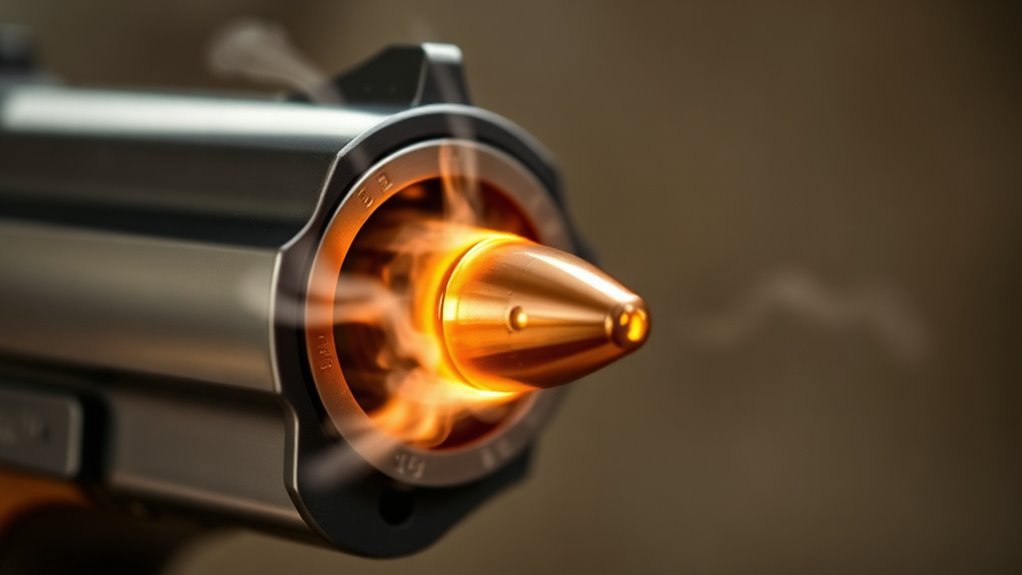
You’ll notice that bullet design plays a big role in how quickly the bullet moves through the barrel. The type of propellant and primer you use directly affects the pressure that pushes the bullet forward.
Plus, the barrel’s shape and length influence how much speed the bullet gains before it exits the muzzle. It’s all about how these parts work together to impact the bullet’s velocity.
Bullet Design Impact
Although several external factors affect a pistol bullet’s speed, internal ballistics play a significant role in determining how fast it travels. When you consider bullet design, mass and form are crucial.
Heavier bullets require more pressure to reach high velocities, so they tend to travel slower than lighter ones. The shape also matters—a more aerodynamic jacket or pointed head reduces air resistance and helps the bullet maintain speed once it leaves the barrel.
Inside the barrel, the bullet’s surface interacts with the rifling, causing friction that slightly slows it down. Plus, the bullet has to deform a bit to seal the bore, which affects acceleration efficiency.
Understanding these design factors helps you see how manufacturers balance speed, stability, and impact in pistol ammunition. It’s pretty interesting how all these details come together to make a bullet perform just right.
Propellant And Primer
When the firing pin strikes the primer, it ignites the propellant inside the cartridge. This rapidly generates high-pressure gas that pushes the bullet down the barrel.
The type of propellant—its chemical makeup and burn rate—shapes the pressure curve. That directly impacts the bullet’s velocity. Heavier bullets need more energy to accelerate, while bullet shape affects how the bullet performs later in flight.
Friction from barrel contact and rifling slightly reduces acceleration. So, the bore surface and bullet material matter too.
| Factor | Effect on Velocity | Notes |
|---|---|---|
| Primer | Ignites propellant | Initiates gas generation |
| Propellant Type | Controls pressure curve | Faster burn = quicker acceleration |
| Bullet Mass | Requires more energy if heavy | Heavier slows acceleration |
| Barrel Friction | Slightly reduces velocity | Depends on bore and bullet material |
Barrel Shape Influence
Since the barrel’s length and shape directly affect the pressure buildup behind the bullet, they play a crucial role in determining its muzzle speed. Longer barrels let expanding propellant gases push the bullet farther, increasing velocity.
The barrel’s rifling—its twist rate and groove design—stabilizes the bullet, keeping it aerodynamically aligned to prevent early wobble or tumbling that would reduce speed. Internal ballistics, including the propellant’s burn rate, shapes the pressure curve that accelerates the bullet.
Meanwhile, the bullet’s mass and design influence how efficiently it responds to that pressure. Friction inside the barrel, especially at the chamber-to-rifling junction, slightly lowers muzzle speed, so smoother barrels or better lubrication can help.
Understanding these factors helps you grasp how barrel shape influences bullet velocity. It’s pretty interesting once you break it down!
How Cartridge Components Affect Pistol Bullet Speed
You’ll find that the primer and propellant work together to create the pressure needed to push the bullet down the barrel. The type and amount of propellant directly affect how fast that bullet can travel.
Plus, the bullet’s weight plays a big role—heavier bullets usually travel slower but carry more momentum. It’s all about balancing these factors to get the performance you want.
Primer and Propellant Role
Although the primer’s strike might seem like a small spark, it plays a necessary role by igniting the propellant inside the cartridge. This propellant rapidly generates high-pressure gas to push the bullet down the barrel.
You’ll find that the type and burn rate of the propellant greatly influence how quickly this pressure builds. Faster-burning propellants create higher pressure sooner, which means the bullet accelerates more rapidly and achieves greater muzzle velocity.
Since pistols have shorter barrels, the propellant must produce enough gas pressure quickly to maximize bullet speed before the bullet exits the barrel. Understanding how primer ignition and propellant characteristics interact helps you appreciate why different ammunition types deliver varying velocities even within the same caliber.
This combination is crucial for the internal ballistics that determine how fast the bullet travels. It’s pretty fascinating once you see how it all works together!
Bullet Weight Impact
When you consider how a pistol’s bullet speed varies, bullet weight plays a significant role in how the propellant’s expanding gases accelerate the projectile. Heavier bullets gain less muzzle velocity because they require more force to accelerate, but they often retain energy better downrange.
Lighter bullets accelerate faster, reaching higher speeds but may lose energy quicker. The cartridge’s primer, powder, and case set the pressure curve that pushes the bullet, but bullet mass determines how that pressure converts into velocity.
Barrel length also affects how long gases can accelerate the bullet, influencing the final speed.
| Bullet Weight | Impact on Speed & Energy |
|---|---|
| Heavy | Lower muzzle velocity, better energy retention |
| Light | Higher muzzle velocity, less energy retention |
| Same Powder | Speed varies with bullet mass |
| Barrel Length | Limits acceleration time |
| Pressure | Drives bullet acceleration |
How Barrel Length Affects Pistol Bullet Speed
The length of a pistol’s barrel plays a key role in determining how fast its bullets travel. Since pistols have shorter barrels than rifles, the propellant gases get less time to accelerate the bullet, resulting in lower muzzle speeds.
When you increase barrel length, more pressure acts on the bullet over a longer distance, boosting its velocity. For example, typical 9mm Luger rounds reach about 1,360 mph from standard handgun barrels.
However, longer barrels also increase friction as the bullet scrapes along the rifling, so speed gains don’t increase perfectly with length. Because pistol barrel sizes vary—from compact to full-size models—you’ll notice noticeable differences in muzzle velocity based on barrel length due to the balance between internal acceleration and friction.
Why Bullet Design Matters for Speed and Stability
Because bullet design directly influences both speed and stability, understanding its impact is essential if you want your shots to perform consistently. The shape of the bullet, especially streamlined designs with higher ballistic coefficients, reduces aerodynamic drag, helping it maintain speed after leaving the muzzle.
Internally, the bullet’s weight and jacket material affect how efficiently it accelerates within the barrel and retains momentum. Stability is just as important—bullets that resist tumbling thanks to their shape and compatibility with barrel twist rates stay on straighter paths, minimizing erratic drag and speed loss.
Even if two bullets leave the barrel at the same velocity, design differences in drag and mass can cause one to arrive faster and more accurately than the other. It just goes to show, design truly matters for your shot’s performance.
How External Forces Slow a Pistol Bullet After Firing
Although a pistol bullet leaves the muzzle at high speed, it starts slowing down immediately as air resistance and gravity begin to take effect. You’ll notice that these external forces quickly reduce its velocity once it’s in flight.
Here’s what affects it the most:
- Air resistance (drag) pushes against the bullet, slowing it down depending on its shape and mass.
- Gravity pulls the bullet downward, altering its trajectory and increasing drag impact.
- The bullet’s spin can lose stability, causing yaw or tumbling that further slows it.
- Deceleration from these forces happens faster than the internal pressure inside the barrel ever could.
Understanding these factors helps you see why a pistol bullet can’t maintain its initial speed for long after firing. It’s pretty interesting once you break it down like that!
Why Ballistic Coefficient Matters for Pistol Bullet Speed
Once a pistol bullet leaves the barrel and faces air resistance, how well it maintains its speed depends heavily on its ballistic coefficient (BC). BC measures a bullet’s ability to overcome air drag, factoring in mass, diameter, shape, and length.
A higher BC means the bullet resists slowing down better, retaining velocity further downrange even if its muzzle speed stays the same. Since air drag substantially slows bullets after firing, a low-BC round will lose speed and drop sooner than one with a higher BC.
Bullet shape plays a big role—streamlined, tapered designs cut through air more efficiently than blunt shapes, improving BC. So, understanding BC helps you predict how quickly a pistol bullet will lose speed and how effective it remains at longer distances.
Typical Pistol Calibers and Their Muzzle Speeds
How fast does a typical pistol bullet travel right out of the barrel? It depends on the caliber and the specific load, but here are some common examples to give you a clear idea:
Typical pistol bullet speeds vary by caliber and load, offering a glimpse into their impressive velocity.
- 9mm Luger: About 1,360 mph (≈2,200 km/h), depending on barrel length and load.
- .45 ACP: Roughly 565–615 mph (900–990 km/h) in standard handguns.
- .40 S&W: Around 650–680 mph (1,050–1,100 km/h) with typical barrel lengths.
- .357 Magnum: Between 820–950 mph (1,320–1,530 km/h), influenced by barrel length.
Since pistols have shorter barrels than rifles, their muzzle speeds are generally lower. But these numbers show you just how fast pistol bullets can fly right when they leave the barrel.
Frequently Asked Questions
How Far Will a 9mm Travel if Shot Straight?
You can expect a 9mm bullet to travel several hundred meters if shot straight, but its exact distance depends on factors like bullet design, weight, barrel length, and air resistance slowing it down over distance.
Keep in mind, things like the shape of the bullet and how heavy it is play a big role. The length of the barrel also affects how fast and far the bullet can go. Plus, air resistance gradually slows the bullet down as it travels.
Is a .38 More Powerful Than a 9mm?
You’ll find the .38’s power plays a part, but the 9mm often outpaces it with higher velocity and energy. While both pack punch, 9mm frequently flexes more force, fitting modern firepower needs better.
It’s kind of like comparing apples and oranges, but in terms of sheer speed and impact, 9mm usually takes the lead. So, if you’re looking at performance, the 9mm tends to be the go-to choice these days.
How Fast Does a 45 Caliber Bullet Travel?
A .45 caliber bullet usually travels between 830 and 1,000 feet per second, depending on its weight and load. Heavier bullets go slower, while lighter ones can reach closer to 1,000 feet per second.
It’s pretty interesting how the weight really makes a difference. So, if you’re aiming for speed, lighter bullets are the way to go!
Is a .45 Stronger Than a 9mm?
When it comes to stopping power, a .45 often packs more punch than a 9mm, thanks to its heavier bullet and higher muzzle energy.
But don’t put all your eggs in one basket—both have their strengths.
Each caliber performs differently depending on the situation, so it’s good to know the pros and cons of both.
Conclusion
You might think a pistol bullet just flies fast and straight, but it’s more complex than that. Inside the gun, cartridge and barrel length team up to boost speed.
Outside, air and gravity slow it down. Bullet design pushes it forward, yet drag pulls it back.
Understanding these forces gives you a clear picture: a pistol bullet’s speed isn’t just about power—it’s a delicate balance of factors working together and against each other. When we talk about how fast a pistol bullet travels, it’s important to consider all these elements. Cartridge size, barrel length, air resistance, gravity, and bullet design all play a role. So, the speed isn’t just about the gun’s power alone; it’s about how these forces interact to shape the bullet’s flight.