
How Do Fish See in the Dark?
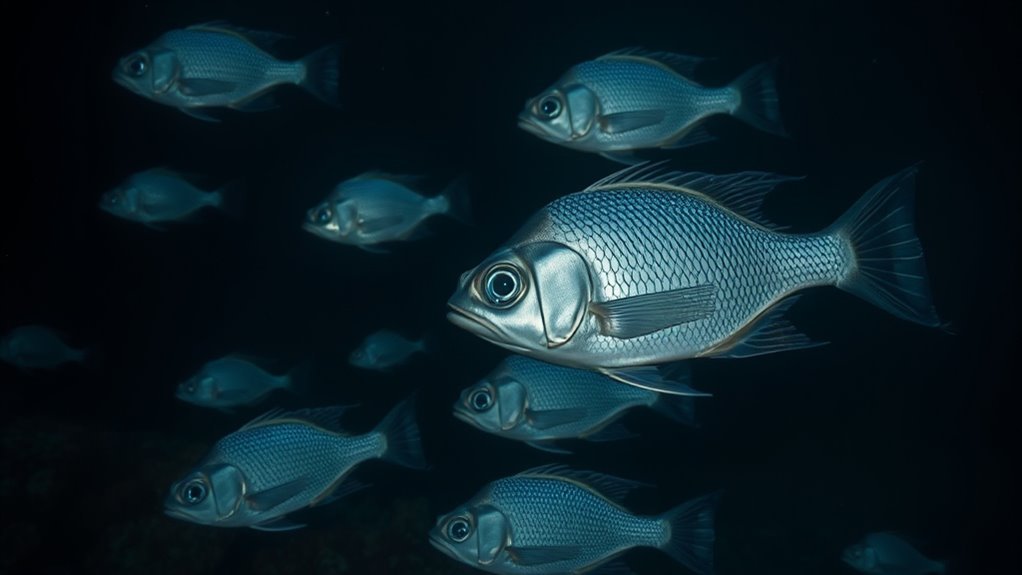
You rely on your eyes to see in the dark, and fish do too, but with special adaptations that help them navigate their underwater environment. Their large, tubular eyes and sensitive rod cells help capture faint light in near-total darkness. Many have a tapetum lucidum behind the retina that reflects light to boost visibility.
Some fish even use bioluminescent signals to spot prey or avoid predators. These amazing features allow fish to thrive in pitch-black waters. Keep exploring to uncover how these unique adaptations work beneath the surface.
How Fish Eyes Adapt for Low-Light Vision
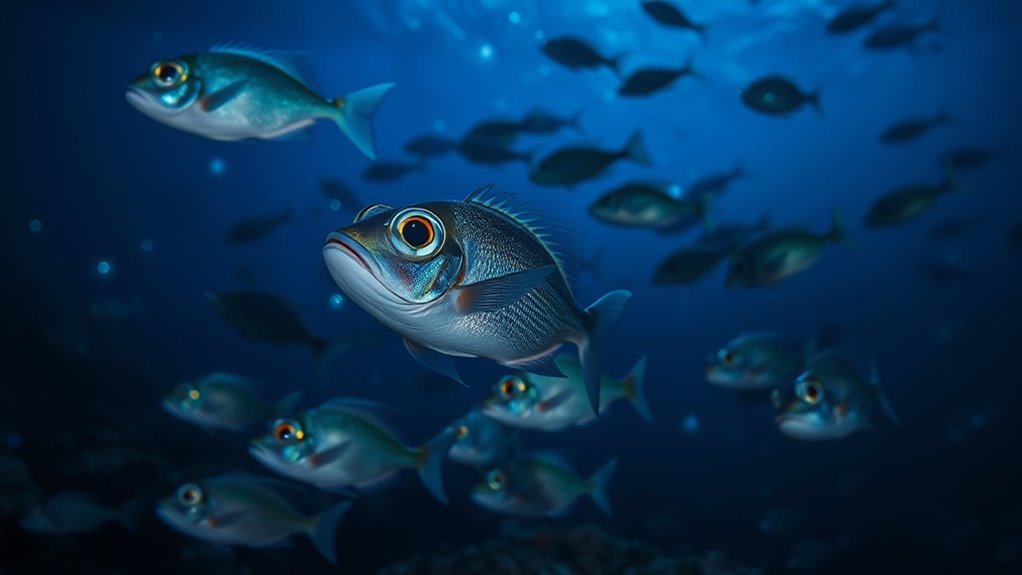
Several unique adaptations help fish see in low-light conditions. When you look at fish eyes, you’ll notice they’re often larger than those of land animals, allowing more light to enter. This is essential for low-light environments.
Many deep-sea fish have tubular or elongated eyes, improving their ability to capture faint light signals. Some, like the macropinna microstoma, even have eyes inside transparent shields, helping them see wide angles without damage.
You’ll also find a tapetum lucidum in fish eyes—a reflective layer that bounces light back onto the retina, boosting sensitivity in darkness.
Plus, some fish develop hybrid photoreceptor cells combining rods and cones, further enhancing their low-light vision. These features work together so fish can navigate and hunt where light barely reaches.
Why Rod Cells Matter for Seeing in the Dark
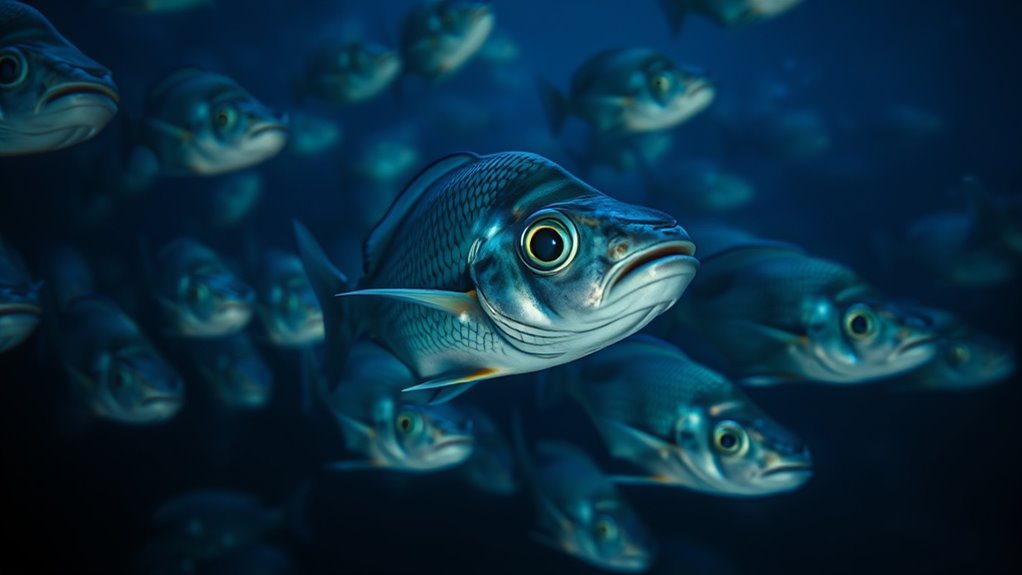
When you find yourself in near-total darkness, your eyes struggle to pick up any detail—but fish rely on rod cells to overcome this challenge underwater. Rod cells are specialized photoreceptors highly sensitive to low-light conditions, allowing fish to detect even the faintest glimmers of light.
Unlike cone cells that focus on color, rod cells provide black-and-white vision, which is essential for steering through dim environments. Fish with more rod cells can see better in darkness, which is vital for their survival in deep or murky waters.
Deep-sea fish, in particular, have an abundance of rod cells to help them hunt and move confidently where light barely reaches. So, rod cells play a critical role, directly influencing a fish’s ability to see clearly when light is scarce.
How Tapetum Lucidum Helps Fish See at Night
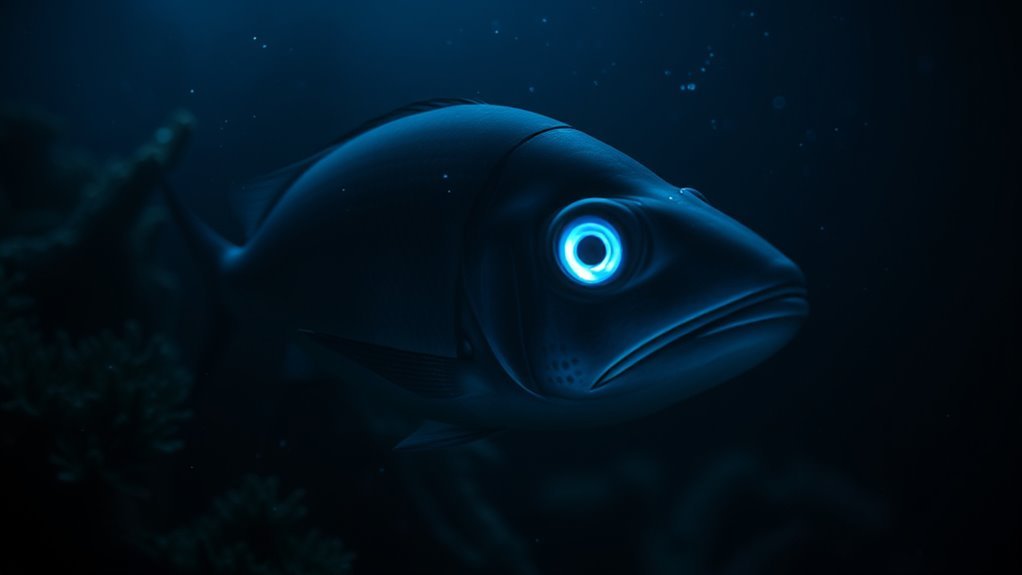
You mightn’t realize it, but fish have a special layer in their eyes called the tapetum lucidum that boosts their night vision.
This reflective layer bounces light back through the retina, giving fish extra help to see in the dark.
Thanks to this, they can navigate and hunt even when light is scarce.
Tapetum Lucidum Function
Because fish often navigate dark or dim environments, the tapetum lucidum plays a crucial role by reflecting light back through the retina, boosting their ability to detect faint light. This reflective layer enhances night vision by increasing the chance that photoreceptor cells absorb photons. Without the tapetum lucidum, fish would struggle to see in deep-sea or murky waters where light is scarce.
It’s especially common among predatory fish relying on this adaptation to hunt effectively at night.
| Feature | Function |
|---|---|
| Location | Behind the retina |
| Role | Reflects light to increase sensitivity |
| Benefit | Enhances night vision |
| Common in | Deep-sea and predatory fish |
| Effect on vision | Amplifies faint light signals |
Night Vision Enhancement
Although underwater environments can be incredibly dark, fish with a tapetum lucidum can still navigate and hunt effectively at night. This reflective layer acts like a mirror behind the retina, bouncing light back onto photoreceptor cells.
By increasing the available light, the tapetum lucidum markedly enhances their night vision, letting these fish detect faint bioluminescent signals and subtle movements in pitch-black waters.
Without this adaptation, many fish would struggle to see in such low-light conditions. The tapetum lucidum boosts visual sensitivity much like the night vision found in cats and owls, giving fish an edge when it’s darkest.
How Deep-Sea Fish Detect Bioluminescent Light
When you explore the depths of the ocean, you’ll find deep-sea fish equipped with highly sensitive eyes designed to detect faint bioluminescent light. Their large, tubular eyes pack many rod cells, perfect for spotting subtle flashes in pitch-black waters. Some even have a tapetum lucidum, reflecting light back onto their retinas to boost sensitivity.
These adaptations let deep-sea fish detect bioluminescent signals from afar, helping them find prey or communicate.
| Feature | Function |
|---|---|
| Large tubular eyes | Capture more light |
| High rod cell density | Detect minimal light |
| Tapetum lucidum | Reflects light for sensitivity |
| Bioluminescent flashes | Signal prey or mates |
| Light scattering | Enhances light detection |
Hybrid Photoreceptors: Boosting Vision in Dim Environments
If you’ve ever wondered how deep-sea fish manage to see in near-total darkness, hybrid photoreceptors play a key role. These specialized cells blend features of rods and cones, boosting vision in low-light conditions where traditional photoreceptors struggle.
Found in larvae of species like hatchetfish, lanternfish, and lightfish—and sometimes adults—hybrid photoreceptors let these fish detect faint light effectively. This adaptation helps them navigate, hunt, and avoid predators in the dark ocean depths.
Hybrid photoreceptors reveal that fish vision isn’t just about rods or cones but a flexible spectrum of light-detecting cells. So, when you think about fish surviving in near pitch-black waters, remember that hybrid photoreceptors give them the edge they need to see when light is scarce.
Fish Species With Remarkable Night Vision
You’ll be amazed at how sharks use their large corneas and reflective eyes to see clearly in near darkness.
Deep-sea fish have evolved unique adaptations like tubular eyes and special retina cells to spot faint light far below the surface.
Let’s explore how these remarkable features give them an edge in the night.
Sharks’ Superior Night Vision
How do sharks navigate the pitch-black depths with such precision? Sharks’ superior night vision lets them hunt and move confidently in near-total darkness. Their large corneas and dense rod cells boost their ability to detect faint light.
Plus, a reflective layer called the tapetum lucidum bounces light back onto their retina, sharpening their vision even more.
You’ll be amazed by how sharks’ night vision helps them:
- Spot prey up to 50 feet away in dark waters.
- Detect subtle movement and contrast despite poor color perception.
- Move silently and skillfully through the deep ocean’s shadows.
Thanks to these adaptations, sharks dominate the dark like true ocean predators.
Deep-Sea Fish Adaptations
Although deep-sea environments are cloaked in near-total darkness, many fish species have evolved incredible night vision adaptations to survive and thrive. Deep-sea fish see in low-light thanks to highly sensitive eyes with tubular lenses that capture faint glimmers. A tapetum lucidum layer reflects light within their eyes, boosting their vision in pitch-black waters.
Take the Macropinna microstoma—it sports transparent shields protecting tubular eyes that scan for silhouettes above. Some deep-sea fish detect bioluminescent signals, helping them spot prey and navigate the dark depths.
Fascinatingly, recent studies reveal that certain species can even see in color, sharpening their ability to find mates or food.
These remarkable adaptations let deep-sea fish master the darkness where few others can.
How Fish Use Vision to Survive in Pitch-Black Waters
What enables fish to navigate the pitch-black depths of the ocean? Their extraordinary eyes and vision adaptations. You might wonder how fish see in such darkness. It’s their ability to detect the faintest light that keeps them alive.
Here’s how they do it:
- Many deep-sea fish have eyes packed with rods and a tapetum lucidum layer, reflecting light to enhance low-light vision.
- Species like the brown hatchetfish have tubular eyes, scanning silhouettes and bioluminescent signals above.
- Lanternfish possess hybrid photoreceptors, blending cones and rods to see in near-total darkness.
These unique eye adaptations allow fish to detect bioluminescent cues, helping them find food and avoid predators in pitch-black waters.
Frequently Asked Questions
Which Fish Is the Friendliest?
You’ll find betta fish the friendliest because they actively interact with you. Guppies are also very social and approachable, while clownfish show friendly, non-aggressive behavior, especially around anemones.
Corydoras and neon tetras are peaceful too.
How Do You Say Goodbye to a Fish?
You say goodbye to a fish by handling it gently, moving slowly to avoid stress, and ensuring its environment is safe if you release it.
Clean its tank and reduce feeding gradually for pet fish before parting.
What Does a Fish Vision Look Like?
You’d see through fish eyes as a world with a higher rod cell count—about 90%—giving you better night vision but less color detail. Their vision’s blurry up close but sharp far away, perfect for underwater life.
What Do Fish Do When It’s Dark?
When it’s dark, you rely on enhanced senses like vibration detection and bioluminescence. You’ll use sensitive eyes or lateral line systems to navigate, find food, and avoid predators in low-light or pitch-black environments.
Conclusion
When you think about how fish see in the dark, it’s like they’ve got built-in night-vision goggles. Their eyes adapt with special rod cells, reflective layers like the tapetum lucidum, and even hybrid photoreceptors that boost their low-light vision.
Deep-sea fish can even spot bioluminescent glimmers to navigate pitch-black waters. So, next time you imagine underwater darkness, remember fish rely on these incredible adaptations to survive and thrive where light barely reaches. These unique visual adaptations are key to fish seeing in the dark.