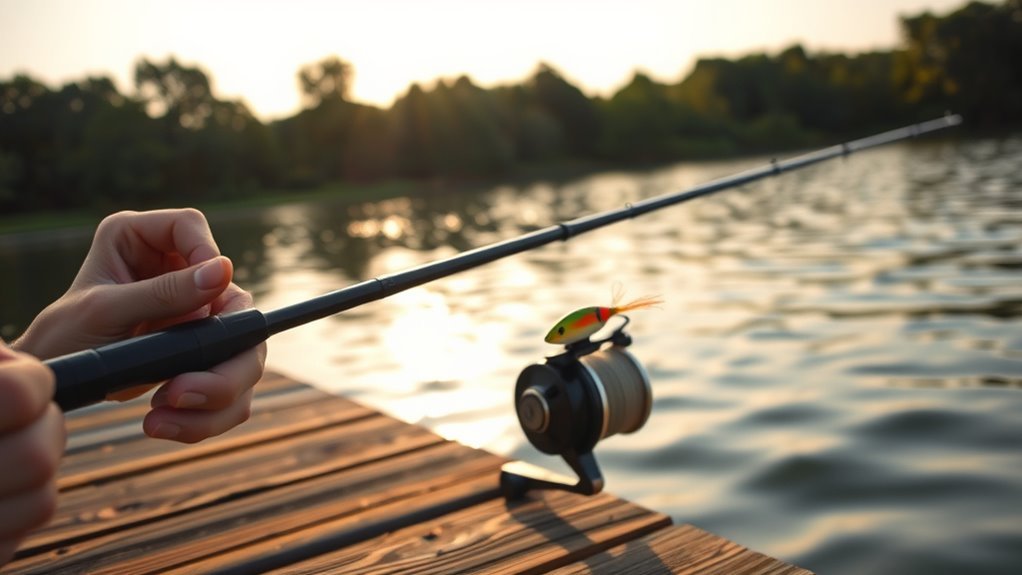
How to Set Up a Fishing Rod in 5 Easy Steps
To set up your fishing rod effectively, start by choosing the right fishing line based on your target fish and environment. Braided lines work best for tough conditions, while monofilament lines are ideal for calmer waters.
Next, attach the line to the reel. Wind it with steady tension, making sure to leave a small gap at the spool’s edge to prevent tangling.
Then, thread the line through each guide from the tip of the rod down to the reel. Securely tie your hook or lure to the end of the line.
Finally, adjust the drag setting to match your fish’s strength, ensuring smooth casting and better control. Keep practicing to master each step perfectly.
Choose the Right Fishing Line for Your Fishing Rod and Target Fish
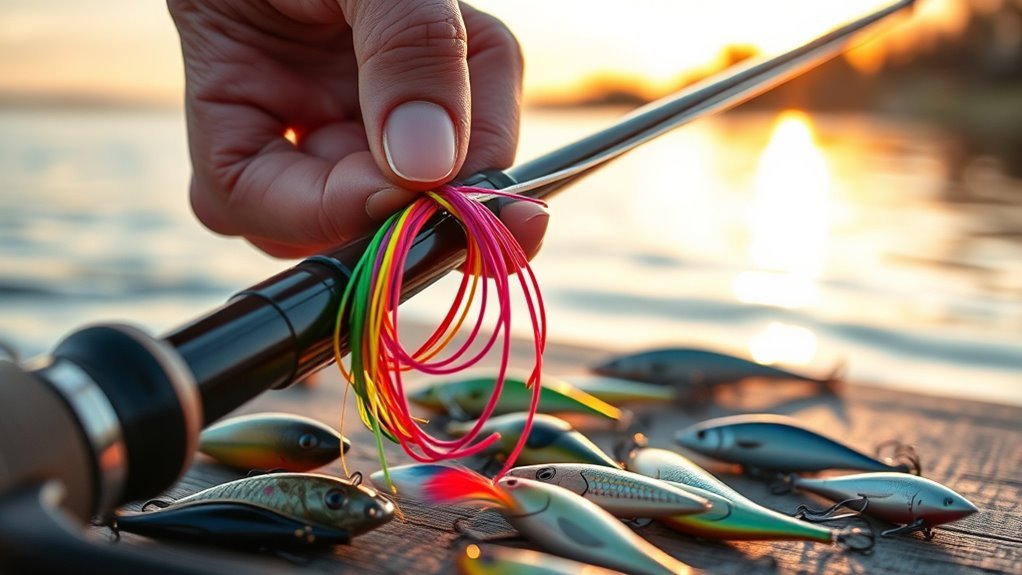
When choosing the right fishing line for your rod, consider both your target fish and the environment you’ll be fishing in. If you’re after toothy species like northern pike in rocky lakes, a braided line with 8-10 lb. test offers the durability you need against snags and abrasion.
Monofilament line works well in less aggressive conditions but can break easier around heavy cover.
Match your line strength to the target fish to prevent breakage while maximizing performance. The fishing environment matters too—braided lines excel in snag-filled waters, while fluorocarbon is less visible underwater.
When spooling your reel, maintain proper line tension and fill the reel spool evenly, leaving about 1/8 inch from the rim to guarantee smooth casting and prevent tangles during your fishing trip.
Attach the Line to the Reel and Wind It With Proper Tension
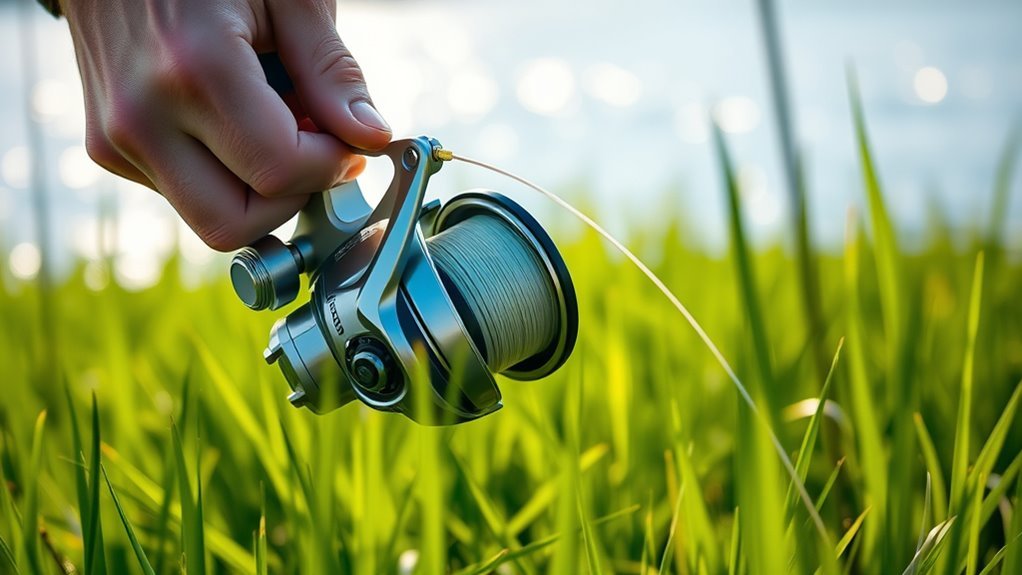
Selecting the right fishing line sets you up for success, but attaching it properly to your reel is what guarantees smooth casting and retrieval.
Start by tying the fishing line to the reel’s spool using a secure arbor knot. Once attached, use a spooler or your fingers to maintain consistent tension as you wind the line evenly onto the spool.
Keeping steady tension prevents tangles and loose wraps, which can cause issues later. Avoid overfilling the spool—stop winding when the line is about 1/8 inch below the rim.
Regularly check the tension throughout to ensure tight, uniform layers.
Properly attaching and winding your line on the reel with the right tension ensures smooth operation and extends the life of both your line and reel.
Thread the Line Through Your Fishing Rod Guides
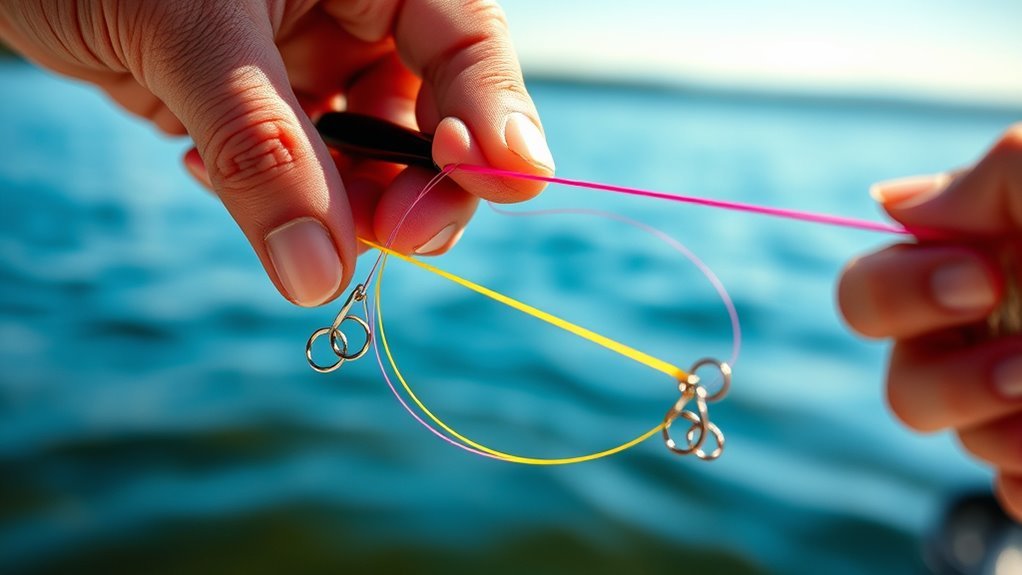
Although you’ve secured the line to your reel, you’ll need to thread it through your rod’s guides before casting. Start by threading the fishing line through the smallest guide near the tip, then work your way down toward the reel.
Begin threading your fishing line through the smallest guide at the tip, moving steadily toward the reel.
To make this easier, create a small loop at the line’s end and feed it gently through each guide in sequence.
Use a steady, gentle pull to assure the line passes smoothly without catching or fraying. Keep the line straight as it moves through the guides to avoid tangles or twists.
Finally, confirm the fishing line exits the last guide cleanly, aligned with the reel and spool, so you’re ready for a smooth, snag-free cast.
Tie Your Hook or Lure Securely to the Line
Securing your hook or lure to the line is essential to prevent it from slipping off during casting or when you’re reeling in a fish. To attach your hook or lure properly, start by threading the fishing line onto the eyelet, leaving enough tag end for tying the knot.
Use secure knots like the improved clinch knot, which is reliable and easy to tie. Before tightening the knot, wet the line slightly to reduce friction and create a snug, strong hold.
Once tied, trim the excess tag end with scissors or nail clippers to avoid tangling.
Always test your knot by gently pulling on the line to ensure it’s firmly fastened. Properly tied knots are a key part of your fishing gear’s effectiveness.
Adjust the Drag on Your Fishing Rod for Smooth Casting
When you adjust the drag on your fishing rod, you control how smoothly the line releases during a cast or a fish’s pull. To adjust the drag, turn the drag knob on your reel clockwise to increase tension or counterclockwise to decrease it. This controls how easily the line slips off the spool, ensuring a smooth release.
Adjust your fishing rod’s drag by turning the knob to control line release and ensure smooth casting.
Set the drag so it lets the line slip smoothly when a fish pulls, preventing breakage while providing enough resistance to tire the fish out.
Test the drag by pulling the line by hand to match the size and strength of your target fish—lighter drag for smaller fish, higher for bigger ones.
Remember to regularly check and adjust the drag during your fishing session to maintain smooth performance.
Frequently Asked Questions
How to Set up a Fishing Rod for Beginners?
Start by choosing the right rod and reel for your fish. Attach the reel firmly, spool line evenly, thread through guides, tie a strong knot, and adjust drag.
You’ll be ready to cast and catch confidently in no time!
How to Make a Fishing Rod Step by Step?
Think of building a fishing rod like piecing together a puzzle: align ferrules gently, attach the reel tight, spool the line neatly, thread through guides, and secure knots firmly.
You’ll craft a rod ready to cast in no time!
How to Cast a Fishing Rod for Beginners Step by Step?
Hold the rod firmly, pull it back to 2 o’clock, then flick forward to 10 o’clock while releasing the line with your fingers.
Focus on your target and practice smooth, controlled motions to improve your casting accuracy.
What Is the Simplest Fishing Setup?
The simplest fishing setup is so easy, it’s like assembling a sandwich! You’ll just need a basic rod, reel, line, and hook. Use pre-spooled lines and tie a simple knot.
You’re ready to fish instantly!
Conclusion
Setting up your fishing rod is like crafting a bridge between you and the watery world beneath. With the right line, a steady reel, and a secure hook, you’re weaving a lifeline to adventure.
Adjusting the drag is tuning your connection, readying you for the tug of the unknown. So cast your line with confidence—each step you’ve taken brings you closer to the dance between patience and the thrill of the catch.
By following these 5 easy steps, you ensure your fishing rod is perfectly set up for success. Remember, mastering how to set up a fishing rod is key to enjoying every fishing trip to the fullest.