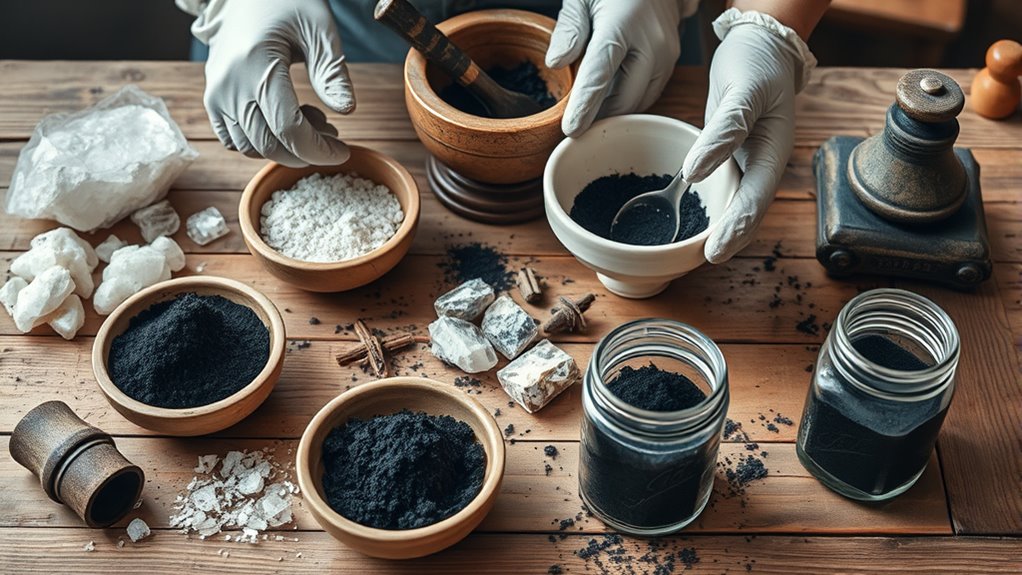
How to Make Gun Powder in 10 Easy Steps
To make gunpowder in 10 easy steps, you’ll need to gather some key ingredients: potassium nitrate, sulfur, and charcoal. It’s important to handle each ingredient safely to avoid any accidents. These components are the foundation of traditional gunpowder, so getting them right is the first step.
Next, grind each ingredient separately until they become a fine powder. This helps ensure a consistent mixture later on.
When you’re ready to combine them, use non-metal tools to slowly mix the powders together. This prevents sparks, which you definitely want to avoid.
After mixing, add a little water and knead the wet mixture until it feels evenly damp and sticky. This step helps the ingredients bind together well.
Then, screen out any clumps to get a smooth texture.
Finally, dry the powder in a breezy spot to let moisture evaporate. Once dry, store your gunpowder in airtight containers to keep it fresh.
Remember, always follow careful safety measures throughout the entire process. Keep practicing, and you’ll master making gunpowder with confidence in no time!
Key Takeaways
- Gather potassium nitrate, sulfur, and hardwood charcoal. Make sure to handle each ingredient separately, wearing protective gear and storing them properly.
- Grind the ingredients finely using dedicated mills. Do it in short bursts to avoid overheating and to keep the particle size consistent.
- Mix the ingredients slowly outdoors using non-metallic tools. This helps prevent sparks, and be sure to wear protective gear to avoid inhalation and static risks.
- Add water to dampen the mixture. Knead it until it feels slightly sticky and has a matte finish—this shows the ingredients are properly combined and the chemical bonds are activated.
- Screen and dry the mixture outdoors on trays. Break up any clumps, stir it periodically, and when fully dry, store the powder safely in airtight containers.
What Ingredients You Need for Gunpowder
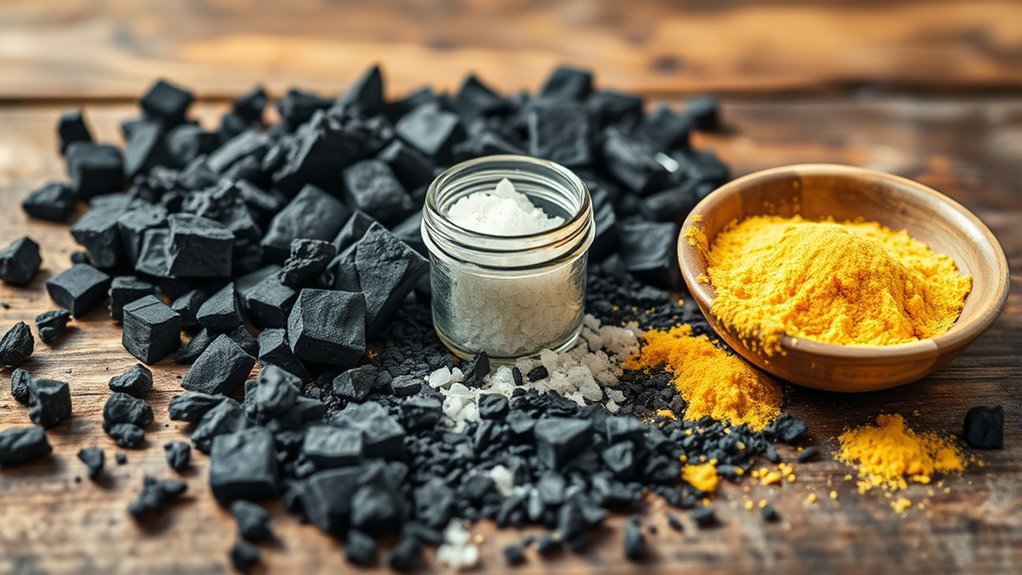
Before you start making gunpowder, you need to gather three essential ingredients: potassium nitrate, sulfur, and charcoal. Potassium nitrate, also known as saltpeter, makes up about 75% of traditional black powder by weight.
Gather potassium nitrate, sulfur, and charcoal—the three essential ingredients for making traditional black powder.
You can find potassium nitrate in stores as stump remover or fertilizer, often containing pure saltpeter. Sulfur, which accounts for roughly 10%, is available at garden centers or extracted from volcanic deposits.
Charcoal, about 15% of the mix, is usually made from hardwood and sold as grilling charcoal. Each ingredient plays a vital role, so make sure you get the right materials and proportions.
Keep in mind that potassium nitrate is the most significant component, as it provides the oxygen needed for combustion, making your gunpowder effective and reliable.
Preparing Gunpowder Ingredients Safely
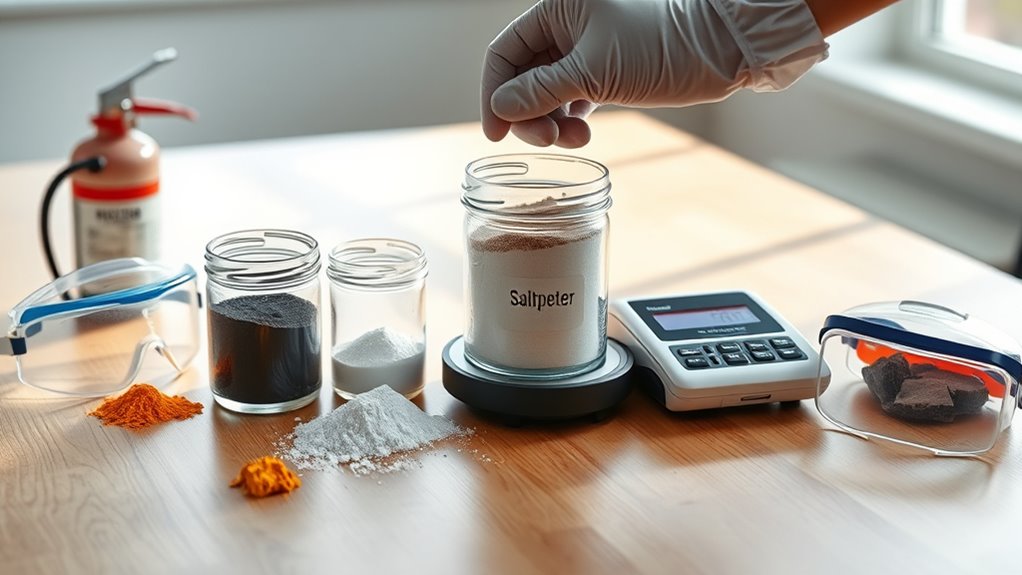
When preparing gunpowder ingredients, you need to source quality materials and handle each one carefully to avoid accidents. Always keep chemicals separate and wear protective gear to prevent inhalation or skin contact.
Make sure to store your milled powders in clearly labeled, sealed containers. Keep them away from heat and contamination to stay safe.
Ingredient Sourcing Essentials
Although sourcing ingredients for gunpowder may seem challenging, you can find all necessary components safely and legally with careful choices. Saltpeter, or potassium nitrate, is commonly available in store-bought stump remover, which contains pure saltpeter and usually has no legal restrictions.
Sulfur, another key ingredient, can be bought at garden centers or hardware stores, often labeled as garden sulfur or elemental sulfur. Charcoal, essential for gunpowder, is easiest to obtain by using commercial grilling charcoal or by making your own from hardwood.
When sourcing these ingredients, purchase from reputable stores and keep chemicals stored separately to reduce risks. By following these guidelines, you’ll guarantee a safe and legal approach to gathering your gunpowder materials without unnecessary complications.
Handling Materials Safely
Since handling gunpowder ingredients involves inherent risks, you need to take strict safety measures at every step. Handling materials safely means treating potassium nitrate, sulfur, and charcoal separately to avoid accidental ignition.
Always grind each chemical individually using a small blade-type coffee mill to get a fine, fluffy powder without mixing ingredients in the mill. Wear protective gear like a dust mask, gloves, and long sleeves to reduce inhalation and skin contact.
Perform all handling outdoors in a well-ventilated area, far from flames, sparks, or heat sources.
- Separate each ingredient to prevent reactions
- Use a dedicated mill for every chemical
- Wear dust mask, gloves, and long sleeves
- Work outside with good ventilation
- Keep milled powders sealed and labeled
Following these steps guarantees handling materials safely every time. Just take it slow and be careful—you’ll be fine.
Storage and Contamination Prevention
Keeping your materials safe doesn’t stop at handling—they need proper storage to stay stable and effective. Store all gunpowder ingredients separately in airtight containers to avoid contamination and unintended chemical reactions.
Label each container clearly with the ingredient name and storage date so you can track freshness and safety easily. Keep your storage area dry, cool, and away from any heat sources or ignition points to maintain stability.
For contamination prevention, always use dry tools and wear protective gear when handling powders. Regularly inspect your storage for leaks, corrosion, or contamination, and promptly dispose of any degraded materials safely.
Following these steps guarantees your ingredients remain safe and effective, reducing risks during the gunpowder-making process. It’s really about being careful and consistent to keep everything in top shape.
Grinding Gunpowder Ingredients Properly
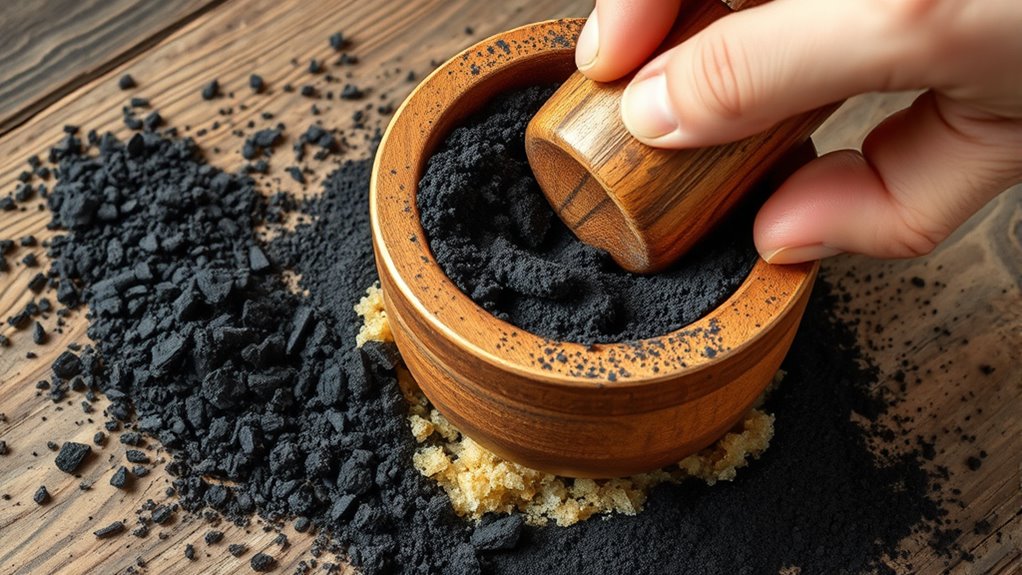
When grinding gunpowder ingredients, you need to handle each one separately to stay safe and avoid accidents. Use short bursts to keep the particles fine and prevent overheating.
Always check the consistency by sifting through a fine mesh screen. Maintaining the particle size consistent ensures your gunpowder will burn effectively and predictably.
It’s really important to take your time and be careful during the process. That way, everything turns out just right!
Safe Grinding Techniques
Although grinding gunpowder ingredients requires careful handling, you can minimize risks by following proper techniques. Safe grinding means treating each component separately and taking steps to prevent overheating or accidental ignition.
Here’s how to grind safely:
- Use a small, dedicated ball mill or stone roller for each ingredient.
- Grind in short bursts of 5-10 seconds, shaking and cooling between sessions.
Always wear a dust mask, gloves, and long sleeves to protect yourself. Never mix chemicals during grinding; keep potassium nitrate, sulfur, and charcoal separate.
Store each milled ingredient in labeled plastic bags away from heat or sparks. Taking these simple steps really helps keep things safe and controlled.
Ingredient Particle Size
To achieve consistent burning and ideal performance, you need to grind each gunpowder ingredient to a fine, fluffy particle size—around 40 mesh (0.4 mm). This ingredient particle size guarantees uniform mixing and controlled combustion.
Use a dedicated ball mill or blade-type coffee mill to grind potassium nitrate, sulfur, and charcoal separately. This helps prevent cross-contamination.
Avoid over-grinding; pulse the mill in short bursts with cooling breaks to reduce ignition risk. Also, don’t create dust clouds, which can be hazardous.
After grinding, store each ingredient in airtight containers to keep moisture out and avoid accidental ignition. By properly managing ingredient particle size, you’ll optimize your black powder’s burning consistency and overall performance.
Mixing Ingredients Without Causing Sparks
Since even a tiny spark can ignite the mixture, you need to handle the ingredients slowly and carefully to prevent static buildup. When making black powder, always mix the chemicals gently and keep them separate until you’re ready to combine them.
Use non-metallic tools like wooden spoons or plastic containers to reduce friction sparks. Work outdoors in a safe, controlled area away from any flames or electrical sources.
Don’t forget protective gear such as gloves, masks, and long sleeves to avoid static discharge and inhaling dust.
- Slowly stirring ingredients with a wooden spoon
- Pouring powders into a plastic bowl
- Wearing gloves and a dust mask
- Mixing outside on a calm day
- Keeping chemicals separated until mixing time
Taking these steps helps you mix black powder safely without causing sparks. Easy, right? Just take it slow and be careful!
Dampening and Kneading the Mixture Correctly
You’ll want to add about 1 ounce of water for every 8 ounces of your powder mix to get the moisture just right.
Knead the damp mixture thoroughly with your hands to guarantee every particle is evenly moistened. This step helps bind the ingredients, making the blend easier to work with without over-wetting or risking clumps.
Achieving Proper Moisture
Although achieving the right moisture level can be tricky, adding about 1 ounce of water per 8 ounces of mixed powder sets you on the right path. You want the mixture damp but not wet—no pooling water should be visible.
Proper moisture helps the powder bind into granules, making it easier to work with and dry evenly. Avoid adding too much water, as over-wetting leads to clumps and increases handling risks.
Visualize the ideal moisture like this: the powder feels slightly cool and sticky to touch. No liquid drips or puddles on your hand.
The mixture holds together loosely when squeezed, and granules begin to form as you mix. The surface looks matte, not shiny or wet.
Keep moisture balanced for safer, more effective gunpowder preparation.
Effective Mixture Kneading
When you add about an ounce of water to your mixed powder, kneading it thoroughly with your hands guarantees the moisture spreads evenly and activates the chemical bonds. Proper kneading ensures the damp mixture holds together without becoming sticky or runny.
You want it moist enough to improve cohesion but not oversaturated. As you knead, focus on distributing moisture uniformly throughout the powder. This step is vital for consistent combustion later on.
Once you’ve finished kneading, you can either screen the mixture into larger grains or let it dry, depending on the black powder size you need. Remember, effective kneading not only enhances chemical activation but also helps produce a reliable and stable final product.
Screening and Breaking Up Damp Powder Clumps
Since damp powder tends to clump together, you need to use a 20-mesh screen to break up these clusters and guarantee a consistent grain size. Screening is essential to assure uniform granules, which helps your gunpowder burn evenly.
After initially passing the damp mixture through the screen, spread it evenly on a tray to dry. Once dry, screen it again to crush any stubborn clumps and get a finer texture.
Keep an eye out for lumps during every screening to maintain quality.
Visualize this process:
- Pouring damp powder onto the screen
- Gently shaking to pass granules through
- Clumps breaking apart on the mesh
- Evenly spread powder drying on a tray
- Fine grains falling uniformly below
Screening keeps your powder reliable and effective.
Drying Gunpowder Outdoors: Best Practices
To dry gunpowder effectively, you’ll want to work outdoors in a warm, breezy spot that encourages even moisture evaporation and prevents vapor buildup. Spread the damp powder thinly on a tray or screen to maximize surface area and speed up drying.
Avoid drying gunpowder indoors or in enclosed spaces since vapor buildup increases ignition risk. While drying, stir or turn the powder periodically to guarantee moisture escapes evenly from all parts.
Be patient and wait until the gunpowder is completely dry and crumbly before handling it further. Following these drying best practices will help you safely prepare your gunpowder for the next steps in your process.
Storing Finished Gunpowder Safely
Although careful preparation is essential, storing finished gunpowder safely is just as important to prevent accidents and keep it effective. You should always use airtight, fireproof containers for storage and keep them away from heat sources, sparks, or open flames.
It’s also important to make sure the storage area is cool, dry, and well-ventilated. This helps stop moisture buildup and clumping. Label containers clearly with the contents and dates so handling is easier.
Try not to store large quantities all in one place to limit any potential damage. And make a habit of regularly inspecting your gunpowder to catch any signs of deterioration early.
- Airtight, fireproof containers for secure storage
- Cool, dry, and ventilated storage area
- Clear labels with content and storage date
- Small quantities stored separately
- Routine inspections for moisture or caking
Following these safety steps protects your gunpowder’s quality and keeps you safe.
Staying Safe: Avoiding Gunpowder Hazards
Whenever you handle gunpowder, you must prioritize safety to prevent accidents and injuries. Staying safe means working only in well-ventilated outdoor areas, far from sparks or open flames.
Always wear protective gear like gloves, safety goggles, and a dust mask to avoid inhaling fine powders and protect your skin and eyes. It’s better to be safe than sorry, right?
Store your gunpowder in airtight, clearly labeled containers. Keep them away from heat, moisture, and incompatible chemicals to avoid any nasty surprises.
Never mill or mix chemicals near ignition sources. Also, be careful to prevent static electricity because that could ignite the powder.
Follow strict safety protocols by working with small batches and handling everything carefully. These steps are essential for staying safe and minimizing the risk of premature explosions or accidental fires during production.
Testing and Using Your Homemade Gunpowder
Before you start using your homemade gunpowder, you’ll want to test it carefully in a safe, open area. Testing helps you understand its burn rate and power, ensuring it performs reliably.
Test your homemade gunpowder carefully in a safe, open space to gauge burn rate and reliability.
Use just a small amount, like a teaspoon, and ignite it with a controlled source such as a fuse. Record how long it takes to burn and watch for consistent combustion.
Always keep your powder dry and well-mixed to avoid misfires. When handling or storing, use sealed, non-flammable containers and keep them away from heat or flames.
Remember, safety is key when using your gunpowder in firearms or fireworks. It’s better to be cautious and take your time.
- Open, clear testing area
- Small, measured quantities
- Controlled ignition source
- Dry, evenly mixed powder
- Safe storage in sealed containers
Frequently Asked Questions
What Are the Ingredients for Gunpowder?
You need potassium nitrate, sulfur, and charcoal to make gunpowder. Potassium nitrate acts as an oxidizer, sulfur lowers ignition temperature, and charcoal serves as fuel. These three ingredients combine to create the explosive mixture.
What Are the Three Things You Need to Make Gunpowder?
You need potassium nitrate, sulfur, and charcoal. Together, they ignite, they burn, they create power. You’ll find each ingredient in nature or stores, and when combined just right, they make gunpowder ready to ignite your purpose.
How Many Bullets Will 1lb of Powder Make?
You can make roughly 50 to 70 bullets per pound of powder, depending on the cartridge. For example, 9mm uses much less powder, so you could get around 2,200 rounds from one pound.
What’s the Best Way to Farm Gunpowder?
You’ll want to focus on mining volcanic rock for sulfur and burning wood in a charcoal kiln for ash. Regularly explore pirate camps and the Foothills region to gather resources, keeping your gunpowder production steady and efficient.
Conclusion
So, now you’re all set to make your own gunpowder—because who wouldn’t want a little DIY explosion in their life? Just remember: handling volatile ingredients requires caution, not curiosity.
If you follow these steps carefully, you’ll have a powerful powder in no time—perfect for impressing friends or perhaps unintentionally redecorating your workspace. Safety first, thrill-seeker.
After all, nothing says excitement like controlled chaos… or a very loud lesson in chemistry. Making gunpowder involves careful attention to detail and respect for the explosive materials. Always prioritize safety when handling these volatile ingredients.
By following this guide on how to make gunpowder in 10 easy steps, you can enjoy the thrill of creating your own explosive mixture responsibly. Remember, knowledge and caution go hand-in-hand to ensure your DIY project remains safe and successful.