How Do You Do Pistol Squats in 10 Essential Steps?
To do pistol squats in 10 essential steps, start by improving your ankle and hip mobility with targeted stretches and drills. These are crucial for getting the flexibility you’ll need to perform the move safely and effectively.
Next, build single-leg strength using lunges and step-ups to prepare your muscles for the challenge.
Practice balance by standing on one foot—it might sound simple, but it makes a big difference. Also, engage your core for stability throughout the movement.
Using partial or assisted variations helps you gain control and avoid injury while you’re still learning.
Focus on slow, controlled movements with proper form, and don’t forget to coordinate your breath.
Keep progressing steadily, and along the way, you’ll discover helpful tips to refine your technique and overcome common challenges.
Stick with it, and those pistol squats will soon feel much easier!
Key Takeaways
- Improve ankle and hip mobility with targeted stretches and drills before attempting pistol squats. This will help you move more freely and reduce the risk of injury.
- Build unilateral leg strength using lunges, step-ups, and Bulgarian split squats. These exercises prepare your muscles for the demands of pistol squats.
- Practice balance by holding single-leg stands and performing slow, controlled movements. It’s all about gaining stability and control over your body.
- Use progression variations like partial pistol squats or assisted supports to develop control and confidence. Don’t rush—take your time mastering each step.
- Maintain proper form with a neutral spine, controlled tempo, arm counterbalance, and coordinated breathing. Good technique makes a big difference in your performance and safety.
What Is a Pistol Squat and Why Is It So Tough?
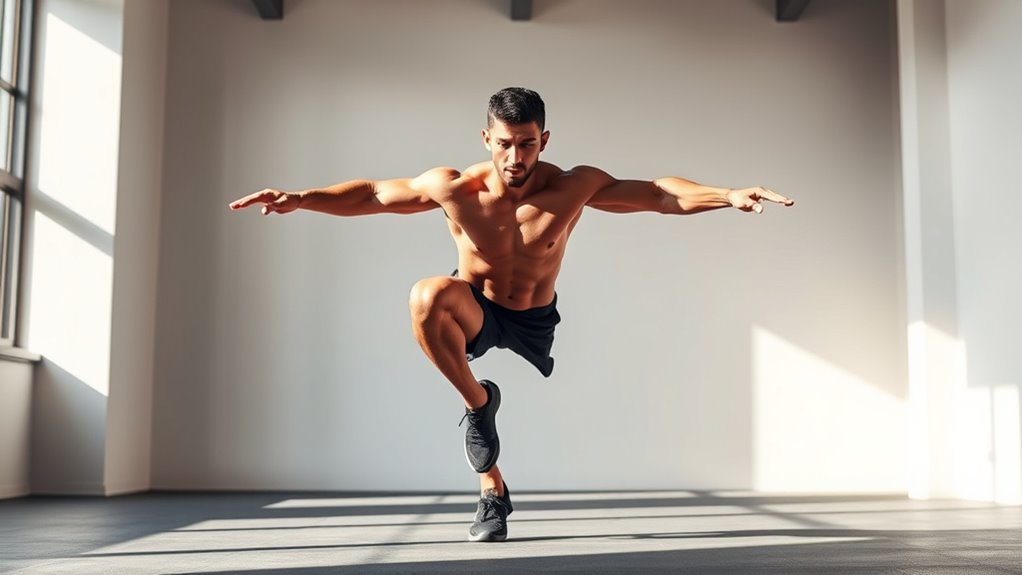
Although it looks simple, a pistol squat is one of the toughest calisthenics moves you’ll face because it requires you to balance on one leg while lowering and rising with control.
A pistol squat challenges your mobility and strength by demanding deep hip and ankle flexibility, alongside unilateral leg power. You extend one leg straight in front while squatting on the other, requiring precise knee tracking to avoid injury.
This move tests your ability to control both eccentric and concentric phases without collapsing inward. Overcoming limitations in ankle dorsiflexion, hip flexibility, and stabilizing muscle control makes the pistol squat particularly difficult.
Your coordination and core stability also play a pivotal role, making it a full-body challenge that’s as much about control as raw strength.
Prepare Your Body: Mobility, Strength, and Balance Basics for Pistol Squats
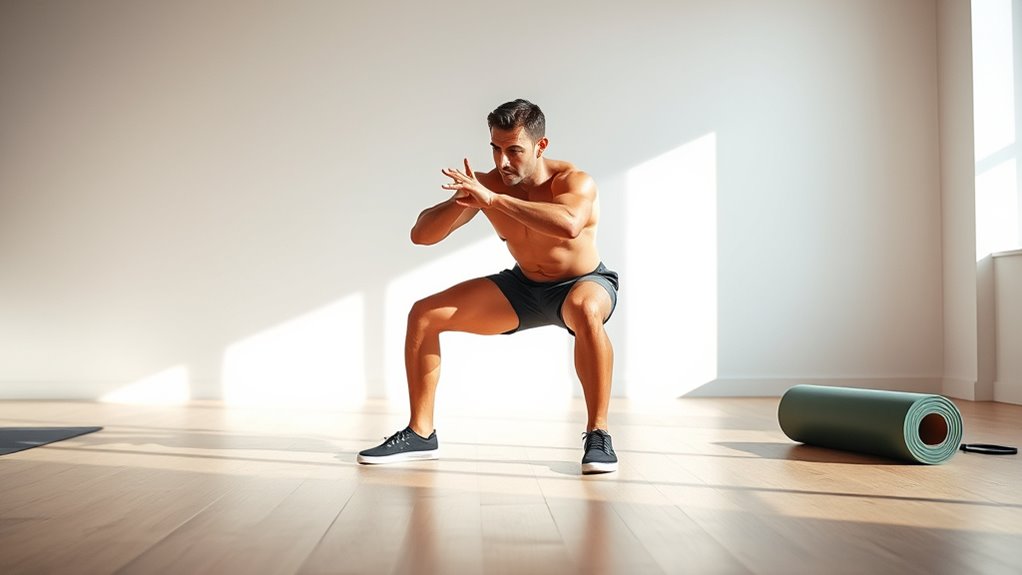
To master pistol squats, you need solid mobility, strength, and balance. Focus on ankle and hip mobility drills to improve your range of motion, and build single-leg strength with targeted exercises.
Don’t forget core stability to help maintain balance throughout the movement. It’s all about combining these elements to move smoothly and safely. Keep practicing, and you’ll see progress!
Mobility Drills Essentials
When you focus on mobility drills like ankle dorsiflexion stretches and hip openers, you increase the flexibility needed to reach deep pistol squat positions. These mobility drills improve your joint range of motion, allowing you to maintain proper form and reduce injury risk.
It’s a good idea to prioritize exercises that target key areas for pistol squats:
- Ankle mobility: Use Frogger drills and calf stretches to enhance dorsiflexion and prevent heel lift.
- Hip openers: Incorporate deep lunges and leg swings to open your hips and improve squat depth.
- Core and hip stability: While primarily for strength, gentle bridges can also aid mobility by encouraging pelvic control.
Strength And Balance
While mobility sets the foundation, building strength and balance is essential to mastering pistol squats. Focus on developing single-leg strength with lunges and step-ups to enhance stability.
Work on balance by practicing assisted pistol squats or partial reps. This helps improve your proprioception and control.
Don’t forget mobility drills like ankle dorsiflexion stretches and hip openers to increase your range of motion.
Strengthen your core, glutes, and hip stabilizers to maintain proper alignment and control throughout the movement.
| Strength Focus | Balance Practice | Mobility Drills |
|---|---|---|
| Single-leg lunges | Assisted pistol squats | Ankle dorsiflexion stretch |
| Step-ups | Partial pistol squats | Hip openers |
| Core & hip stabilizers | Proprioception training | Thoracic spine mobility |
Master the Assisted Squat to Build Your Foundation
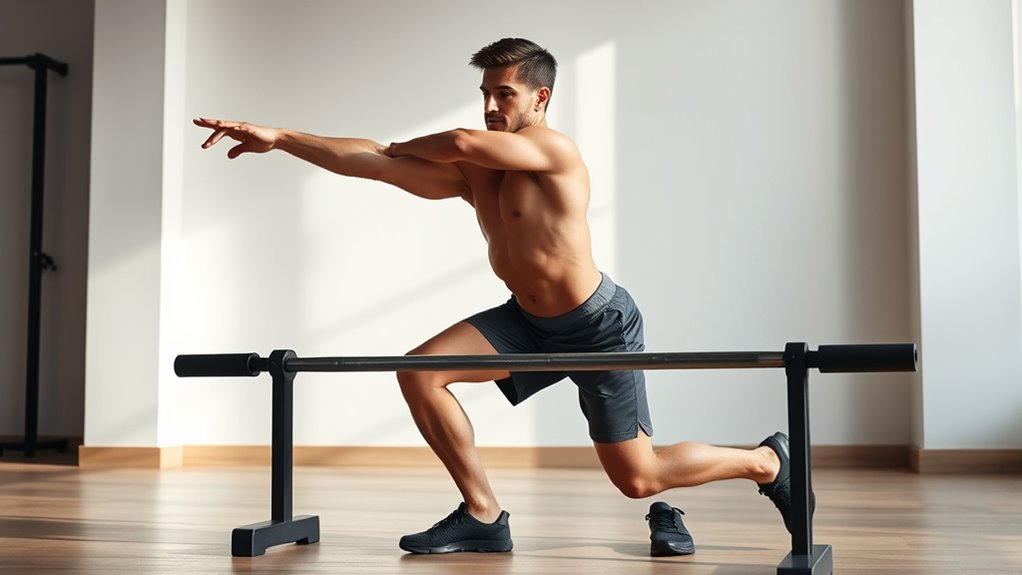
Building a strong foundation with assisted squats helps you develop the balance, strength, and mobility essential for pistol squats. Using support like a wall, TRX, or chair lets you control your movement while maintaining proper knee and ankle alignment.
Start shallow and increase depth as your strength and flexibility improve.
Focus on these key points:
- Engage your core and keep your heel grounded to maintain stability.
- Confirm your knee tracks over your toes to protect your joints.
- Practice regularly to build the muscle control necessary for unassisted pistol squats.
Mastering the assisted squat trains your body to move safely and efficiently. It really sets you up for success as you progress toward full pistol squats.
Practice Single-Leg Balance and Stability for Pistol Squats
After mastering assisted squats, you’ll want to sharpen your single-leg balance and stability to support your pistol squat progress. Start by standing on one foot for 30 seconds to 1 minute. Gradually increase the time as your control improves.
Try adding stability drills like single-leg deadlifts and balance reaches. These help strengthen the muscles that keep you steady.
You can use support tools like a wall or chair during bodyweight training. This builds confidence while you work on maintaining your balance.
Make sure to engage your core muscles, including your obliques and transverse abdominis. This really helps enhance your balance and control.
Practice slow, controlled movements on each leg regularly. Doing this develops your proprioception and muscle memory, which are key for nailing pistol squats with precision.
Improve Ankle and Hip Mobility for Pistol Squats
To nail pistol squats, you’ll need to boost your ankle dorsiflexion with targeted drills like ankle circles and foam rolling. These moves really help get your ankles moving better.
Stretching your hip flexors regularly also makes a big difference. It opens up your range of motion for smoother, deeper squats.
Make sure to weave these mobility exercises into your routine. That way, your joints stay flexible and ready to support the movement safely.
Ankle Dorsiflexion Drills
Since proper ankle dorsiflexion plays a crucial role in achieving full pistol squat depth, you need to prioritize mobility drills that enhance both ankle and hip flexibility.
Limited dorsiflexion often causes your heel to lift, which compromises your balance and depth. So, to improve your ankle mobility and dorsiflexion, focus on these key drills:
- Frogger Stretch and Ankle Circles – Loosen tight joints and increase flexibility.
- Dorsiflexion Wall Slides – Practice controlled ankle movement by sliding your knee over your toes while keeping your heel down.
- Calf and Achilles Release – Use foam rollers or lacrosse balls to break up fascia and improve range of motion.
Try to incorporate these consistently, track your progress, and gradually deepen your dorsiflexion for better pistol squat performance. You’ll notice the difference!
Hip Flexor Stretching
Three key hip flexor stretches can dramatically improve your ankle and hip mobility for pistol squats. Stretching the hip flexors, like with kneeling hip flexor stretches or lunges with a hip extension, increases flexibility in the front of your hips. This is essential for reaching the deep squat position without compromising form.
Regularly stretching your hip flexors reduces tightness that limits your range of motion during the descent, helping you maintain better pelvis positioning. Improved mobility prevents excessive forward lean and knee overextension, which can cause injury.
Mobility Routine Integration
Although improving ankle and hip mobility takes consistent effort, integrating targeted drills into your routine will boost your pistol squat performance considerably. Enhancing your ankle mobility and hip mobility is essential for achieving the flexibility needed for deep, controlled pistol squats.
Focus on these key mobility exercises:
- Ankle dorsiflexion stretches and foam rolling to increase ankle mobility and improve squat depth.
- Hip circles, butterfly stretches, and deep lunges to enhance hip flexibility and external rotation.
- Dynamic warm-ups like leg swings and hip hinges to prepare joints and muscles for movement demands.
Try to practice these 3-5 times weekly to gradually improve your range of motion and stability. Consistent mobility work really guarantees safer, deeper pistol squats and sustained joint health over time.
Use the Bottom-Up Method to Build Strength and Control
When you focus on the bottom-up method, you build strength and control right where pistol squats challenge you most—the lowest point. This method centers on mastering the bottom position by practicing deep squats, then rolling back into that position and rising to stand on one leg.
By controlling both the descent and ascent without relying on momentum or bounce, you develop precise control and stability. Training from this low position directly improves your mobility and targets the strength gaps that often cause failure in pistol squats.
Gradually, as your control and strength increase at the bottom, you’ll find it easier to perform the full pistol squat without support. This approach guarantees you build a solid foundation for safe, effective pistol squats.
Try Partial and Elevated Pistol Squat Variations for Safer Progression
Building strength and control at the bottom of the pistol squat sets a strong foundation. But you can make progress even safer and more manageable by trying partial and elevated variations.
Building strength and control at the bottom of the pistol squat creates a solid foundation for safer, manageable progress.
These methods help you build mobility and stability gradually. That way, your progression feels smoother and less intimidating.
Try these three approaches:
- Use the partial pistol squat to lower only partway. This boosts strength and confidence without going all the way down.
- Perform elevated pistol squats by placing your non-working leg on a box or platform. It reduces the balance demands, making it easier to focus on form.
- Incorporate supports like a chair or TRX during these variations. They help you maintain control and reduce the risk of injury.
Form Tips to Avoid Injury and Work Better
To nail pistol squats safely, keep your spine neutral and avoid rounding your back. Control your movement pace by lowering yourself slowly and steadily.
Use your arms to help balance and maintain stability throughout the exercise. It really makes a difference when you focus on steady control and good form. Just take it slow and steady, and you’ll get there!
Maintain Neutral Spine
Because maintaining a neutral spine is essential for preventing injury and maximizing efficiency, you should engage your core muscles throughout the pistol squat. This core engagement helps you avoid excessive arching or rounding of your lower back, keeping proper alignment from head to tailbone.
Focus on gently hinging at the hips and keeping your chest up to support a neutral spine. It really makes a difference in how you feel during and after the movement.
To uphold a neutral spine during your pistol squat:
- Engage your abdominal and lower back muscles consistently to prevent overextension or collapse.
- Use a mirror or fixed point ahead to keep your head aligned with your spine.
- Maintain a straight line from your head to your tailbone, avoiding forward or backward leaning.
This approach ensures safe, effective movement and better results. Give it a try and notice how much smoother your pistol squats become!
Control Movement Pace
Maintaining a neutral spine sets a strong foundation, but controlling your movement pace is what truly refines your pistol squat. Keep a slow, controlled tempo to engage muscles properly and avoid injury caused by momentum.
Pause briefly at the bottom to build strength and stability before rising. Also, coordinate your breathing—inhaling as you descend, exhaling as you ascend—for better core control.
Avoid rushing; focus on smooth, deliberate movements. If needed, use supports like a pole or TRX to maintain balance and prevent sudden shifts.
| Tip | Benefit |
|---|---|
| Slow, controlled tempo | Proper muscle engagement |
| Pause at bottom | Builds strength and stability |
| Deliberate breathing | Enhances control and core stability |
Use Arm Balance
When you extend your arms forward or to the sides during pistol squats, you enhance your balance and stability by engaging your core and upper body. This arm balance acts as a counterweight, helping you control the movement and avoid wobbling.
To use arm balance effectively, focus on these key points:
- Reach your arms forward to maintain proper torso alignment and prevent excessive leaning.
- Engage your core fully to stabilize your body and support the squat’s depth.
- Move your arms in a controlled manner to improve technique and reduce injury risk.
It might feel a little awkward at first, but with practice, using your arms like this will make the whole movement smoother and easier to control. Give it a shot!
Add Exercises That Boost Your Single-Leg Strength
To master pistol squats, you’ll need to strengthen each leg individually through targeted exercises. Focus on single-leg strength by incorporating step-ups and Bulgarian split squats. These build the unilateral power essential for pistol squats.
Strengthen each leg with step-ups and Bulgarian split squats to build the unilateral power needed for pistol squats.
Improve mobility and ankle stability with anterior tibialis-focused movements like grog squats and shin raises. Don’t neglect deep two-legged squats and assisted pistol variations to enhance hip and knee mobility alongside strength.
Boost your balance and core control with single-leg planks and balance drills. These are essential for maintaining stability during the movement.
As you progress, add shrimp squats and negative pistols to challenge your muscles further and refine your balance. This combination will prepare you effectively for the demands of pistol squats.
Troubleshoot Common Pistol Squat Challenges and How to Fix Them
Although pistol squats are a powerful exercise, they often come with common challenges like knee collapse, poor balance, and limited depth. To troubleshoot these issues, focus on correcting knee valgus, improving balance, and enhancing mobility.
Fix knee valgus by strengthening your hip abductors and external rotators with clamshells and monster walks. These moves really help stabilize your knees.
Boost balance by practicing single-leg exercises such as step-ups, Bulgarian split squats, and supported pistol variations using a wall or chair. Getting comfortable on one leg takes time, so be patient with yourself.
Increase ankle mobility through dorsiflexion stretches and Frogger drills to safely reach full depth. Better ankle flexibility makes a big difference here.
Using support tools during practice helps reduce strain and builds confidence as you master proper pistol squat form. Don’t hesitate to use a chair or wall until you feel solid on your own.
Frequently Asked Questions
How to Do a Pistol Squat Step by Step?
Stand on one leg, extend arms forward, and lift the other leg straight. Bend your standing knee, hinge at hips, lower yourself, then push through your heel to rise. Use support if needed for balance.
What Are Common Pistol Squat Mistakes?
You often mistake by letting your knee cave inward, lifting your heel, or leaning too far forward. Don’t rush the movement or ignore ankle and hip mobility; these errors mess up balance and risk injury.
Should You Hold Your Foot in a Pistol Squat?
Wondering if you should hold your foot in a pistol squat? Yes, you should—especially when starting out. It helps you maintain balance, control the movement, and build strength safely before progressing to full, unassisted pistol squats.
How Long Will It Take to Be Able to Do a Pistol Squat?
You’ll usually take a few months to a year to master pistol squats, depending on your strength, mobility, and consistency. With focused practice and progressions, you might see results in as little as 4-6 weeks.
Conclusion
Mastering pistol squats means meeting mobility, strength, and stability challenges head-on. By building balance, boosting your base with assisted squats, and embracing essential exercises, you’ll steadily strengthen single-leg skills.
Stay safe, stay smart—steadily stepping through small successes will sculpt strength and skill. Remember, persistence powers progress. Push past pitfalls with patience and precision, and you’ll proudly perform pistol squats with poise and power in no time.
Pistol squats demand dedication, but with consistent practice focusing on mobility, strength, and balance, anyone can improve. Keep working on those essential steps, listen to your body, and celebrate each small win. Before you know it, pistol squats will become a powerful part of your fitness routine, showcasing your strength and stability with confidence.