7 Reasons a .243 Is a Good Deer Rifle
You’ll appreciate the .243 Winchester’s flat trajectory and manageable recoil, making your shots more precise and comfortable. This makes the .243 a great deer rifle choice for hunters who want accuracy without the kick.
Its versatile bullet options deliver effective energy for ethical kills up to 300 yards. Whether you’re in dense woods or open fields, this rifle performs well in various terrains.
Plus, it fits smaller shooters nicely, offering better control and quick follow-up shots. Reliable performance and ease of handling come together to make the .243 Winchester an ideal pick for deer hunting.
Keep exploring to discover how these features combine for a smooth and successful hunting experience.
Key Takeaways
- The .243 Winchester offers a flat, fast trajectory for precise shot placement at moderate distances. This really helps when you want to make every shot count.
- Low recoil makes shooting more comfortable and easier to control. It’s especially great if you’re newer to hunting and still getting the hang of things.
- You’ll find quality bullet options that deliver effective penetration and expansion. This means you can make ethical, humane kills without worrying about follow-up shots.
- The rifle’s versatility shines in different terrains and deer sizes. Whether you’re in dense woods or open fields, it adapts well.
- Plus, it’s reliable and manageable, so you can shoot confidently in all kinds of hunting situations. That consistency is a big deal out there.
Why the .243 Winchester Is Ideal for Deer Hunting
Although many cartridges can handle deer hunting, the .243 Winchester stands out because it offers a flat, fast trajectory. This helps you place accurate shots with minimal bullet drop at moderate distances.
The .243 Winchester excels with a flat, fast trajectory, ensuring precise shots and minimal bullet drop.
This deer cartridge combines precision and versatility. It uses bullet weights typically between 70 and 100 grains to guarantee effective performance across various terrains.
You’ll appreciate the light recoil, around 8.8 ft/lb, which makes shooting comfortable and manageable. This is especially true if you’re recoil-sensitive or guiding younger hunters.
The .243 maintains good energy up to 300 yards, giving you enough stopping power for ethical, humane kills.
Its proven track record and reliable performance have earned it a reputation as a trusted choice. This makes it an ideal option for anyone serious about deer hunting.
Why the .243 Winchester Offers Manageable Recoil for Better Accuracy
One of the standout benefits of the .243 Winchester is its manageable recoil, which plays a crucial role in helping you shoot with better accuracy. Producing just about 8.8 ft/lb of recoil energy and a recoil velocity near 8.7 ft/sec, this rifle feels much gentler compared to larger calibers.
That manageable recoil reduces flinching, letting you maintain a steady aim and deliver precise shots. Because the kick isn’t harsh, you can practice more confidently and consistently, especially if you’re young or new to hunting.
Plus, the low recoil makes follow-up shots quicker and more accurate, leading to ethical hunting outcomes where you can cleanly take down deer without unnecessary suffering. Overall, the .243 offers a balanced shooting experience that improves your accuracy considerably.
How Bullet Choices Affect .243 Winchester’s Deer Hunting Success
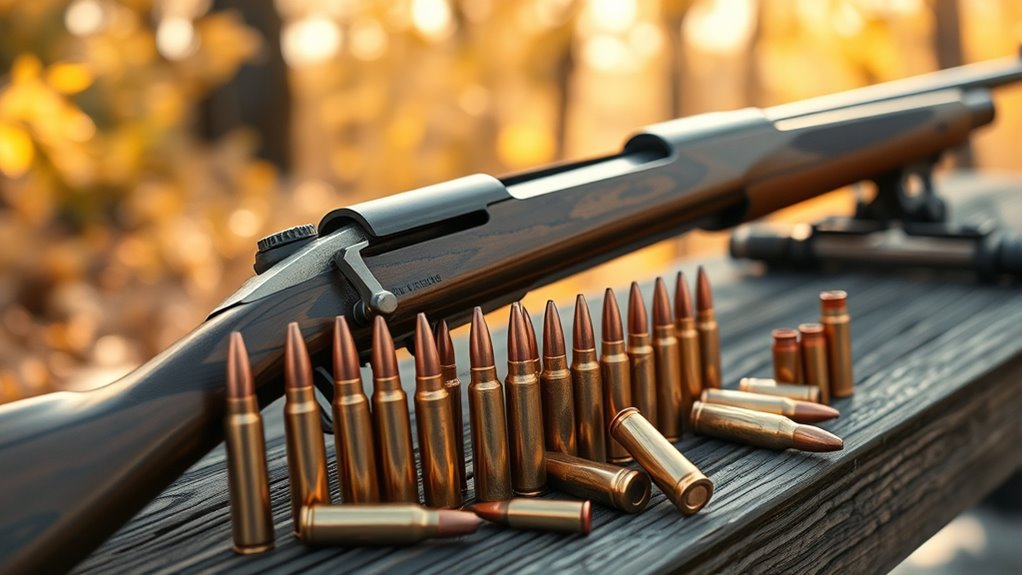
Choosing the right bullet weight plays a huge role in your .243’s performance on deer. Heavier bullets over 100 grains offer better penetration and reliable expansion, leading to more effective, ethical kills.
It’s also important to understand how bullet construction affects terminal ballistics. This knowledge helps you make the best shot every time.
Bullet Weight Importance
When you pick the right bullet weight for your .243 Winchester, you’ll improve your chances of a clean, ethical deer kill. The bullet weight you choose affects trajectory, recoil, and terminal performance. These are all crucial for deer hunting success.
Here’s what to keep in mind:
- Heavier bullets (100 grains or more) deliver better energy and penetration. This makes them ideal for deer.
- Lighter bullets (55-70 grains), often designed for varmints, usually lack the necessary weight to guarantee effective kills on deer.
- Selecting quality bullet types like Nosler AccuBond or Barnes TTSX enhances performance. It also increases your success rate.
Choosing the right bullet weight ensures your .243 maintains adequate energy at typical hunting distances. Usually, that’s up to 200 yards.
Penetration And Expansion
Two key factors determine how well your .243 performs on deer: penetration and expansion. Your bullet choice directly affects these factors.
Heavier bullets, like 100 grains or more, offer deeper penetration to reach vital organs, especially at longer distances. Bullets such as Nosler Ballistic Tip or Hornady SST are built to expand reliably upon impact, maximizing energy transfer for ethical kills.
Monolithic options like Barnes TTSX or Hornady ELD-X combine uniform expansion with deep penetration, boosting your success rate. Using high-quality bonded or partitioned bullets guarantees you don’t sacrifice penetration for expansion.
Balancing these factors by selecting proper bullet design and weight makes the .243 a versatile and effective deer cartridge. It gives you confidence in every shot.
The Ideal Shooting Range for Ethical .243 Winchester Deer Shots
You’ll find the .243 Winchester excels at ethical shots within 200 yards thanks to its flat trajectory and reliable accuracy.
Even out to 300 yards, it holds enough energy for clean kills if you choose the right bullet. Staying within this range helps guarantee precise shot placement and humane deer harvesting.
Optimal Effective Distance
Because the .243 Winchester maintains sufficient energy and accuracy at moderate distances, it’s an excellent choice for ethical deer shots within 200 to 300 yards. This ideal effective distance balances power, bullet performance, and shooter control, ensuring humane kills.
When using soft point bullets, you maximize terminal impact without sacrificing trajectory.
Consider these key points for the best results:
- At 200 yards, the .243 retains about 1.6 times its muzzle energy, delivering enough force for clean kills.
- Its flat trajectory reduces holdover, helping you place accurate shots within 300 yards.
- Soft point bullets enhance expansion and penetration, improving effectiveness at moderate ranges.
Staying within this range lets you confidently make ethical shots while taking advantage of the .243’s strengths.
Ethical Shot Placement
How far should you take a shot with a .243 Winchester to guarantee an ethical harvest? For ethical shot placement, keep your shots within 200 yards.
This range balances the rifle’s flat trajectory and minimal recoil energy, allowing for steady aim and precise hits. Using heavier bullets (100+ grains) ensures deep penetration, reaching vital organs quickly and humanely.
Beyond this distance, bullet drop and reduced energy risk wounding the deer.
| Distance (yards) | Recoil Energy | Shot Ethics |
|---|---|---|
| 0-100 | Low | Ideal for ethical shots |
| 100-200 | Moderate | Acceptable with skill |
| 200+ | Higher | Not recommended |
Stay within these limits to honor the principles of ethical hunting with your .243 Winchester.
How the .243 Winchester’s Flat Trajectory Boosts Shot Precision
When you’re aiming at deer within 300 yards, the .243 Winchester’s flat trajectory makes a noticeable difference in shot precision. This cartridge’s high-velocity rounds maintain a straighter flight path, reducing bullet drop and simplifying your shot.
Here’s how this benefits you:
Here’s how this benefits you by enhancing accuracy and confidence with every shot.
- Minimal Vertical Hold Correction – You won’t need to guess how much to adjust for bullet drop, letting you place shots more accurately.
- Consistent Trajectory – Fewer sight adjustments mean you can quickly and confidently line up your target.
- Focus on Target Acquisition – With less need to compensate for drop, you concentrate on the deer, boosting your shot precision.
The .243 Winchester’s flat trajectory really streamlines your shooting process. It makes it easier to deliver ethical, precise shots every time.
Why .243 Winchester Rifles Fit Smaller Shooters Comfortably
Although many hunting rifles can feel bulky or unwieldy, .243 Winchester models like Weatherby’s Camilla and 307 series are crafted with smaller shooters in mind. These rifles feature ergonomic designs with shorter overall length and lighter weight, making them easier to handle and aim.
The Camilla, designed by women, offers a shorter pull and thinner grip that fit smaller hands and frames comfortably. Meanwhile, the modular 307 Series lets you customize components to enhance fit and balance for your stature.
Pairing the .243 Winchester cartridge with these rifles helps smaller shooters maintain better control and accuracy. That combination makes the .243 Winchester a good deer rifle choice if you want comfort without sacrificing performance in the field.
How the .243 Winchester Handles Different Deer Species and Terrain
Because the .243 Winchester offers a flat trajectory and moderate recoil, you can confidently take accurate shots across varied terrain—from dense woods to open fields. This versatility makes it an excellent choice for handling different deer species and terrain types.
Here’s how it performs:
- For smaller deer in thick cover, use lighter bullets (55-75 grains) for quick, humane kills without excessive recoil.
- When hunting larger species like mule deer in rugged terrain, heavier bullets (90-100 grains) provide the necessary penetration and energy.
- Its effective range up to 400 yards suits mountains, plains, and everything in between, letting you adapt to diverse terrain with precision.
With the .243, you get a reliable, adaptable rifle ready for any deer hunting scenario. It’s a solid choice whether you’re stalking through brush or glassing from a ridge.
Frequently Asked Questions
Is a 243 Good Enough for Deer?
Yes, a .243 is good enough for deer if you use proper shot placement and choose heavier bullets around 100 grains. You’ll appreciate its flat trajectory and manageable recoil, making ethical, accurate shots easier even at longer ranges.
How Far Can I Shoot a Deer With a 243 Rifle?
You can ethically shoot a deer with a .243 rifle up to about 200 yards confidently, extending to 300-400 yards if you’re skilled, use proper bullets, and guarantee precise shot placement for a humane kill.
Is a 243 Caliber Rifle Good for Deer Hunting?
Yes, a .243 caliber rifle is great for deer hunting. You’ll get accurate shots with manageable recoil, letting you place shots precisely. Just pick the right bullet, and you’ll have an effective, ethical hunting experience.
Is a 243 Better Than a 6.5 Creedmoor for Deer Hunting?
You’ll find the .243’s recoil is often half that of the 6.5 Creedmoor, making it easier to shoot accurately. So for typical deer hunting within 200 yards, you’ll likely prefer the .243 for quick, precise shots.
Conclusion
You might think a smaller caliber means sacrificing power, but with the .243 Winchester, that’s just not true. You’ll find its manageable recoil lets you shoot more accurately, while its flat trajectory guarantees cleaner, ethical shots.
Funny enough, the very reasons it suits smaller shooters also make it perfect for tackling different deer species across varied terrain.
So, if you want versatility and precision, the .243 might just be your ideal deer rifle. It offers a great balance of power and control, making it a top choice for hunters who want an effective, reliable, and easy-to-handle option. Whether you’re new to hunting or a seasoned pro, the .243 Winchester delivers consistent performance and ethical kills, proving why it’s such a popular deer rifle caliber.