How to Have a Legal Stock on an AR Pistol Without Being Illegal
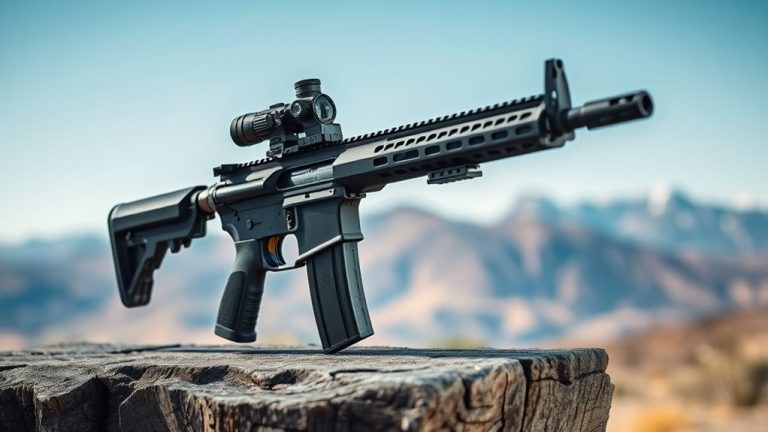
To keep your AR pistol legal, it’s important to use a brace specifically designed to physically limit the length-of-pull (LOP) to under 13.5 inches. A great example is the KAK Shockwave Blade 2.0. This is much better than using a stock that extends past this legal limit.
Always make sure to measure your firearm fully assembled with the brace extended. Focus on confirming that the LOP and overall length (OAL) stay under 26 inches. This step is key to staying compliant and avoiding legal trouble.
Also, having proper documentation and knowing the specifications of your parts can really help prevent issues down the road.
There’s more to consider if you want to ensure your setup stays on the right side of the law, so don’t overlook the details!
Key Takeaways
- Use a brace designed to physically limit length-of-pull (LOP) to under 13.5 inches to avoid classifying as a stock.
- Measure trigger-to-brace-end distance directly, making sure the brace doesn’t extend beyond the legal LOP limit when fully extended.
- Confirm overall length (OAL) with the brace attached stays under 26 inches. Measure from the muzzle tip to the rearmost point of the brace for accuracy.
- Remember to include any pinned or welded muzzle devices in your length measurements. These can affect the overall firearm length calculations.
- Keep detailed records with date-stamped photos and exact measurements of barrel length, brace model, and OAL. This helps with legal verification if needed.
How to Spot Legal AR Pistol Braces Vs Stocks
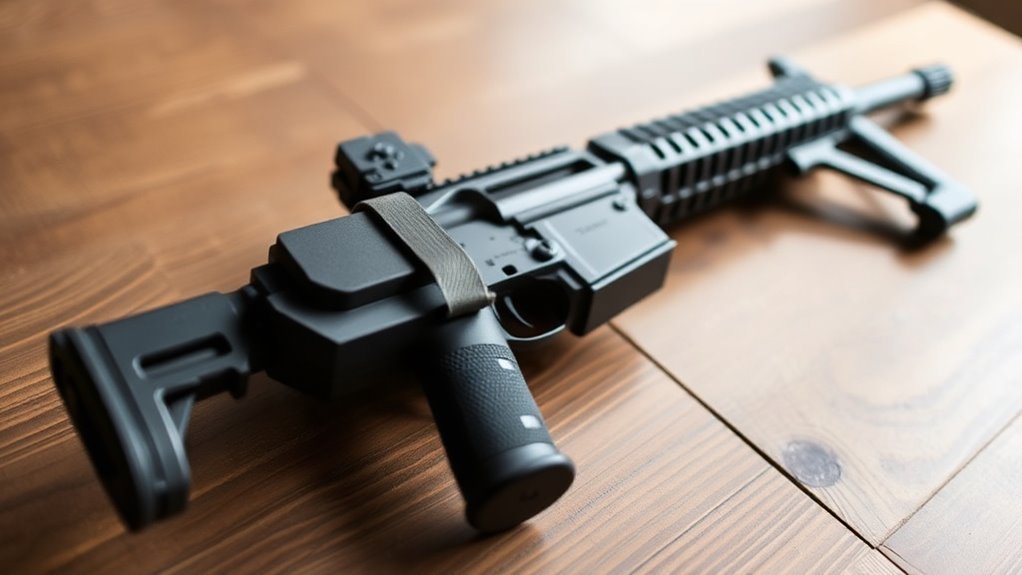
When spotting legal AR pistol braces versus stocks, focus on how the brace is designed to limit the length-of-pull (LOP). Usually, this means keeping the distance from the trigger to the end under about 13.5 inches.
You’ll want to make sure every gun you handle has a brace that physically stops at or before this length. Adjustability alone doesn’t define legality; it’s about the actual measurement and function.
Be cautious with designs that look like rifle stocks but don’t restrict LOP properly—they might cross the legal line. When shopping, check product specs for a stated LOP target and verify the assembled unit’s length yourself.
Watch out for stock-like braces that don’t limit length-of-pull; always verify specs and measure yourself.
This approach keeps things easy to understand and helps you confidently distinguish between legal braces and illegal stocks on your AR pistol.
Measuring Your AR Pistol’s Overall Length

You need to measure your AR pistol’s overall length carefully, from the muzzle tip to the rearmost point with the brace fully extended.
Remember, adjustable braces and permanently attached muzzle devices impact this measurement and can affect legal classification.
Knowing how the ATF treats these parts helps you stay compliant and avoid confusion between braces and stocks.
Proper Overall Length Measurement
To measure your AR pistol’s overall length (OAL) accurately, start by placing the firearm on a flat surface and using a straight edge or tape measure. Measure from the muzzle end—including any permanently attached muzzle device like one pinned, welded, or “rockset’d”—to the rearmost point of the firearm in its actual used configuration.
Don’t separate the muzzle device if it meets ATF permanence standards; include its length in your OAL measurement. Make sure you measure the firearm as it sits during use since buffer tube extension or brace position can change the rearmost point.
Keep consistent measurement methods and document your barrel length, muzzle device attachment type, and OAL. This helps verify you stay within legal limits when you change your AR pistol’s setup.
Brace Versus Stock Rules
Understanding the distinction between a brace and a stock is important for keeping your AR pistol legal. This is especially true since the ATF focuses on overall length (OAL) rather than just appearance.
The key measurement runs from the end of the buffer tube or recoil assembly to the muzzle end. Your AR pistol must stay under 26 inches. While adjustable braces may look like stocks, older ATF guidance treats the brace itself as excluded from OAL.
However, you still must meet the OAL limit. Keep in mind, length-of-pull (LOP) from trigger to brace end matters too and can influence whether your pistol is seen as shoulder-fired.
Because enforcement varies, always precisely measure your OAL and LOP for your exact setup. This includes barrel and muzzle device lengths to stay compliant.
Muzzle Device Length Impact
Although muzzle devices may seem minor, their size actually plays a key role in figuring out your AR pistol’s overall length (OAL). You measure OAL from the muzzle end all the way back to the buffer tube or brace end. This measurement determines if you meet the 26-inch legal limit.
Keep these points in mind:
First, always include the actual size of any pinned or welded muzzle device in your OAL—not just the barrel length.
If the muzzle device isn’t permanently attached but is about the same length as others accepted as part of the barrel assembly, treat it as functionally equal.
Make sure to verify your OAL using the exact muzzle device length and your specific barrel-to-device setup.
And don’t forget to re-measure after changing any muzzle device, especially if you’re close to length limits. Use consistent points each time.
Doing this helps you stay compliant without any guesswork.
Why Length-of-Pull Matters for Your AR Pistol

Why does length-of-pull (LOP) play such a key role in the legality of your AR pistol? The ATF focuses on whether a shoulder support functions like a traditional stock, often using a 13.5-inch LOP measured from the trigger to the brace’s end as a threshold.
If your device exceeds that, it’s treated as a stock, making your AR a short-barreled rifle, which is illegal without proper registration. Some braces, like the KAK Shockwave Blade 2.0, are engineered to stay under that limit.
Remember, adjustable braces can push LOP beyond legal bounds when extended, so you must measure in the adjusted position you’ll actually use. It’s about functional length, not just appearance.
Keeping your LOP under the threshold ensures your AR pistol stays legal. So, always double-check before you shoot!
Picking Adjustable Braces That Keep You Legal
When picking an adjustable brace, you need to make sure its length stays under the legal 13.5-inch limit from trigger to end of the brace. Measuring the length of pull accurately is key to distinguishing a legal brace from an illegal stock.
Always check the manufacturer’s specs and your exact setup to keep your AR pistol compliant. It might seem tricky at first, but once you get the hang of it, it’s pretty straightforward. Just take your time and double-check everything.
Adjustable Brace Length Limits
Because adjustable braces can run past legal limits, you need to confirm the length of pull (LOP) from the trigger to the end of the brace remains under 13.5 inches. To keep your AR pistol legal, follow these steps:
First, check the manufacturer’s specs for the maximum extended LOP—don’t rely on photos or guesses. It’s always best to get the exact numbers from the source.
Next, choose braces designed to stop short of exceeding 13.5 inches, like the KAK Shockwave Blade 2.0. Picking the right brace makes staying legal a lot easier.
Then, measure your setup yourself with the brace fully extended to ensure compliance. Don’t just trust the specs—double-check with a ruler or tape measure.
Measuring Length Of Pull
If you want to keep your AR pistol legal, you’ll need to measure the length of pull (LOP) on adjustable braces carefully. The key is making sure the distance from the trigger to the brace’s end stays under 13.5 inches.
Don’t just guess—measure at the exact brace setting you plan to use, whether it’s collapsed, mid, or fully extended. Some manufacturers design braces to stop before hitting that 13.5-inch limit, so it’s worth checking if they make that claim.
Watch out for mil-spec buffer tube setups; they often don’t limit extension. This can risk having an illegal LOP when fully extended.
Use a consistent method to measure from the trigger to the contact point where the brace ends. Think of LOP compliance as a strict measurement requirement—not just about how the brace looks.
Legal Brace Versus Stock
Although adjustable braces can look a lot like rifle stocks, what really matters is their actual length-of-pull measurement to stay legal. Visual similarity doesn’t determine legality—length does.
When you’re picking an adjustable brace, keep a few things in mind:
- Make sure the manufacturer’s stated Length-of-Pull (LOP) in its adjusted position stays under 13.5 inches.
- Choose braces designed to stop before going beyond the 13.5-inch LOP, like those with the KAK Shockwave Blade 2.0-style stop.
- Avoid swapping parts or configurations that increase the LOP past legal limits.
- Keep product specs and measurement documentation handy because enforcement usually focuses on the measurements, not how it looks.
How to Document Parts and Measurements to Prove Legality
Three essential steps help you document your AR pistol’s parts and measurements to prove its legality. First, log key measurements like barrel length and length of pull (LOP) from trigger to brace end, using a tape measure or calipers. Be sure to include photos with a ruler for scale.
Second, save detailed specs of each relevant part—brace model, buffer tube, and muzzle device—showing advertised dimensions. This way, you have clear proof of what you’re working with.
Third, record the exact configuration, including tube stack and any pinned components, since these affect legal length calculations. It’s important to capture how everything fits together.
| Measurement | What to Include | Why It Matters |
|---|---|---|
| Barrel & OAL | Photos with scale, date-stamped | Proves barrel length and overall length |
| LOP | Measured trigger to brace end | Confirms compliance with 13.5″ limit |
| Parts Specs | Model, SKU, exact dimensions | Verifies advertised dimensions match setup |
| Configuration | Tube/adapter stack, attachments | Shows how parts affect measurements |
Why Swapping AR Uppers and Receivers Can Get You in Trouble
When you swap an AR upper onto a different lower, you risk crossing legal lines that can classify your firearm as something regulated under the National Firearms Act (NFA). This can happen if your configuration creates a short-barreled rifle (SBR) or any other restricted category.
Here’s why you should be cautious:
Understand the risks before swapping AR uppers and lowers to avoid unintended legal consequences.
- Mixing a rifle upper with a pistol lower may “make” a new firearm under federal law, triggering NFA rules.
- Installing a pistol upper on a receiver classified as a rifle can be viewed as unlawful redesign.
- Repeated swapping risks showing intent to manufacture a prohibited firearm.
- Legal interpretations hinge on “intended design” and “readily convertible” status, which are subjective.
Bottom line? Avoid risky swaps and always talk to a legal expert before you alter your build. It’s just not worth the headache.
What Cops Look For When Checking AR Pistols
Because law enforcement officers need to quickly determine if your AR pistol complies with regulations, they focus on specific legal classification signals and measurements. They check whether the receiver is configured as an AR pistol or a rifle, paying close attention to overall length (OAL) and barrel length, often comparing these to the 26-inch OAL threshold.
Officers assess if the brace functions like a shoulder stock by examining practical shoulder-compatibility, length-of-pull (LOP), and adjustment stops—especially if the trigger-to-end-of-brace length approaches 13.5 inches. They also scrutinize muzzle devices, noting if flash suppressors or other attachments are permanently fixed, as these affect length calculations.
Knowing what cops look for helps you keep your AR pistol legal and avoid trouble during inspections. So, it’s good to be aware and prepared when handling or transporting your firearm.
Smart Ways to Store Your AR Pistol Safely and Legally
Although you might want quick access to your AR pistol, storing it safely and legally requires careful planning and adherence to best practices.
Here’s how you can do it smartly:
- Store your AR pistol unloaded in a locked container, keeping ammunition separately—especially if children are around.
- Use quick-access safes only for situations when you truly need immediate access. Never leave the firearm unsecured on furniture or drawers.
- Follow manufacturer guidelines for braces and stocks, ensuring all parts remain in their intended configuration to avoid illegal setups.
- Perform a routine condition check before locking up: verify the chamber is empty, the bolt is open or properly positioned, and magazines are removed.
Keeping a detailed storage checklist also helps prevent mistakes and keeps you compliant with the law.
Frequently Asked Questions
Is It Legal to Put a Folding Stock on an AR Pistol?
You can’t legally put a traditional folding stock on an AR pistol without risking SBR classification. Instead, use a folding pistol brace designed for that purpose.
Make sure to double-check the latest rules with a qualified attorney. It’s always better to be safe than sorry!
What Does “Mexican Carry” Mean?
“Mexican carry” means you carry your pistol angled up or out for a quick draw, often partially concealed.
You’ll want to remember it’s slang, so legality depends on how and where you actually carry, not the term itself.
What Is Illegal on an AR Pistol?
You can’t legally attach a traditional rifle stock or a buffer tube setup that creates a rifle-length pull on your AR pistol.
Doing so risks it being classified as an unregistered short-barreled rifle, which’s illegal.
Can a Pistol Brace Be Adjustable?
Absolutely, an adjustable pistol brace can comply if it cleverly controls your length-of-pull.
You’ve got to check that, at every setting, it stays safely under 13.5 inches to stay legal and legit.
Conclusion
To stay safe and sound with your AR pistol, stay sharp on specs, stock selections, and size. Spot legal braces, measure meticulously, and maintain mindful documentation.
Avoid accidental amendments that attract attention, and always act according to the law’s letter. By blending careful choices with clear compliance, you’ll confidently carry without crossing lines.
Keep your craftsmanship clean, your conduct cautious, and your collection compliant to conquer confusion and court challenges. Remember, knowing the difference between a legal stock and an illegal modification is key.
Always double-check local laws and federal regulations before making changes. With the right approach, you can enjoy your AR pistol legally and confidently, avoiding trouble while respecting the rules. Staying informed and careful is your best defense against legal issues.