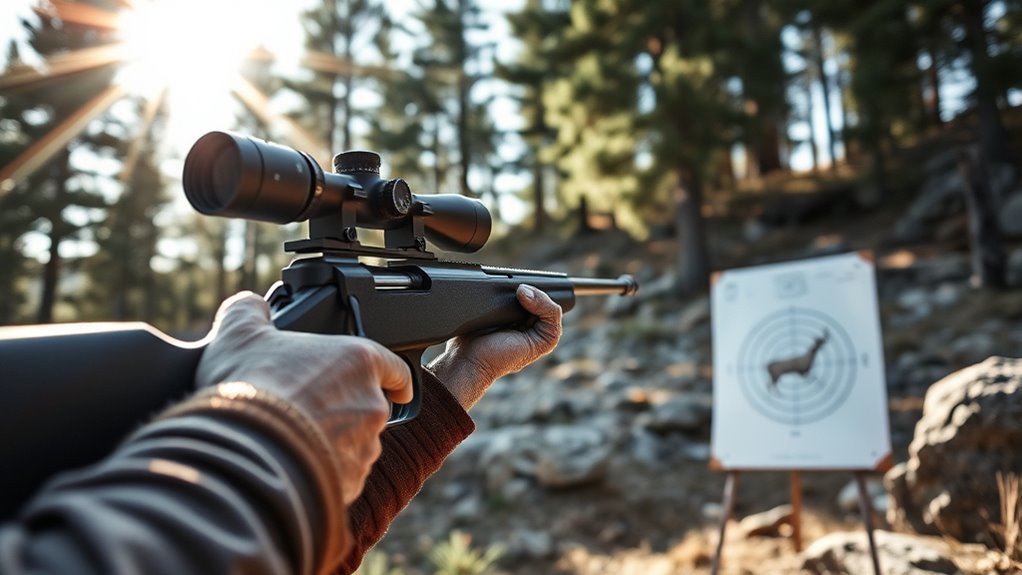
5 Essential Steps for Sighting a Rifle
To sight your rifle accurately, start by prepping your rifle and setup—clean it, tighten mounts, and use a stable platform with a close target. These essential steps for sighting a rifle ensure you have a solid foundation before you begin. Proper preparation can make a big difference in your shooting accuracy.
Next, practice steady shooting techniques to reduce errors. Bore sight at around 25 yards to roughly align the scope with your barrel. This will save you time and ammo when you start making precise adjustments.
Then, adjust your scope in small increments based on shot groupings. Take your time with this step to fine-tune your aim.
Finally, confirm your zero at longer ranges like 100 yards for precision. Follow these steps closely, and you’ll sharpen your aiming skills with ease.
Key Takeaways
- Prepare the rifle by cleaning, assembling, and securing mounts on a stable shooting platform with a 25-yard target. This setup helps you get started on the right foot.
- Use steady shooting techniques including proper stance, trigger control, and controlled breathing to ensure consistent shots. These basics really make a difference when you’re aiming.
- Bore sight the rifle at 25 yards by aligning the bore and scope reticle with the target using a bore sighting device. It’s a handy way to get your initial alignment close.
- Adjust the scope turrets based on shot group deviations using turret clicks and a 1-inch grid for precise zeroing. Small adjustments here can save you time later.
- Confirm and fine-tune zero at longer distances (100-200 yards) by assessing shot impacts and making necessary turret adjustments. This final step ensures your rifle is dialed in for real-world shooting.
Prepare Your Rifle and Shooting Setup for Accurate Zeroing
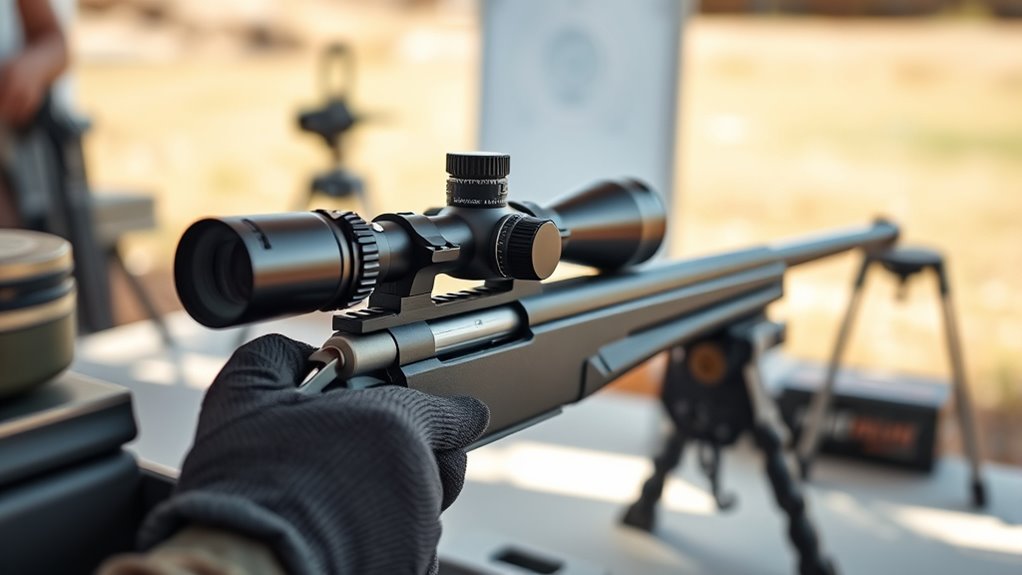
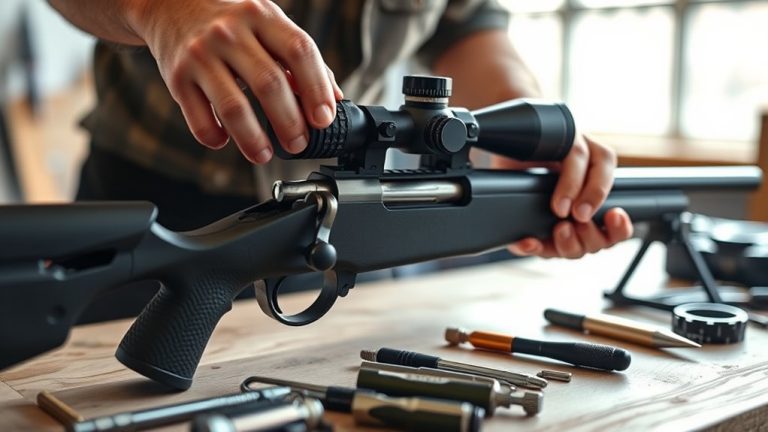
Before you begin sighting your rifle, make sure it’s clean and fully assembled. Check that all screws on mounts and rings are tightened to the manufacturer’s specs. Proper rifle preparation is key for a consistent zeroing setup.
Clean and assemble your rifle, ensuring all screws are tightened to spec for a consistent zeroing setup.
Use the correct assembly torque to secure mounts and rings. This helps ensure stability during shooting. It really makes a difference in keeping everything steady.
Choose a stable shooting platform like a bench rest or sandbags. This will help reduce movement and improve accuracy.
Next up is bore sighting. Align the scope with the target by looking down the barrel or using a boresighting tool.
Place a target with a clear bullseye and 1-inch grid lines at your zero distance, which is usually 25 yards. This makes it easier to see where your shots land.
Finally, check scope levelness with a bubble level to avoid canting errors. Keeping your scope level is super important.
And remember, maintain a solid shooting position throughout for the best results. Staying steady really pays off!
Use Steady Shooting Techniques to Eliminate Human Error
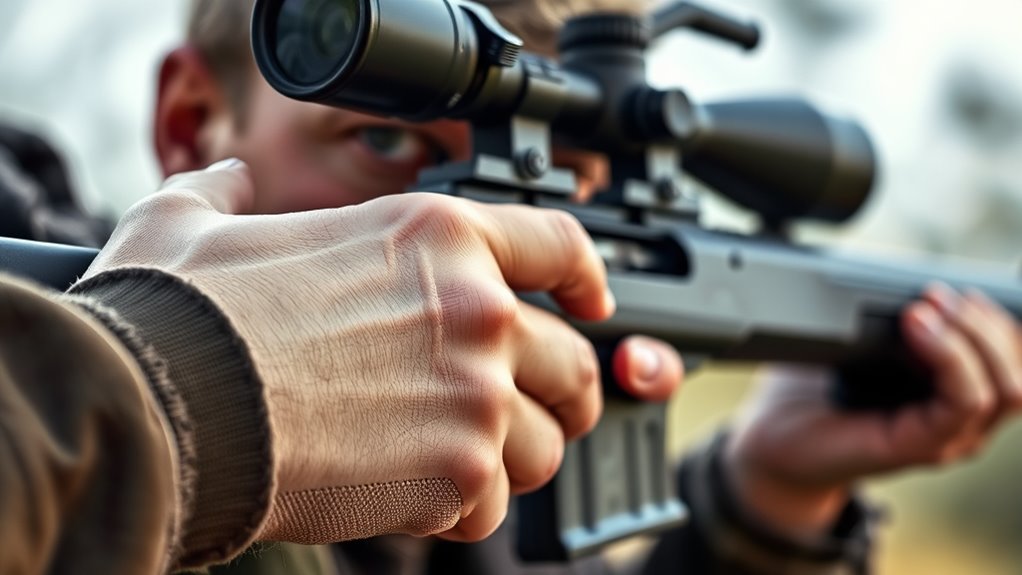
When you stabilize your rifle using a shooting rest, sandbags, or bipod, you drastically reduce movement that can throw off your shot. To guarantee steady shooting, maintain a consistent stance and stable position, supporting the rifle with your arms rather than mounting it directly to your shoulder.
Focus on proper trigger control by lightly squeezing the trigger without jerking, preventing aim disruption. Incorporate a controlled breathing technique—exhale slowly and hold briefly before squeezing the trigger—to minimize movement.
Repeating this consistent stance, grip, and aiming technique builds muscle memory, helping you eliminate human error over time. By combining these elements—shooting rest support, smooth trigger pull, steady breathing, and repeatable positioning—you enhance your accuracy and make every shot count during the sighting process.
Bore Sight Your Rifle at Close Range to Begin Zeroing
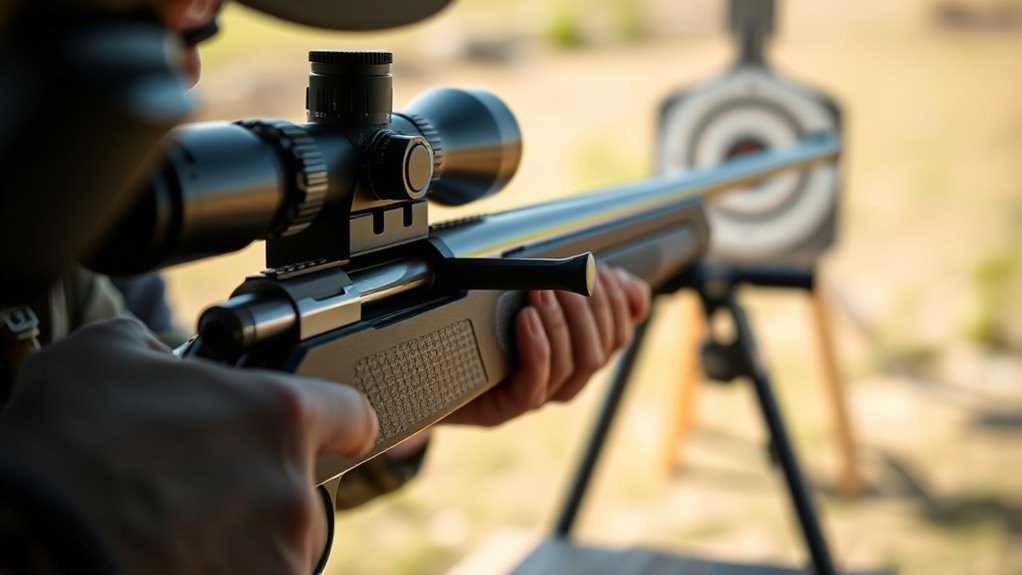
Although it may seem simple, bore sighting your rifle at close range lays the foundation for accurate zeroing. Start by removing the bolt and looking down the barrel to align the bore with your target, guaranteeing the scope’s crosshairs match the same line.
Using a bore sighting device can speed this process by projecting a laser onto the target, giving you a precise point of reference. Set up your target at about 25 yards with a clear bullseye. Position your rifle on a stable rest to prevent movement.
Focus on these key steps:
- Align the bore and scope reticle to the target for initial zeroing
- Use scope adjustments to bring the reticle in line with the bore sight
- Secure the rifle to maintain consistent alignment during sighting in
This close range bore sight ensures your scope adjustments start on the right path. It’s a simple step that really pays off when you start shooting for accuracy.
Adjust Your Scope Step-by-Step to Zero Your Rifle Precisely
Since every shot counts, adjusting your scope precisely guarantees your rifle hits where you aim.
Begin by determining how many clicks on your scope turrets move the impact point one inch at 100 yards; multiply that by four for your 25-yard zero. Use a target grid with 1-inch squares to measure shot deviations accurately.
Calculate clicks per inch at 100 yards, then multiply by four for precise 25-yard zeroing.
After firing a shot grouping, modify the scope turrets opposite the deviation—turn windage left if shots hit right, and lower elevation if shots are high. Make incremental scope adjustments, firing multiple rounds to confirm each change.
Use your scope’s click value and mil-dot reticle to refine zeroing during this sight-in process. This careful scope calibration ensures your impact point aligns perfectly with your aiming point.
Confirm and Fine-Tune Your Rifle Zero at Longer Distances
After zeroing your rifle at 25 yards by adjusting the scope turrets, extend your shooting distance to 100 yards to confirm your zero. At longer distances, verifying zero becomes critical for consistent hits and accurate shot placement.
Fire multiple shots to observe the impact point before making any scope adjustments. Use MOA measurements to fine-tune your settings precisely.
To effectively confirm and fine-tune your rifle zero at longer distances:
- Verify zero with fresh targets at 100 and then 200 yards for accurate assessment
- Adjust the scope turrets opposite to bullet deviation to correct shot placement
- Ensure consistent hits by firing groups and tracking impact point changes
This process makes sure your zero is reliable and your rifle performs accurately at extended ranges. Taking the time to double-check pays off when it counts.
Frequently Asked Questions
What Should You Do When Sighting in a Rifle?
When sighting in your rifle, you’ll want to secure it, shoot at a close range, adjust the scope turrets opposite to your shot’s deviation, fire multiple rounds, and record your settings to guarantee accuracy and consistency.
What Should You Sight Your Rifle in At?
Think of your rifle like a bow aiming at a bullseye—you should sight it in at the distance you’ll shoot most, usually 100 yards. Adjust closer or farther depending on where you plan to hunt or shoot.
What Are the Five Fundamentals of Rifle Shooting?
The five fundamentals you should focus on are steady position, natural point of aim, breath control, trigger control, and follow-through. Mastering these helps you shoot accurately by minimizing movement and maintaining consistent alignment throughout each shot.
Do You Chase the Bullet When Sighting in a Rifle?
No, you shouldn’t chase the bullet when sighting in a rifle. Instead, make small adjustments after multiple shots to avoid overcorrecting and guarantee consistent zeroing. Patience and systematic changes deliver better accuracy.
Conclusion
By following these five essential steps, you’ll zero your rifle with pinpoint accuracy faster than a lightning bolt strikes! Preparing your setup and using steady shooting are the first keys to success.
Next, bore sighting helps align your rifle before you even fire a shot. Adjusting your scope carefully ensures your aim is true, while confirming at longer distances guarantees your shots hit exactly where you want.
Skipping any step can throw off your aim, so stick to the process. With practice, you’ll become so precise, even a hawk would envy your marksmanship! Remember, sighting a rifle properly is all about patience and attention to detail. Master these steps, and you’ll enjoy consistent accuracy every time you take a shot.