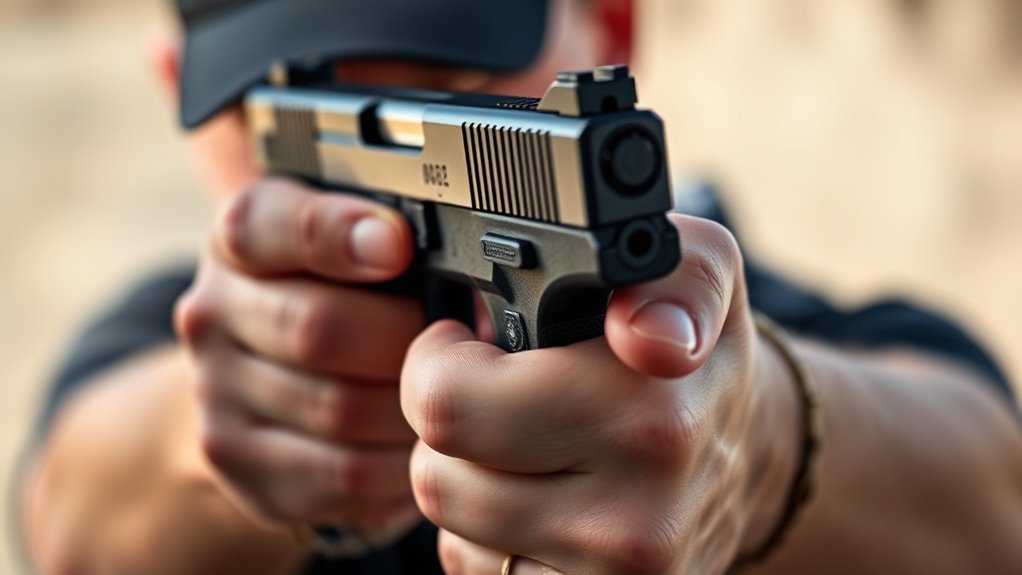
How to Shoot a Pistol in 10 Essential Steps
To shoot a pistol well, start by adopting a stable stance with your feet shoulder-width apart and knees slightly bent. This foundation helps you stay balanced and ready for recoil.
Next, grip the pistol high and firm, making sure to use your support hand for added control.
Focus sharply on the front sight while keeping both eyes open. This improves your accuracy and situational awareness.
When you’re ready to fire, press the trigger smoothly with your finger pad—avoid jerking it to maintain precision.
Practice reloading and clearing jams efficiently. These skills are essential for safe and effective pistol handling.
Don’t forget to dry fire regularly to build muscle memory.
Master these basics, and you’ll soon develop stronger skills and greater confidence with your pistol. Keep practicing, and you’ll see steady improvement every time you shoot.
Key Takeaways
- Establish a stable shooting stance with feet shoulder-width apart, knees slightly bent, and shoulders squared to the target. This gives you a solid foundation to shoot from.
- Grip the pistol high and firm with both hands, keeping elbows slightly bent. This helps you absorb recoil effectively and stay in control.
- Align the front sight centered and level within the rear sight notch. Focus sharply on the front sight post to get a clear aim.
- Use the trigger finger pad to apply smooth, steady pressure straight back until the trigger breaks. Be careful not to disturb your sight alignment while doing this.
- Practice dry firing and live drills regularly. This builds muscle memory, improves trigger control, and helps you manage recoil confidently.
Get Into the Proper Shooting Stance and Grip
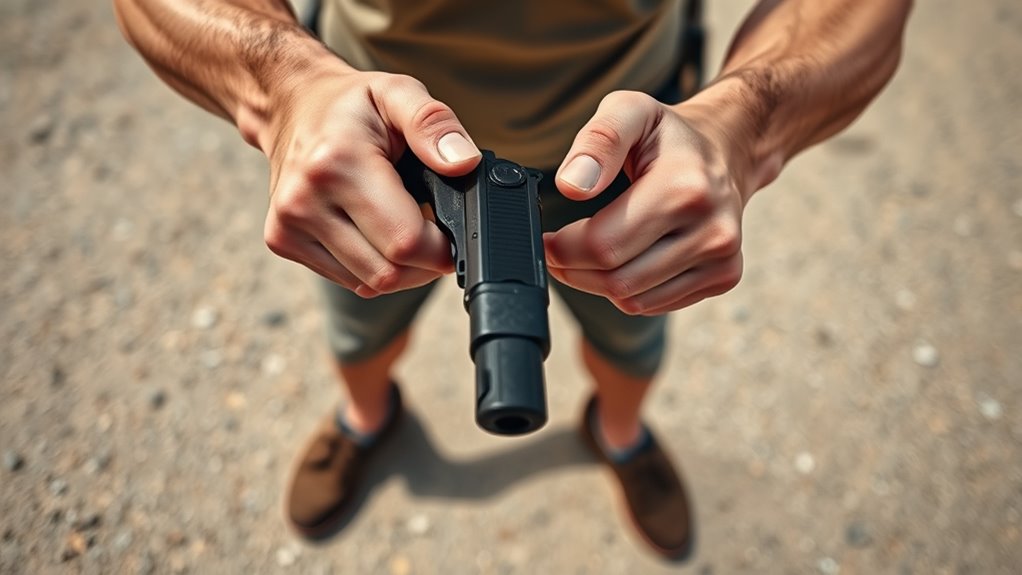
Before you take your first shot, make sure you stand with your feet shoulder-width apart and knees slightly bent to keep your balance. This stance gives you a stable foundation and helps absorb recoil.
Stand with feet shoulder-width apart and knees bent for balance and recoil control.
Square your shoulders directly to the target to align your body properly with the pistol. When it comes to your grip, hold the pistol high into the beaver tail or tang. This grip maximizes control and leverage, allowing for steadier aim.
Wrap the fingers of your support hand into the grooves of your dominant hand to enhance stability. Keep your support arm slightly bent and elbows relaxed, which helps maintain balance and prepares you for accurate follow-up shots.
Mastering this stance and grip sets you up for successful shooting. It might take a bit of practice, but once you get it down, you’ll notice a big difference in your accuracy and control.
Keep a Consistent Grip and Body Position
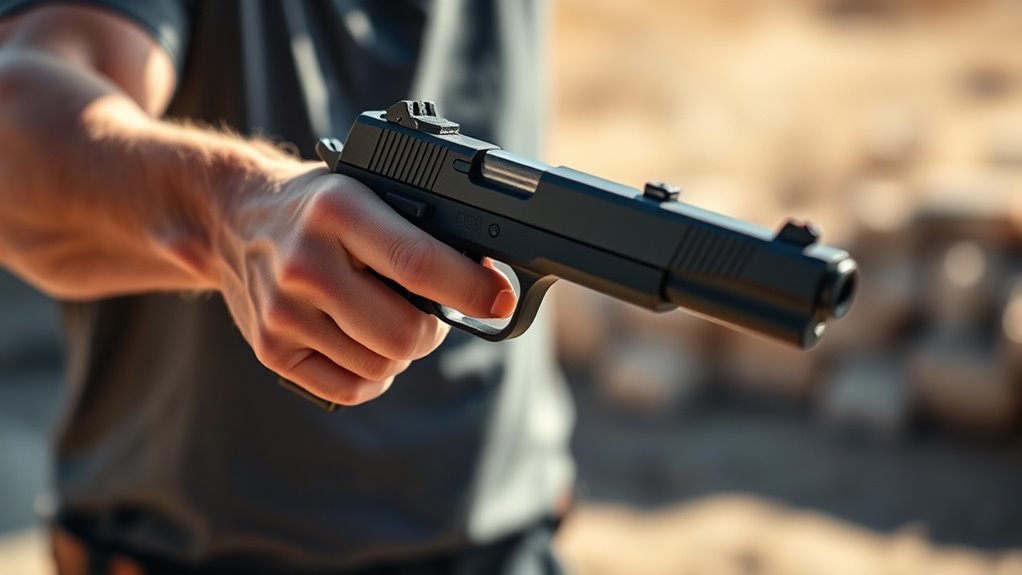
To shoot accurately, you need a firm high grip that leverages control and stability. Keep your elbows slightly bent to absorb recoil and maintain steady aim.
Also, make sure your stance stays square to the target for consistent body alignment. This helps you stay balanced and ready for the next shot.
Firm High Grip
Although it might feel natural to grip the pistol loosely, you need to maintain a firm, high grip by holding the beaver tail or tang for maximum leverage and control.
Supporting your dominant hand fingers in the grip grooves enhances stability and reduces movement. Keeping a consistent grip every shot builds muscle memory, improving accuracy.
Applying firm pressure prevents limp wristing, which can cause malfunctions. A firm grip also helps manage recoil effectively, keeping your sights aligned on target.
| Grip Aspect | Purpose | Benefit |
|---|---|---|
| Firm Grip | Prevents limp wristing | Avoids malfunctions |
| High Grip | Holds beaver tail/tang | Maximizes leverage/control |
| Consistent Grip | Builds muscle memory | Enhances accuracy |
| Recoil Control | Manages recoil efficiently | Keeps sights aligned |
Elbow Bend Importance
A firm, high grip sets the foundation, but how you position your elbows plays a big role in controlling your pistol during shooting. Keeping a slight, consistent elbow bend helps you absorb recoil and maintain stability throughout each shot.
Avoid locking or fully straightening your elbows, as this can increase movement and reduce your recoil control. Instead, a natural, relaxed bend lets you manage recoil better and prepare for quicker follow-up shots.
This consistent elbow bend also supports your grip and body alignment, contributing to overall shooting precision. By focusing on maintaining that steady elbow bend, you’ll improve both your stability and accuracy, making your pistol handling smoother and more controlled with every round you fire.
Proper Stance Alignment
When you maintain a square stance with your feet shoulder-width apart and knees slightly bent, you create a stable base that helps control your pistol better. Proper stance alignment is vital for consistent shooting.
Keep your body upright and aligned with the target, avoiding leaning forward or backward, which can compromise stability. Grip the pistol high, pressing into the beaver tail to maximize control and reduce recoil.
Your elbows should stay slightly bent, acting as natural suspension to maintain consistent positioning. Also, place your support hand fingers firmly in the grip grooves, adding stability and control.
Align Your Sights for Accurate Targeting
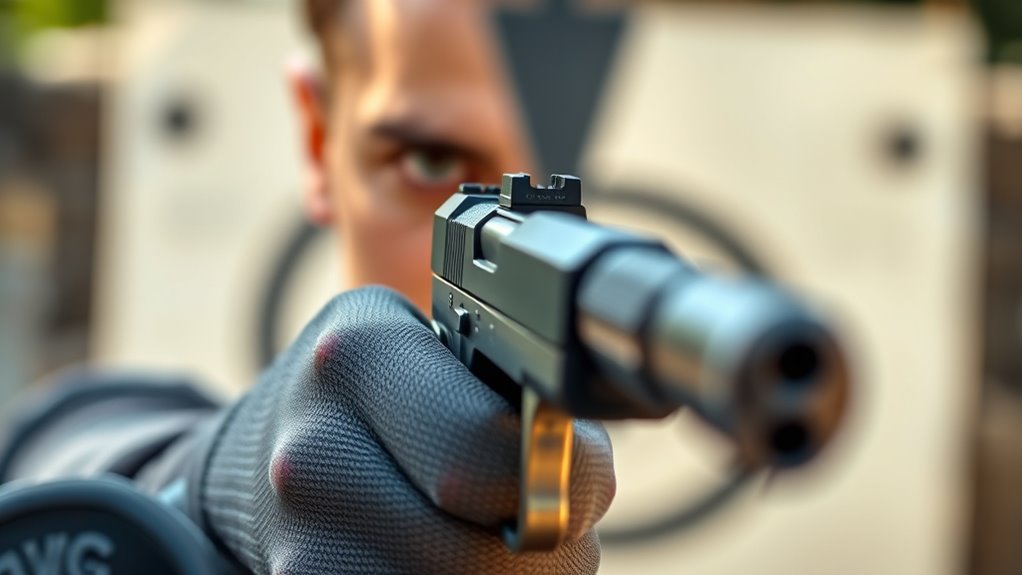
You’ll want to focus on the front sight post, keeping it sharp while the target blurs slightly. Make sure the front sight is centered and level within the rear sight for proper alignment.
Use your dominant eye to aim and keep both eyes open to stay aware of your surroundings. It really helps you stay sharp and ready.
Front Sight Focus
Since your accuracy depends heavily on sight alignment, focus sharply on the front sight post while allowing the rear sight and target to blur slightly. This front sight focus is key to maintaining a steady aim and consistent sight alignment.
Keep the top of the front sight level with the rear sight and centered in the notch. Before every shot, verify your front sight remains clear and steady.
| Front Sight Focus | Description |
|---|---|
| Sharpness | Front sight is crisp |
| Rear Sight | Slightly blurred |
| Target | Soft focus |
| Alignment | Front sight centered |
| Aim Stability | Steady, consistent focus |
Prioritizing front sight focus guarantees precise shot placement every time. It really makes all the difference when you want that perfect shot.
Proper Sight Alignment
Mastering front sight focus sets the stage for proper sight alignment, which plays a vital role in accurate targeting. To achieve this, line up the front sight post perfectly in the center of the rear sight aperture, making sure they’re level and flush at the top.
Keep your vision locked on the front sight, allowing the target to appear slightly blurred—this improves your sight clarity. Maintain consistent sight alignment by keeping the front post centered horizontally and vertically within the rear notch.
Before each shot, verify your sight picture to confirm precision. Using the sights as your guide helps you aim accurately, especially at longer ranges.
This will enhance your overall target focus and shooting effectiveness. Proper sight alignment is essential for hitting your mark every time.
Dominant Eye Use
Although aiming might feel natural, identifying your dominant eye is essential for accurate pistol shooting. To find your dominant eye, look through a small opening or focus on a distant object and see which eye naturally aligns with the target.
When aiming, close or cover your non-dominant eye to confirm which one maintains proper sight alignment. While shooting, keep both eyes open to stay aware of your surroundings but rely on your dominant eye for precise aiming.
Focus on aligning the front sight with the rear sight and your target using your dominant eye, ensuring the sights are centered and level. Consistently using your dominant eye improves accuracy and helps you develop a stable, repeatable shooting technique.
Use Both Eyes and Focus on the Front Sight
When you shoot a pistol, keeping both eyes open boosts your peripheral vision and situational awareness. This helps you stay alert to your surroundings and react faster.
Using both eyes also helps maintain a clear sight picture, which improves your ability to shoot accurately. To focus correctly, keep your attention on the front sight, making it sharp and clear. Let the rear sight and target blur slightly.
Keeping your focus sharp on the front sight while letting the rear sight and target blur enhances shooting accuracy.
Here are some key points to remember:
- Use both eyes to enhance depth perception and awareness.
- Keep the front sight aligned and centered in the rear sight notch.
- Focus sharply on the front sight, not the target at close range.
- Allow the rear sight and target to remain slightly blurry.
- Identify and use your dominant eye for consistent sight alignment.
This technique really sharpens your focus and accuracy when aiming. Give it a try and see the difference!
Master Smooth and Controlled Trigger Pressing
When you press the trigger, use the pad of your finger to push straight back. Avoid using the tip or sides of your finger.
Gradually apply pressure to defeat the trigger slack until you feel the break. Keep your motion smooth and controlled.
This technique helps you maintain your sight picture. Plus, it really improves your accuracy.
Defeat Trigger Slack
Mastering smooth and controlled trigger pressing starts with identifying the trigger wall. That’s the point where slack feels minimal before the shot breaks.
To defeat trigger slack, focus on steady pressure and precise trigger control. Don’t jerk or rush the trigger because that messes with your sight alignment and accuracy.
Work on your trigger reset by releasing just enough to hear or feel the click. Then press again smoothly without losing your sight picture.
Consistent practice helps make your shots predictable and clean.
- Identify the trigger wall carefully
- Apply steady, gradual pressure until the break
- Avoid rushing or jerking the trigger
- Practice trigger reset without losing sight alignment
- Maintain smooth, controlled trigger control for accuracy
Use Finger Pad
Although it may feel natural to use the tip of your finger, pressing the trigger with the finger pad provides better control and consistency. Using the pad allows you to apply steady pressure, making your trigger control smoother and more precise.
Keep your finger straight and aligned with the trigger to avoid any side-to-side movement that could affect your shot. Focus on gradually increasing pressure until the trigger breaks cleanly, rather than jerking or slapping it.
This controlled action helps maintain your sight picture and improves accuracy. Practice pressing the trigger using just the finger pad, developing a smooth, steady trigger control that becomes second nature during shooting.
Mastering this technique is essential for consistent, accurate pistol shooting. Give it some time, and you’ll notice the difference in your shots!
Press Straight Back
To improve your accuracy, press the trigger straight back using the pad of your finger. Keep it aligned to prevent any sideways movement.
Maintain a steady, consistent pressure on the trigger until the shot breaks. Avoid rushing; a slow, deliberate press really helps keep your sight picture intact.
You’ll want to defeat trigger slack by applying gentle pressure until you feel the tactile wall. Then, smoothly continue through the break.
After each shot, reset the trigger gently by releasing it just enough to hear or feel the click. This way, you stay in control for your next shot.
- Use the pad of your finger, keeping it straight.
- Press the trigger straight back without lateral movement.
- Apply steady pressure to overcome trigger slack.
- Focus on a smooth, slow trigger press to ensure accuracy.
- Reset the trigger gently for consistent follow-up shots.
Manage Recoil by Driving the Gun Back on Target
When you fire a pistol, driving the gun straight back on target during recoil helps maintain accuracy and control. Focus on keeping your grip firm but relaxed to avoid limp wristing, which can throw off your aim.
Keep your eyes on the sights and bring the pistol back to the original sight picture smoothly. Using controlled pressure on the trigger helps prevent disturbing the alignment during the shot.
Practice both dry firing and live drills to build muscle memory for consistent recoil management. It really makes a difference when you train regularly and stay focused on these basics.
Reload Efficiently and Clear Malfunctions
Efficiently reloading and clearing malfunctions keeps you in control and ready to shoot. When your magazine is empty and the slide locks back, press the magazine release to drop it and quickly insert a fresh one.
Efficient reloads and clearing malfunctions ensure you stay in control and ready to engage effectively.
Then, fully rack the slide to chamber a new round—pull it back smoothly without riding it forward. If you experience a malfunction, lock the slide to the rear, remove the magazine, and inspect for jams or misfeeds.
After clearing the malfunction, reinsert the magazine and release the slide to chamber a round. Remember, regular maintenance and understanding your pistol’s operation are key to quick reloads and clearing issues.
- Drop empty magazine with magazine release
- Insert fresh magazine promptly
- Smoothly rack the slide to chamber
- Clear malfunctions by locking slide back
- Reinsert magazine and release slide
Practice Dry Firing to Build Trigger Awareness
Although it might feel unusual at first, practicing dry firing sharpens your trigger control without using live ammunition. When you dry fire, focus on defeating slack at the wall, applying steady pressure, and feeling the trigger break smoothly.
This builds muscle memory and helps you recognize tactile and auditory cues, improving your shooting consistency.
Simulate the entire firing process—proper sight alignment, trigger press, and reset—to reinforce trigger discipline and reduce anticipation.
| Aspect | Benefit |
|---|---|
| Steady Pressure | Prevents jerking the trigger |
| Trigger Reset | Speeds up follow-up shots |
| Muscle Memory | Builds consistent trigger control |
Regular dry fire drills create reliable habits, making live shooting more accurate and controlled. It’s a simple, effective way to boost your skills without any ammo.
Pick the Right Pistol and Learn Your Sights
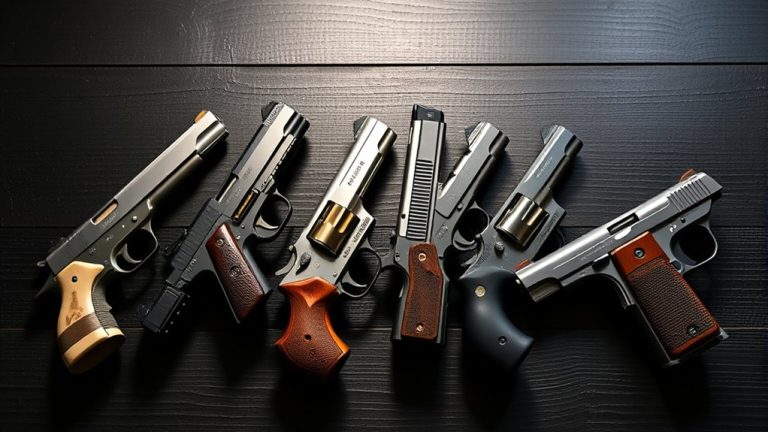
Since your comfort and control directly affect your shooting, pick a reliable semi-automatic pistol like a Glock or CZ that fits your hand well. Understanding your pistol’s sights is essential for accurate shooting.
Most pistols have iron sights with a rear aperture and a front post. Focus on sight alignment by lining up the front post within the rear sight notch, keeping the top edges flush. Concentrate on the front sight, not the target, to improve accuracy.
- Choose a pistol that fits your hand size comfortably
- Learn standard iron sights: rear aperture and front post
- Practice proper sight alignment for consistency
- Focus on the front sight rather than the target
- Consider red dot sights once you’ve mastered traditional sights
Keep Improving With Regular Practice
To keep improving your pistol skills, you need to practice regularly and consistently. Scheduled sessions reinforce your shooting technique and build muscle memory.
Try combining dry firing with live shooting to spot and fix errors. Tracking your progress through scores and observations really helps keep you motivated to keep advancing.
Vary your drills to expand your skill set, and don’t forget to review expert videos to stay sharp.
| Practice Type | Focus Area | Benefit |
|---|---|---|
| Dry Firing | Technique | Muscle memory |
| Live Shooting | Accuracy | Real-time feedback |
| Varied Drills | Precision & Speed | Adaptability |
Regular practice and technique review guarantee continuous progress and confidence with your pistol. Keep at it, and you’ll see the results!
Frequently Asked Questions
How Do I Choose the Right Ammunition for My Pistol?
You select the right ammunition by checking your pistol’s manual for recommended calibers and bullet types. Match the ammo to your shooting purpose—target practice, self-defense, or competition—to guarantee safety, reliability, and ideal performance.
What Safety Gear Should I Wear While Shooting?
You should wear eye protection to guard against debris and ear protection to prevent hearing damage. Consider gloves for better grip and a long-sleeve shirt to protect your arms from hot brass and potential burns.
How Can I Clean and Maintain My Pistol Properly?
Think of your pistol as a trusted steed—clean it after every use by disassembling, wiping down parts, lubricating moving areas, and inspecting for wear. This keeps it reliable and ready, just like a well-cared-for companion.
What Legal Requirements Apply to Pistol Ownership in My Area?
You need to check your local, state, and federal laws on pistol ownership, including age limits, background checks, permits, and registration requirements. Laws vary, so contact your local law enforcement or a legal expert to stay compliant.
How Do I Handle Misfires or Squib Loads Safely?
Think of misfires like a hiccup in your pistol’s rhythm. You’ll want to keep the gun pointed safely downrange, wait 30 seconds, then carefully eject the round. Don’t force anything—stay calm and check thoroughly.
Conclusion
By mastering your stance, grip, and sight alignment, you’ll naturally improve your shooting accuracy—coincidentally, the same skills that boost your confidence.
As you practice smooth trigger presses and efficient reloads, you’ll notice your focus sharpens not just on the range but in everyday life.
So, keep practicing regularly, pick the right pistol for you, and remember: every dry fire session is a step closer to becoming the shooter you want to be.
Consistent practice is key to improving your pistol shooting skills. By focusing on fundamentals like stance, grip, and sight alignment, you build a solid foundation that enhances accuracy and confidence alike. Regularly working on trigger control and reloads helps sharpen your focus and muscle memory, making each shot count. Choosing the right pistol that fits your style and comfort level further boosts your performance. Remember, every session, even dry firing, is valuable practice that moves you closer to becoming a skilled and confident shooter. Keep at it, and your progress will show both on the range and beyond.