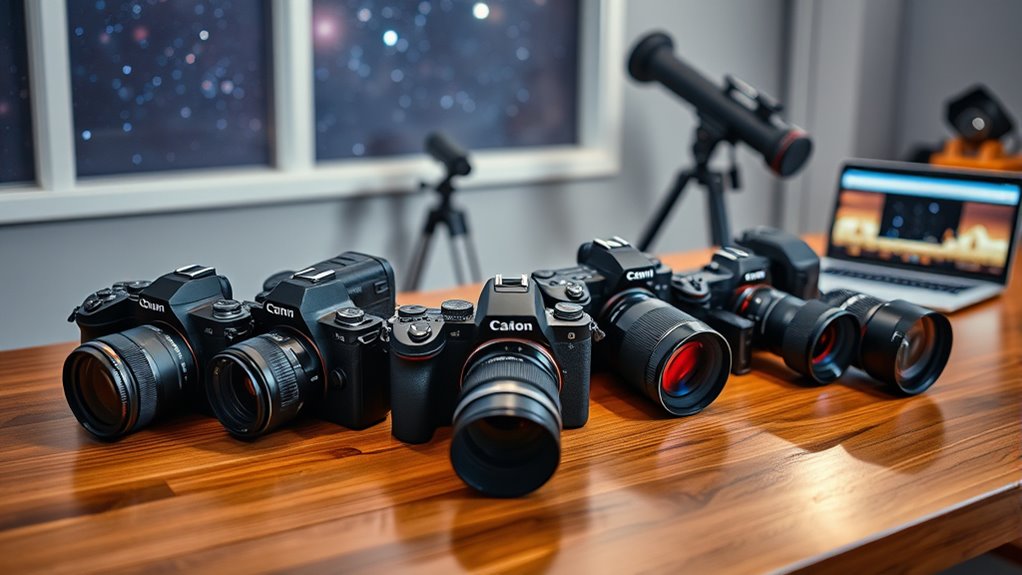
9 Best Beginner Astrophotography Cameras for 2027
If you’re starting with astrophotography in 2027, choosing the right camera can make all the difference. Beginner astrophotography cameras like the DWARFLAB Dwarf 3 smart telescope or the SVBONY SV105 offer easy and portable imaging options. These are perfect if you want something simple to carry and use under the night sky.
The ZWO Seestar S30 Pro brings 4K dual-camera tracking, which is great for capturing detailed shots.
Meanwhile, the Canon EOS Rebel T7 is versatile and handles low-light conditions well, making it a solid choice for various astrophotography needs.
For guiding your shots, the SVBONY SV905C stands out by providing precise tracking.
The OM System OM-3 combines high-resolution video capabilities with durable build quality.
These choices balance quality, ease of use, and affordability—ideal for beginners looking to capture stunning night skies. Exploring their features will help you find the best fit for your astrophotography journey.
DWARFLAB Dwarf 3 Smart Telescope, App-Controlled Astrophotography Camera
Experience the joy of exploring the night sky with the DWARFLAB Dwarf 3 Smart Telescope. This lightweight, compact device is designed to make astrophotography easy and accessible. Its portability means you can take it on any outdoor adventure without hassle.
The telescope’s app-controlled system simplifies focusing and tracking. Auto-focus, auto GOTO, and 4K auto-tracking ensure sharp, clear images whether you’re observing wildlife or distant celestial bodies. The intuitive interface reduces the learning curve, letting beginners and experts enjoy the sky.
Built with a 35mm objective lens and a dual-lens setup, it captures detailed images in various lighting conditions. Maintenance is straightforward, with included accessories like a wipe cloth and filter pouch to keep your optics clean and ready.
While it uses a single lithium-ion battery, which might need frequent recharging during extended use, its compact size and included carrying bag enhance portability and convenience. The telescope balances ease of use with advanced imaging features for versatile outdoor observation.
Best for: Outdoor enthusiasts and amateur astronomers seeking a portable, user-friendly smart telescope with reliable imaging capabilities.
What We Like:
- Ultra-lightweight (3 pounds) with compact design and convenient carrying accessories
- Dual-lens system offers versatile imaging from day to night
- App-controlled autofocus and 4K auto-tracking simplify astrophotography
- Easy maintenance with included cleaning and storage accessories
Specification:
| Feature | Details |
|---|---|
| Manufacturer | DWARFLAB |
| Dimensions | Compact, backpack-friendly |
| Weight | 3 pounds (1.36 kg) |
| Objective Lens | 35mm |
| Power Source | Single lithium-ion battery |
| Included Accessories | Carrying bag, filter pouch, USB-C cable, wipe cloth |
SVBONY SV105 Telescope Camera, 1.25″ IMX307 CMOS Color Eyepiece Camera
The SVBONY SV105 Telescope Camera offers a straightforward way to capture clear lunar and planetary images. Its 1.25-inch IMX307 CMOS sensor delivers sharp 1080p video at 30 fps, helping users see fine details through their telescope. The camera also supports 2K high-speed recording, ideal for capturing fast-moving celestial objects.
Setup is simple and convenient with plug-and-play compatibility on Windows, Linux, Android, and macOS. You won’t need to install drivers, which saves time and reduces hassle. The manual focus and standard threaded M28.5×0.6 connection fit most telescopes and filters, making it easy to integrate into your existing gear.
Designed for everyday use, the camera features dark light compensation to improve visibility in low-light conditions. Its 1.5-degree field of view provides a focused image, perfect for detailed observations. Weighing just 0.29 kg, the compact and durable design ensures easy handling and long-term use.
Maintenance is minimal due to its robust build, and the straightforward design reduces the risk of technical issues. While the manual focus requires some adjustment, it offers precise control over image sharpness. Note that the camera is not compatible with iOS devices, limiting use with iPhones and iPads.
Best for: Enthusiasts and beginners seeking a simple, high-quality telescope camera for lunar, planetary, and terrestrial imaging with broad device compatibility.
What We Like:
- Plug-and-play operation across Windows, Linux, Android, and macOS
- High-quality 1080p video and 2K recording with dark light compensation
- Standard 1.25-inch threaded connection for easy telescope integration
- Compact, lightweight, and durable design for convenient use
Specification:
| Feature | Details |
|---|---|
| Manufacturer | SVBONY |
| Sensor Type | 1.25-inch IMX307 CMOS |
| Video Resolution | 1080p at 30 fps, 2K recording |
| Connection | Threaded M28.5×0.6 |
| Field of View | 1.5 degrees |
| Weight | 0.29 kg (0.64 lb) |
ZWO Seestar S30 Pro Smart Telescope, App-Controlled Astrophotography
Discover the ease of exploring the night sky with the ZWO Seestar S30 Pro, a smart telescope designed to remove the complexity from astrophotography. Its app-controlled GOTO system lets you track celestial objects with simple taps, making star and deep-sky imaging accessible even for beginners.
The telescope’s dual 4K cameras capture stunning, high-resolution images, while AI-powered noise reduction sharpens details by minimizing background interference. This combination enhances image clarity without requiring extensive editing skills.
Weighing just 3.64 pounds, the Seestar S30 Pro is lightweight and portable, ideal for outdoor sessions. Its apochromatic optics reduce color distortions for true-to-life views, and built-in anti-dew protection helps maintain performance during long stargazing nights.
Maintenance is straightforward, though a stable setup is necessary for deep-sky tracking accuracy. The device uses a nonstandard battery, which may require planning for replacements. Advanced users might notice fewer manual controls compared to professional models.
Best for: Beginners and outdoor enthusiasts seeking a compact, user-friendly smart telescope with quality astrophotography features.
What We Like:
- App-controlled GOTO system simplifies celestial navigation and imaging.
- Dual 4K cameras with AI noise reduction deliver clear, detailed photos.
- Lightweight design paired with anti-dew protection supports extended outdoor use.
Specification:
| Feature | Details |
|---|---|
| Manufacturer | ZWO |
| Dimensions | Compact, portable size |
| Weight | 3.64 lb (1.65 kg) |
| Material | Durable telescope-grade |
| Color Options | Standard telescope black |
Smart Telescope with 4K Camera and Dual Screens
Explore the night sky with ease using the Smart Telescope with 4K Camera and Dual Screens. Designed for both kids and adults, this telescope solves the common challenge of sharing clear celestial views during stargazing. Its 350X magnification and fully coated 78mm lens deliver crisp, detailed images, making distant stars and planets visible with sharp clarity.
The telescope’s dual screens, including a foldable 3-inch external display, allow multiple users to observe in real time. This feature enhances group experiences and makes astronomy more interactive and enjoyable for families. Capturing high-quality photos is simple with built-in autofocus and 64GB of storage, eliminating the need for extra devices.
Maintenance is straightforward thanks to its portable, user-friendly design. The telescope is easy to set up and carry, perfect for beginners exploring astrophotography. While the external display size might feel small for some, and storage expansion is limited to 512GB, it still meets most casual users’ needs effectively.
Best for: Families, beginners, and kids interested in astronomy who want an easy-to-use, portable telescope with advanced imaging and sharing capabilities.
What We Like:
- Clear, detailed views with 350X magnification and coated 78mm lens
- Dual screens enable real-time group observation
- Autofocus and built-in 64GB storage simplify capturing 4K images and videos
Specification:
| Feature | Details |
|---|---|
| Manufacturer | Not specified |
| Magnification | 350X |
| Lens Diameter | 78 mm |
| Focal Length | 300 mm |
| Display | Dual screens (3-inch foldable external) |
| Storage Capacity | 64 GB internal, expandable up to 512 GB |
| Weight | Not specified |
Canon EOS Rebel T7 DSLR Camera Kit
- 24.1 Megapixel CMOS (APS-C) sensor with is 100–6400 (H: 12800)
- Built-in Wi-Fi and NFC technology
- 9-Point AF system and AI Servo AF
- Optical Viewfinder with approx 95% viewing coverage
- Use the EOS Utility Webcam Beta Software (Mac and Windows) to turn your compatible Canon camera into a high-quality webcam. Compatible Lenses- Canon...

Capture stunning images even in challenging low-light conditions with the Canon EOS Rebel T7 DSLR. Designed for ease of use, this camera helps beginners and hobbyists improve their photography skills without overwhelming complexity. Its 24.1-megapixel APS-C sensor offers clear, detailed shots, ideal for capturing night skies and astrophotography.
The included EF-S 18-55mm lens with image stabilization adapts to a variety of scenes, from wide landscapes to zoomed-in portraits. The camera’s 9-point autofocus system and multiple exposure modes provide reliable focus and creative flexibility. A fixed 3-inch LCD and optical viewfinder make composing shots straightforward, though the screen’s lack of articulation means limited angles for shooting.
Maintaining the Canon EOS Rebel T7 is simple, with built-in Wi-Fi and USB connectivity streamlining the process of transferring and sharing images. While the camera shoots at 3 fps and records video in Full HD 1080p, these features suit most casual photography needs rather than high-speed or 4K video requirements.
This DSLR balances ease of use with essential functions, making it a practical choice for those starting their photography journey or exploring astrophotography.
Best for: Beginners and intermediate photographers seeking an affordable DSLR with strong low-light performance for astrophotography and everyday shooting.
What We Like:
- High-resolution 24.1MP sensor for clear, detailed images.
- Versatile EF-S 18-55mm lens with image stabilization.
- User-friendly 9-point autofocus and exposure modes.
- Built-in Wi-Fi and USB for easy image sharing.
Specification:
| Feature | Details |
|---|---|
| Manufacturer | Canon |
| Sensor | 24.1MP APS-C CMOS |
| Lens | EF-S 18-55mm with IS |
| ISO Range | Up to 12800 |
| LCD Screen | Fixed 3-inch |
| Continuous Shooting | 3 fps |
| Video Resolution | Full HD 1080p |
| Connectivity | Built-in Wi-Fi, USB |
| Weight | Approx. 450g (body only) |
Celestron NexImage 20 Solar System Imager – Lunar & Planetary Camera, Color
- FAST, HASSLE-FREE IMAGING: Plug-and-play planetary camera connects easily to your telescope and computer so you can start capturing Solar System...
- 20 MP AR2020 CMOS SENSOR: Ultra-high-resolution sensor (5240 x 3840, 1.4 micron pixels) records crisp lunar, planetary, and solar detail with low...
- OPTIMIZED FOR SOLAR SYSTEM TARGETS: Purpose-built for the Moon, planets, and Sun (with filter); reveals features like Jupiter’s storms, Saturn’s...
- REGION OF INTEREST (ROI): Crop the sensor to boost frame rate, reduce file size, and speed stacking; ideal for capturing Solar System objects with...
- BUILT-IN AUTOGUIDING SUPPORT: In addition to planetary imaging, attach NexImage 20 to a guidescope and use it as an autoguider for accurate tracking...
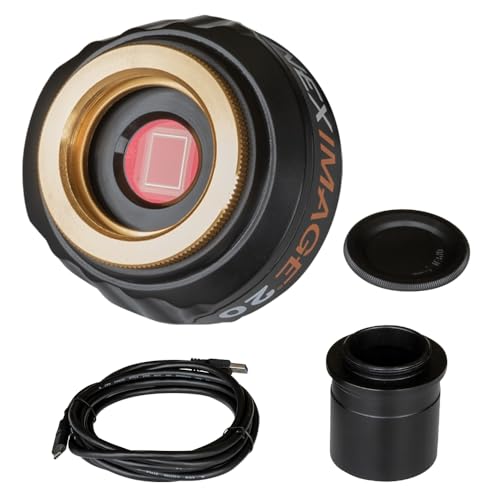
The Celestron NexImage 20 Solar System Imager transforms your telescope into a powerful imaging tool. Its 20 MP back-illuminated CMOS sensor captures sharp, vivid details of the Moon, planets, and other celestial bodies. This camera helps you overcome common astrophotography challenges like low resolution and slow frame rates.
Designed to fit telescopes with 1.25-inch eyepiece holders, it connects easily to Windows PCs via USB-C for fast and stable data transfer. The included iCap software gives you control over exposure, gain, and frame rate, making it simple to fine-tune your shots. The Region of Interest (ROI) feature speeds up frame rates, ideal for capturing fast-moving planetary details.
Maintenance is straightforward since the device lacks complex moving parts. However, careful handling is necessary because the camera is not water-resistant and does not include image stabilization. Its fixed-focal-length lens is optimized specifically for lunar and planetary imaging, ensuring you get precise and high-quality results.
Best for: Enthusiast astrophotographers and beginners who want detailed, high-resolution images of the Moon and planets with easy Windows compatibility.
What We Like:
- High-resolution 20 MP back-illuminated CMOS sensor for sharp, colorful images
- ROI feature increases frame rates for better planetary image stacking
- Supports autoguiding for improved tracking during long exposures
Specification:
| Feature | Details |
|---|---|
| Manufacturer | Celestron |
| Sensor | 20 MP back-illuminated CMOS |
| Pixel Size | 1.4 microns |
| Eyepiece Holder Size | 1.25 inches |
| Connection | USB-C |
| Compatible OS | Windows only |
| Weight | Approx. 0.2 lb (90 g) |
SVBONY SV305C Astrophotography Camera, 2.1MP IMX662 Color Telescope Camera
Discover the ease of capturing stunning celestial images with the SVBONY SV305C astrophotography camera. Designed to simplify your imaging experience, it offers versatile modes that adapt to both high-speed planetary shots and long-exposure deep sky captures. This flexibility helps you achieve clearer, more detailed photos without complex adjustments.
Equipped with a 2.1MP IMX662 sensor, the camera enhances sensitivity for lunar and EAA imaging. You can fine-tune the resolution using the ROI function, which speeds up image capture without losing detail. This feature makes it easier to focus on specific celestial targets and improves overall efficiency.
The SV305C connects via USB 2.0 and fits standard 1.25-inch telescope interfaces. It also supports C/CS-mount lenses, broadening your compatibility options. Maintenance is straightforward, with no removable UV/IR cut filter, so filter changes are limited but the camera stays ready for use with minimal upkeep.
Its support for ISO 100–3200 and JPEG format allows quick image processing, while SharpCap software makes switching between modes simple. Although limited by USB 2.0 speeds and modest resolution, this camera suits those beginning their astrophotography journey with reliable performance.
Best for: Beginners and amateur astrophotographers looking for a user-friendly, adaptable camera to capture planetary, lunar, and EAA images with solid sensitivity.
What We Like:
- Versatile imaging modes with noise reduction for clear captures
- ROI function enables faster frame rates without quality loss
- Compatible with 1.25-inch telescope adapters and C/CS-mount lenses
- Simplified operation through SharpCap software
Specification:
| Feature | Details |
|---|---|
| Manufacturer | SVBONY |
| Sensor | 2.1MP IMX662 color CMOS |
| Interface | USB 2.0 |
| Telescope Compatibility | 1.25-inch interface |
| Lens Mount | C/CS-mount adapters |
| ISO Range | 100–3200 |
| Image Format | JPEG |
SVBONY SV905C Guide Camera Telescope Eyepiece, 1.23MP CMOS Sensor, 1.25Inch
The SVBONY SV905C Guide Camera offers precise autoguiding with its 1.23MP CMOS sensor, designed to track faint stars with ease. Its compact 1.25-inch diameter fits seamlessly into various guide scopes and Off-Axis Guider systems, making setup straightforward for astrophotographers.
This camera features an 80% peak quantum efficiency, enhancing sensitivity to dim light sources while maintaining low read noise for clear imaging. It connects via USB 2.0 and ST4 interfaces, providing compatibility with popular guiding software like PHD2 and NINA.
Maintenance is simple due to its sturdy design and standard CS connector with an adapter ring, allowing easy lens swaps and upgrades. Its lightweight build integrates well into existing setups without adding bulk.
While it excels in autoguiding, the SV905C is not compatible with the ASI AIR system and offers a modest 1.23MP resolution. However, it remains a reliable choice for those prioritizing precision tracking over high-resolution imaging.
Best for: astrophotographers and hobbyists seeking a compact, efficient autoguiding camera for reliable tracking of faint stars during planetary imaging and guiding setups.
What We Like:
- High 1.23MP CMOS sensor with 80% peak quantum efficiency for excellent sensitivity
- Fits various guide lenses and Off-Axis Guiders with 1.25-inch diameter and CS adapter
- Supports major guiding software (PHD2, NINA) through USB 2.0 and ST4 interfaces
Specification:
| Feature | Details |
|---|---|
| Manufacturer | SVBONY |
| Sensor Resolution | 1.23MP CMOS |
| Peak Quantum Efficiency | 80% |
| Diameter | 1.25 inches |
| Interfaces | USB 2.0, ST4 |
| Connector Type | CS mount with adapter ring |
| Weight | Lightweight (exact weight not specified) |
Om System -3 Astro Mirrorless Camera, Silver
The OM System OM-3 Astro Mirrorless Camera is designed for photographers who need reliable low-light and astrophotography performance in a compact form. Its 20.4MP Four Thirds BSI Stacked CMOS sensor delivers vibrant, detailed images with reduced noise, making night sky and dimly lit scenes clearer and more striking.
This camera’s 7.5-stop optical stabilization helps maintain sharpness in handheld shots, reducing blur without extra equipment. Its durable metal body with IP53 weather sealing ensures it withstands outdoor conditions, so you can confidently shoot in challenging environments.
Fast and precise autofocus with 1053 phase-detection points keeps your subject in focus quickly, while 4K video at 60fps enables smooth, high-quality recordings. The versatile Micro Four Thirds mount supports a wide range of lenses, offering creative flexibility.
Maintenance is straightforward due to its robust build, and its design balances portability with durability. However, the native ISO range starting at 200 may limit very low ISO shooting, and the Four Thirds sensor size is smaller than full-frame alternatives. Connectivity features like Bluetooth 4.2 and Wi-Fi 802.11n are functional but not the latest standards.
Best for: Photographers and videographers seeking a compact, durable mirrorless camera optimized for low-light and astrophotography work.
What We Like:
- High-resolution 20.4MP sensor with low noise in dim conditions
- Weather-sealed metal body built for outdoor use
- Fast autofocus with extensive phase-detection points
- Smooth 4K video recording at 60fps
- Versatile Micro Four Thirds lens compatibility
Specification:
| Feature | Details |
|---|---|
| Manufacturer | OM System |
| Sensor | 20.4MP Four Thirds BSI Stacked CMOS |
| Optical Stabilization | 7.5 stops |
| Autofocus Points | 1053 phase-detection |
| Video Resolution | 4K at 60fps |
| Body Material | Metal with IP53 weather sealing |
| Mount Type | Micro Four Thirds |
| Connectivity | Bluetooth 4.2, Wi-Fi 802.11n |
| Color | Silver |
Factors to Consider When Choosing a Beginner Astrophotography Camera
When choosing your first astrophotography camera, focus on sensor type and resolution to capture clear, detailed images. You’ll also want a model that’s easy to use and works well with your existing devices.
Don’t forget to take into account portability, weight, and helpful imaging features that suit your shooting style. These factors can really make a difference when you’re out under the stars.
Sensor Type And Resolution
Choosing the right sensor type and resolution plays a crucial role in capturing stunning images of the night sky. You’ll want a camera with a CMOS sensor, as it offers low noise and high sensitivity, perfect for astrophotography.
Look for sensors with at least 20MP resolution to capture fine celestial details and allow cropping without losing image quality. The sensor size matters too—APS-C and Four Thirds sensors provide a good balance between field of view and light-gathering capability, enhancing overall image quality.
Also, consider back-illuminated sensors because they boost low-light performance by letting more light reach the photodiodes. This means clearer, sharper shots of faint stars and deep-sky objects, giving your astrophotography an impressive edge.
Ease Of Use
Ease of use can make or break your experience with a beginner astrophotography camera. Look for a user-friendly interface with simple controls and an intuitive setup to get started quickly.
Features like automatic focusing, auto-tracking, and built-in image processing let you capture stunning images without needing deep technical skills. Lightweight, portable designs with quick assembly and minimal calibration help you spend more time shooting and less time fiddling with gear.
Pre-configured modes and guided tutorials are invaluable, guiding you step-by-step to master the basics efficiently. While many cameras connect to smartphones or tablets via dedicated apps for remote control and live viewing, we’ll cover device compatibility in detail later.
For now, prioritize ease of use to keep your astrophotography journey enjoyable and frustration-free.
Compatibility With Devices
Since your astrophotography camera needs to work seamlessly with your existing devices, checking compatibility is essential before making a purchase. First, verify the camera supports your operating systems, whether it’s Windows, macOS, Android, or Linux.
Next, confirm the connection types it requires—USB-C, USB 2.0, or HDMI—and ensure your devices have matching ports. You don’t want to get stuck needing adapters or extra accessories that complicate setup.
Also, make sure the camera can interface with the astrophotography software or apps you plan to use. This compatibility guarantees smooth file transfers and easy control during your night sky sessions.
Taking these steps will save you frustration and help you focus on capturing stunning celestial images right away.
Portability And Weight
A lightweight and portable astrophotography camera makes a huge difference when you’re setting up under the night sky. Cameras weighing less than 4 pounds ease your load, letting you carry and set up quickly without fatigue.
Their compact size fits neatly in your backpack, perfect for spontaneous trips or travel-based sessions. You’ll appreciate how reduced weight simplifies mounting and handling, especially when you’re still learning to align and stabilize your gear.
Heavier cameras often demand sturdier mounts and extra support, complicating setup and slowing you down. For beginners, choosing a portable, lightweight camera means less hassle and more time capturing stunning celestial images.
Prioritizing portability guarantees your astrophotography adventures remain enjoyable and manageable, wherever the night takes you.
Imaging Features And Modes
When selecting your first astrophotography camera, you’ll want to focus on imaging features and modes that match your interests and skill level. Beginner cameras often offer multiple modes like planetary, lunar, deep-sky, and wide-field photography, letting you explore different celestial targets.
Look for high-resolution sensors—20+ megapixels or 4K video—that capture fine details. Auto-focus and auto GOTO features simplify tracking moving objects, while built-in processing modes enhance images automatically.
Adjustable exposure settings let you manually control exposure time and gain, helping you optimize shots in varying light conditions. Some models also include AI-powered noise reduction and automatic image stacking, which improve clarity and detail without extra effort.
These features make your astrophotography journey smoother and more rewarding. So, take your time picking a camera that feels right for you!
Frequently Asked Questions
What Is the Best Time of Night for Astrophotography?
The best time for astrophotography is during the darkest hours, typically between midnight and 4 a.m. That’s when the sky is usually at its clearest and darkest.
You’ll want the moon to be minimal or completely absent too. This gives you the best chance to capture stunning stars and galaxies without extra light getting in the way.
How Do I Reduce Noise in My Astrophotography Images?
Think of noise like static in a radio signal. You’re capturing faint stars, so use low ISO, longer exposures, and stack multiple shots.
You’ll clear that static, revealing the cosmos’ true melody in your photos. It’s like tuning your radio just right to catch the best signal.
Can I Use My Smartphone for Astrophotography?
Yes, you can use your smartphone for astrophotography, especially with apps that enable manual settings. Just keep your phone steady with a tripod, use long exposures, and be patient to capture clearer night sky images.
It’s pretty amazing what modern phones can do these days. With a little practice and the right tools, you’ll be surprised at the shots you can get!
What Accessories Improve Astrophotography Results?
Think of accessories as a spaceship’s crew—tripods steady your journey, remote shutters avoid shaky turbulence, and star trackers guide you through the cosmic sea.
With these allies, you’ll capture clearer, sharper, breathtaking starry skies.
How Do Weather Conditions Affect Astrophotography?
Weather conditions greatly affect your astrophotography by impacting visibility and clarity. Clouds, humidity, and light pollution blur stars.
On the other hand, clear, dry nights with minimal wind help you capture sharp, detailed images of the night sky. So, if you want the best shots, keep an eye on the weather!
Conclusion
Choosing your first astrophotography camera is like catching a shooting star—exciting and full of potential. Whether you opt for a smart telescope with app control or a classic DSLR, the right gear will open the universe right at your fingertips.
Remember to take into account ease of use, sensor quality, and compatibility with your setup. These factors make all the difference when you’re just starting out.
With the right camera in hand, you’ll be capturing the cosmos’ beauty in no time. From crisp star fields to glowing nebulae, beginner astrophotography cameras can help you reveal the night sky’s wonders with ease.
So, whether you’re a total newbie or upgrading your gear, choosing one of the best beginner astrophotography cameras for 2027 will set you on the path to stunning space shots. Happy stargazing!