How to Measure Pistol Barrel Length in 7 Easy Steps
Start by confirming your pistol is unloaded and set it on a stable, well-lit surface. This step is crucial for safety before you begin measuring your pistol barrel length accurately.
Locate the breech face at the back of the chamber as your starting point. Then, use a ruler or calipers, aligning it straight and flush with that breech face. Carefully measure from there all the way to the muzzle end.
Take several measurements to ensure accuracy, then average your results for the most precise barrel length. Recording this exact measurement will help guarantee a proper holster fit and optimal performance.
Keep going, and you’ll discover how to perfect this process even further!
Key Takeaways
- Ensure the firearm is unloaded and stable on a flat surface before measuring. Safety first, right?
- Use a ruler or calipers to measure from the breech face to the muzzle end. Make sure your tool is accurate for the best results.
- Align the measuring tool parallel to the barrel and flush with the breech face for accuracy. This helps avoid any misleading measurements.
- Take multiple measurements, record each, and average them for a precise barrel length. It’s always good to double-check.
- Standardize the final measurement in inches and document it for holster fitting and customization. That way, you’ll have the exact number when you need it!
Prepare Your Firearm and Workspace for Measuring
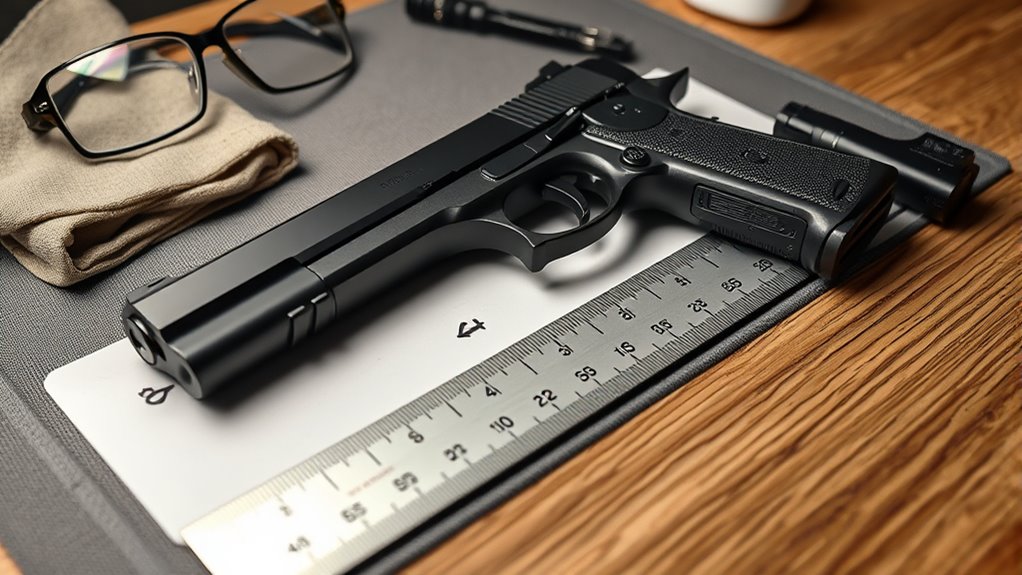
Before you begin measuring your pistol barrel, make certain the firearm is unloaded and the chamber is clear to guarantee safety.
To accurately measure barrel length, set up on a stable, flat surface with good lighting. This will help you avoid mistakes during barrel length measurement.
Make sure to remove any accessories like lights or lasers that might interfere with accessing the firearm’s barrel.
Use precise tools such as a ruler, tape measure, or calipers to get an exact reading.
When measuring, focus on the length of a firearm’s barrel from the chamber to the end of the barrel.
Proper preparation not only ensures safety but also affects the accuracy of your measurement, which plays a key role in your weapon’s performance and understanding various barrel lengths.
Find the Right Starting Point for Barrel Length
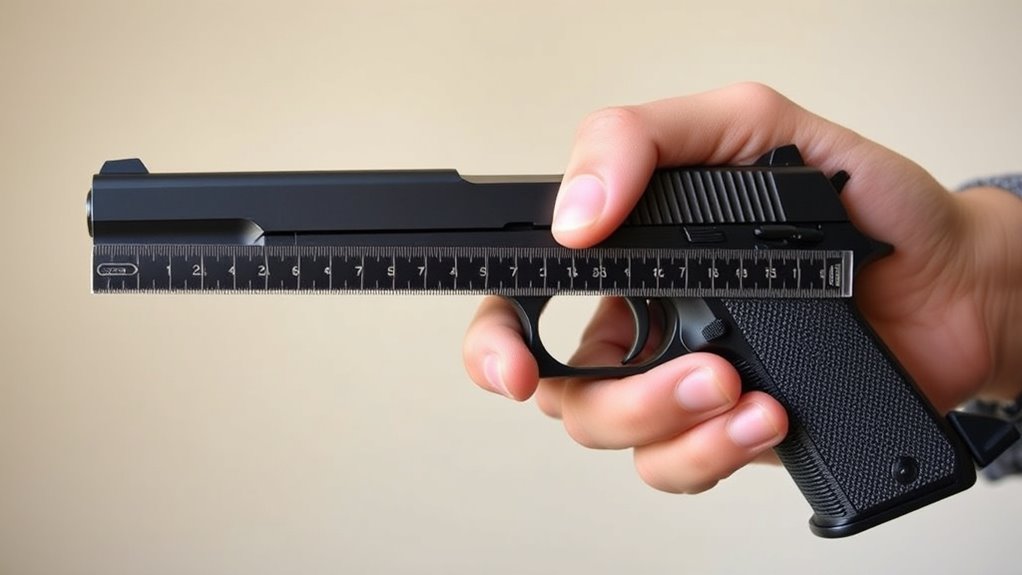
To get an accurate measurement, start at the right point—the back edge of the ejection port where the barrel begins.
You’ll want to clearly identify this spot before placing your ruler or tape measure.
Focusing here guarantees your barrel length is measured correctly every time.
Identifying Barrel Starting Point
When measuring your pistol’s barrel length, you’ll need to start at the correct point to guarantee accuracy. Begin by locating the breech face, which is the rear of the chamber where the cartridge sits. This spot serves as a consistent reference for your measurement.
Before you start, make sure your firearm is unloaded and secure. Use a caliper or ruler to place firmly against the breech face, confirming the measurement starts exactly where the barrel begins to extend beyond it. This assures your barrel length is precise and standardized.
Avoid guessing or measuring from other parts. The breech face provides the most reliable starting point for consistent results every time. It’s a simple step that makes a big difference in accuracy!
Recognizing Ejection Port Edge
Although the breech face is a common reference, you’ll find that the ejection port edge offers a clear and consistent starting point for measuring your pistol’s barrel length.
To begin, locate the rear edge of the ejection port on your firearm’s slide. This edge serves as a visible and reliable marker from which you can measure.
Make sure your gun is unloaded and resting on a stable surface with the barrel aligned straight. Then, measure from the back of the ejection port to the muzzle’s end.
Using the ejection port edge standardizes barrel length measurements across different pistol models, reducing confusion.
Align Your Measuring Tool Along the Barrel Length
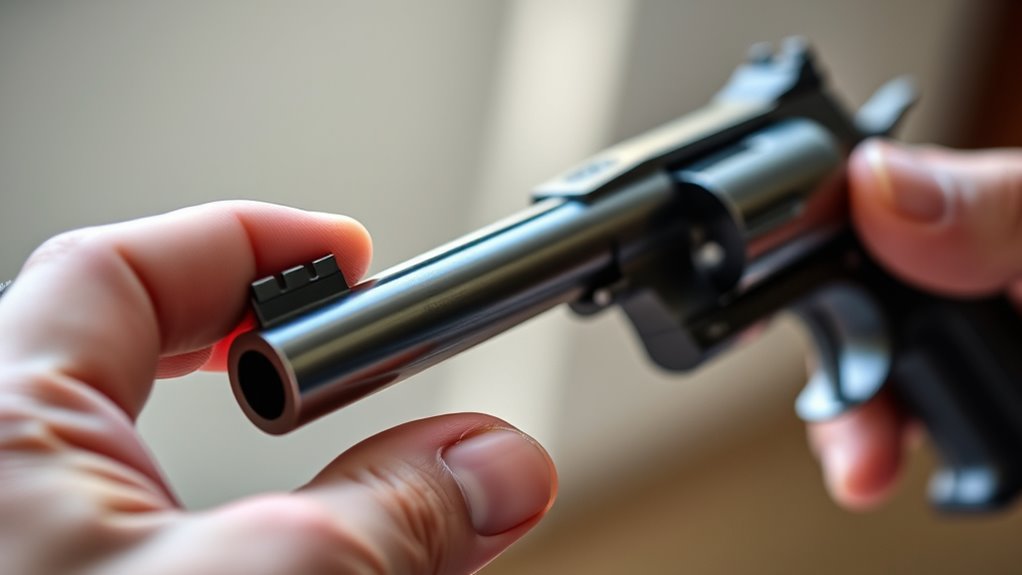
Since accurate measurement hinges on proper alignment, you’ll want to make certain your measuring tool runs straight along the barrel’s centerline. Begin by placing the start of your ruler or tape measure flush with the back of the barrel’s breech face.
Keep the tool parallel to the barrel to avoid skewed or inaccurate readings. Make sure the measuring device consistently touches the barrel at the same point along its length throughout the process.
Avoid angling or tilting the ruler, as this will give you an incorrect length of the barrel. By maintaining a straight, consistent alignment, you guarantee your measurement reflects the true length of the barrel.
This way, you set yourself up to get precise and reliable results every time.
Measure From the Breech Face to the Muzzle Carefully
To get an accurate measurement, you’ll want to measure from the breech face—the part of the slide where the cartridge sits—straight to the muzzle’s end. Make sure your pistol is unloaded and stable.
Use a ruler, tape measure, or calipers, keeping them parallel to the barrel to avoid skewed results. The measuring tool should touch the muzzle precisely for an exact length.
Record your measurement to the nearest millimeter or 1/16 inch, which is essential for proper holster or accessory fit.
| Step | Action | Tip |
|---|---|---|
| 1 | Unload the firearm | Prioritize safety |
| 2 | Align tool with breech face | Keep tool parallel |
| 3 | Extend to muzzle end | Ensure contact at barrel tip |
| 4 | Take measurement | Use precise units |
| 5 | Record result | Note for accessory fitting |
Repeat Measurements for Accuracy and Consistency
You’ll want to take multiple measurements from the same points to guarantee your results are consistent. Make sure your measuring tool is properly aligned with the barrel each time.
Recording each measurement separately helps you spot any variations and confirm accuracy. This way, you can be confident your data is reliable.
Multiple Measurement Attempts
How often should you measure your pistol barrel to guarantee accuracy? You should make multiple measurement attempts from different points along the barrel. Doing this helps you spot any inconsistent readings caused by misalignment or user error.
By repeating the measurement process several times, you increase your confidence in the final barrel length. When your measurements are consistent across attempts, it shows you’re using the right technique. If you find discrepancies, it’s a sign to carefully realign your measuring tool.
Always record each measurement so you can compare and average the results for a more precise and reliable length. Sticking to the same measuring tool and method each time reduces variables that might skew your results. Multiple measurement attempts are key to accuracy.
Consistent Tool Alignment
After making multiple measurement attempts, focus on keeping your measuring tool perfectly aligned with the barrel’s axis. Consistent tool alignment is vital to avoid skewed results and guarantee accuracy.
Keep the firearm steady and maintain the same angle during each measurement to preserve consistency. Use a fixed reference point, like the back of the ejection port, for all measurements so you can compare them accurately.
Before recording, always confirm your tool’s position to assure precise, repeatable results. Taking measurements from slightly different angles and averaging them also helps account for any minor misalignments.
Calculate the Average Barrel Length From Your Readings
Since multiple measurements can vary slightly, calculating the average barrel length guarantees you get an accurate representation of your pistol’s dimensions. Start by taking several barrel length readings from different points, like the muzzle and breech face.
Taking multiple barrel length measurements ensures a precise and accurate representation of your pistol’s size.
Make sure your measuring tool stays steady to avoid errors. Record each measurement carefully and double-check that all readings use the same unit, such as inches.
Next, add all the barrel length measurements together and divide the total by the number of readings you took. Use a calculator or do the division manually to find a precise average.
This method helps you confidently determine the true barrel length, ensuring your measurements reflect your pistol’s actual size accurately. It’s a simple step that really pays off in accuracy.
Record Your Barrel Length for Holster Fit
When you record your barrel length for holster fit, accuracy is key to ensuring your pistol sits securely and comfortably. First, make sure your firearm is unloaded and pointed safely.
Use a ruler or tape measure to find the distance from the back of the ejection port to the end of the barrel. Keep your measuring tool aligned straight along the barrel’s axis to avoid errors.
Record the barrel length in inches, as holster specifications typically use the Imperial standard. To guarantee precision, take several measurements and average them.
This careful approach helps you choose or customize a holster that fits perfectly, providing both safety and convenience when carrying your pistol. Precise barrel length recording is essential for ideal holster performance.
Frequently Asked Questions
How to Determine Barrel Length on a Pistol?
You determine barrel length by measuring from the rear of the chamber to the muzzle’s end. Use a ruler aligned along the barrel’s top, keep the gun stable, and record the measurement in inches for accuracy.
How to Calculate Barrel Length?
Think of measuring barrel length like tracing a pencil’s lead to its tip. You calculate it by measuring straight from the breech face or ejection port’s rear to the barrel’s muzzle end, keeping your ruler aligned perfectly.
What Is the 26 Inch Rule?
The 26-inch rule means if your firearm’s barrel is under 26 inches, it’s legally classified as a short-barreled rifle or shotgun, requiring special permits. You need to measure carefully to avoid legal trouble.
How Is Pistol Length Measured?
Measuring pistol length is like drawing a straight line from the back of the slide to the barrel’s end. You’ll keep the gun safe, use a ruler, and align it precisely for an accurate, reliable measurement every time.
Conclusion
Measuring your pistol barrel length is as straightforward as following a recipe. By preparing your workspace, aligning your tool carefully, and double-checking your measurements, you’ll get an accurate reading every time.
Taking the time to measure correctly guarantees your holster fits perfectly, keeping your firearm secure and ready. Trust the process, and soon measuring your barrel will feel like second nature—easy, precise, and reliable.
Remember, accurate barrel length measurement is key for both safety and functionality. Whether you’re customizing your firearm or just making sure everything fits right, these simple steps make the job hassle-free. Stick with the method, and you’ll master measuring your pistol barrel length quickly and confidently.