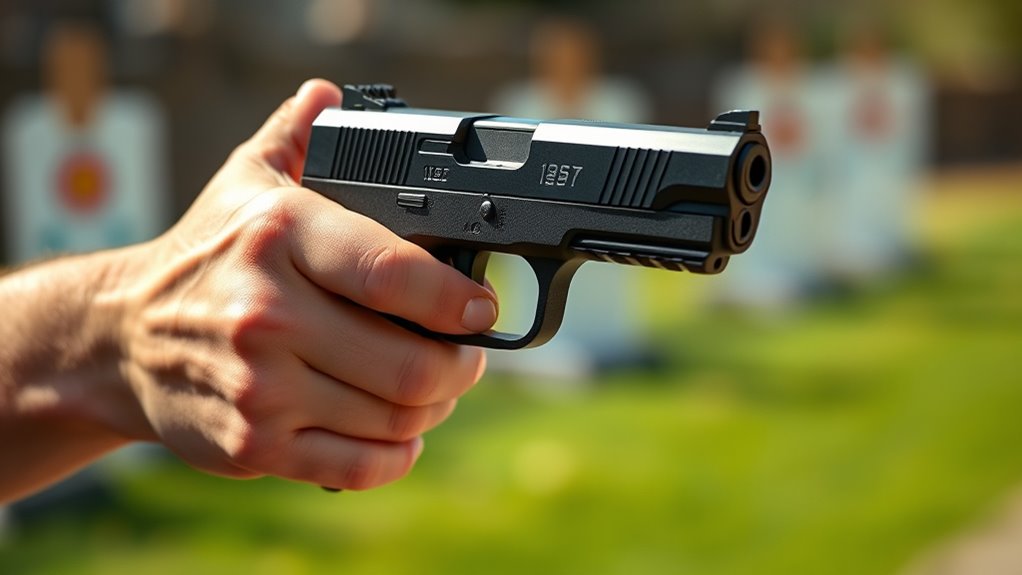
How to Aim a Pistol in 10 Essential Steps
To aim a pistol effectively, start by getting a firm, high grip. This helps control recoil and keeps your shots stable.
It’s important to identify and use your dominant eye while keeping both eyes open for better awareness.
Next, bring the pistol up to eye level and align the front and rear sights precisely. Take your time with this step—it’s key for accuracy.
When you’re ready, press the trigger smoothly without jerking to avoid throwing off your aim.
Managing recoil is crucial for quick follow-up shots.
Always verify your sight alignment before every shot.
Practicing dry firing regularly helps build consistency and boosts your confidence.
Keep at it, and you’ll sharpen your pistol aiming technique even further!
Key Takeaways
– Grip the pistol high with a firm, stable hold to control recoil and maintain consistent sight alignment.
This helps you keep the pistol steady and ready for the next shot.
– Identify and use your dominant eye for precise aiming with both eyes open to enhance peripheral awareness.
It might feel tricky at first, but keeping both eyes open really helps you stay aware of your surroundings.
– Align the front sight centered and level within the rear sight, focusing sharply on the front sight post.
Don’t get distracted by the target just yet—your main focus should be on that front sight.
– Apply steady, straight-back pressure on the trigger pad, smoothly breaking the shot without jerking or twisting.
A smooth trigger pull makes all the difference in accuracy, so take your time with this step.
– Practice dry firing regularly to build muscle memory, reinforce sight alignment, and improve trigger control consistency.
Dry firing might sound boring, but it’s one of the best ways to get better without using live ammo.
Get a High, Firm Grip for Better Control

How do you guarantee better control when aiming a pistol? For new shooters, the key is to get a high, firm grip. Grip the pistol high into the beaver tail or tang area to maximize leverage and control.
Place your fingers firmly in the grooves of your dominant hand to add stability. Whether you’re shooting a single action or any other type, maintaining a firm but relaxed grip prevents limp wristing, which can affect the gun’s cycling and accuracy.
Consistently gripping the pistol the same way each time helps you build muscle memory, making your shots more reliable. A high, secure grip also helps manage recoil effectively, keeping the sights aligned and improving your overall aim.
Identify and Use Your Dominant Eye to Improve Aim

Start by figuring out which eye is dominant using simple tests like the triangle method. Once you know, always aim using that eye while keeping both eyes open for better awareness.
Practicing this will help you improve your accuracy and consistency. It might feel a bit strange at first, but stick with it—you’ll notice the difference!
Determine Dominant Eye
Why does knowing your dominant eye matter when aiming a pistol? Your dominant eye provides your strongest visual input, so aligning your pistol’s sights with it improves accuracy.
To determine your dominant eye, form a small triangle with your hands around a distant object and focus on it with both eyes open. Then, close one eye at a time.
The eye that keeps the object centered in the triangle when you remove your hands is your dominant eye. Knowing this lets you adjust your pistol grip and sight alignment accordingly, ensuring your aim matches your natural visual preference.
Consistently using your dominant eye reduces parallax error and enhances shot consistency at different distances. This makes your shooting more precise and reliable.
Practice With Both Eyes
Now that you know which eye is dominant, you can enhance your aiming skills by practicing with both eyes open. Using both eyes helps you keep your peripheral awareness and boosts your overall situational perception. This is super important for accurate shooting.
Try to focus on the front sight with your dominant eye. At the same time, keep your non-dominant eye relaxed so it doesn’t get strained. This kind of binocular coordination helps stabilize your aim and cuts down on parallax error, which happens when you close one eye.
| Step | Purpose |
|---|---|
| Identify dominant eye | Use the “distant object test” |
| Keep both eyes open | Maintain peripheral vision |
| Focus front sight | Enhance aiming precision |
| Relax non-dominant eye | Prevent eye strain and fatigue |
Keep Both Eyes Open to Stay Aware While Aiming

Keep both eyes open when aiming to take advantage of your binocular vision, which improves depth perception and situational awareness. Focus with your dominant eye on the front sight while your other eye monitors the surroundings.
This technique reduces eye strain and helps you spot movement or potential threats quickly. It’s a simple trick that can make a big difference in staying alert and ready.
Benefits Of Binocular Vision
Several key advantages come from aiming with both eyes open, especially when handling a pistol. This technique enhances your overall shooting experience by engaging your natural binocular vision.
Here’s why you should keep both eyes open:
- Improved Depth Perception: Binocular vision helps you judge distances more accurately, which is essential for precise aiming and shot placement.
- Better Peripheral Awareness: With both eyes open, you stay alert to your surroundings, increasing safety and situational awareness during shooting.
- Reduced Eye Strain: Keeping both eyes open minimizes fatigue, allowing you to maintain focus and stability for longer periods.
Identifying Your Dominant Eye
Understanding how to identify your dominant eye plays a significant role in taking full advantage of aiming with both eyes open. To find your dominant eye, form a small triangle with your hands around a distant object and focus on it. Close one eye at a time; the eye that keeps the object centered is your dominant one.
Your dominant eye naturally aligns with your hand and pistol, guiding your aim more accurately than the other. Keeping both eyes open while aiming enhances situational awareness and reduces tunnel vision, helping you track targets better.
Bring the Pistol to Eye Level for a Clear Sight Picture
When you bring the pistol up, align the sights smoothly with your dominant eye at eye level to create a natural and stable aiming position. This helps you maintain consistency and clarity in your sight picture.
To do this effectively, keep your elbows slightly bent to hold the pistol comfortably at eye level without dropping your head or tilting the muzzle.
Keep your elbows gently bent to hold the pistol steady at eye level without tilting your head or muzzle.
Maintain a consistent stance and grip to guarantee the pistol stays steady and aligned with your line of sight.
Position the pistol so the sights are level with your eye. Avoid any tilt that could distort your aim.
Align Front and Rear Sights for Accurate Aiming
To aim accurately, you need to line up the front sight post within the rear sight’s valley so their tops are level. Make sure the front post is centered between the two sides of the rear sight, creating a consistent sight picture.
Keep equal space on either side of the front post, ensuring the sights are flush and centered on your target. Always check the alignment visually before each shot to confirm the front post is properly centered and level within the rear sight.
| Sight Element | Alignment Detail |
|---|---|
| Front Sight Post | Level with rear sight top |
| Rear Sight Valley | Center front sight post |
| Space on Sides | Equal light on both sides |
| Visual Check | Confirm centered and level |
Focus on the Front Sight to Sharpen Your Aim
After lining up your sights correctly, sharpen your focus on the front sight post. This is key to improving your aim.
Keep the front sight sharp and clear while letting the rear sight blur slightly. Don’t focus on the target; your eyes must lock on the front sight for consistent precision.
Here’s how to sustain that focus:
- Align the top of the front sight evenly within the rear sight notch or aperture.
- Keep the front sight flush with the top of the rear sight to ensure proper sight alignment.
- Always verify the front sight is centered in the rear sight before taking your shot.
Press the Trigger Smoothly to Avoid Jerking Shots
To press the trigger smoothly, start by defeating the slack until you reach the trigger’s wall. Use the pad of your finger to apply steady, straight-back pressure without twisting.
This approach helps you avoid jerking the pistol and keeps your shots accurate. Just take it slow and steady—it really makes a difference.
Defeat Trigger Slack
How exactly do you defeat trigger slack and keep your shots smooth?
First, you need to gradually increase pressure on the trigger until you reach the trigger wall without disturbing your sight picture. This steady buildup prevents jerking and keeps your aim true.
To master this, focus on:
- Identifying the trigger wall by feeling the point where the trigger resists further movement.
- Applying consistent pressure beyond the slack to break the shot cleanly.
- Resetting the trigger smoothly after each shot to maintain control and prepare for the next.
Use Pad Of Finger
Although it might seem natural to use the tip of your finger, pressing the trigger with the pad of your index finger gives you the best control and helps prevent jerking shots. The pad provides a larger, more stable surface, allowing you to apply steady pressure without sudden movements that throw off your aim.
Focus on gradually increasing pressure until you feel the trigger “break” or reach the wall. This smooth, controlled press ensures consistent shot placement.
Avoid pressing from the side or using the tip, as these can cause uneven pressure and missed shots. To build muscle memory and improve accuracy, practice dry firing regularly.
This helps you develop a feel for the trigger’s wall and maintain smooth, deliberate trigger control every time you shoot.
Press Straight Back
Why does pressing the trigger straight back matter? It prevents side-to-side movement, helping your shot stay true to the target. Jerking or slapping the trigger causes your aim to drift, so pressing smoothly is key.
Here’s how to do it right:
- Apply steady pressure with the pad of your finger, keeping the pull aligned with the barrel.
- Defeat the slack at the trigger wall first, then increase pressure gradually until the trigger breaks smoothly.
- After firing, release just enough to feel the reset, preparing for a clean, straight-back press on the next shot.
Focus on a slow, consistent squeeze rather than rushing. This technique keeps your shots accurate and avoids flinching. It really helps improve your overall aim.
Manage Recoil for Faster, More Accurate Follow-Up Shots
When you drive the pistol straight back on target during recoil, you keep your sight alignment intact for quicker follow-up shots. To control recoil effectively, use a firm, high grip and avoid limp wristing. Limp wristing can cause malfunctions and throw off your aim.
Slightly bend your elbows and stay square to the target to absorb recoil smoothly. Focus on maintaining a consistent, smooth trigger press so you don’t disrupt your sight picture as the pistol recoils.
Practice dry firing and recoil management drills regularly to build muscle memory. This helps you drive the gun back on target and recover quickly. Managing recoil this way guarantees faster, more accurate follow-up shots, improving your overall shooting performance.
Verify Sight Alignment Before Every Shot
Controlling recoil sets you up for the next shot, but you still need to make certain your sight alignment is correct each time before you pull the trigger. Proper alignment ensures your shot hits the target where you intend.
Mastering recoil control is vital, but perfect sight alignment guarantees your shot lands exactly where you aim.
Always check that the front post is perfectly centered in the rear sight aperture and flush with the top. Here’s what to focus on before every shot:
- Verify the front post is directly over the rear sight’s center and level.
- Ensure the sights haven’t shifted from movement or handling.
- Confirm the sight picture shows the front post correctly positioned in the rear sight valley.
Practice Dry Firing to Build Consistent Aiming Skills
Although you won’t be firing live rounds, practicing dry firing helps you build consistent aiming skills by reinforcing proper trigger control and sight alignment. Focus on pressing the trigger smoothly and straight back to the wall, avoiding any movement of the sights.
Use a snap cap or an unloaded pistol to safely simulate live firing. Reset the trigger after each dry fire to improve timing and consistency.
Analyze your sight picture and technique to spot and correct errors. This practice sharpens muscle memory and boosts confidence.
| Focus | Control | Confidence |
|---|---|---|
| Sight alignment | Trigger press | Steady hands |
| Muscle memory | Smooth motion | Clear sight |
| Timing | Consistency | Trust yourself |
Frequently Asked Questions
What Type of Ammunition Is Best for Target Practice?
You’ll want to use full metal jacket (FMJ) ammunition for target practice since it’s affordable, reliable, and reduces barrel fouling. It’s perfect for consistent shooting without damaging your pistol or increasing costs unnecessarily.
How Often Should I Clean My Pistol for Optimal Performance?
You should clean your pistol after every shooting session or at least every 300-500 rounds to guarantee peak performance. Regular cleaning prevents residue buildup and maintains reliability, accuracy, and safety each time you use it.
What Safety Gear Should I Wear While Shooting?
You should wear protective glasses to shield your eyes and hearing protection like earplugs or earmuffs to protect your ears. Also, consider wearing close-fitting clothes to avoid snagging and sturdy shoes for stable footing.
How Do I Choose the Right Pistol for Beginners?
Wondering which pistol fits you best? You’ll want something lightweight, with manageable recoil and simple controls. Try handling a few models, and pick one that feels comfortable and reliable to build your confidence right from the start.
Can Environmental Conditions Affect Pistol Accuracy?
Yes, environmental conditions like wind, rain, and lighting can affect your pistol’s accuracy. You’ll need to adjust your aim and stance accordingly to maintain precision in different weather and visibility situations.
Conclusion
Mastering pistol aim isn’t just about hitting a target—it’s about discipline and focus, like a dancer moving with precision. With a firm grip, clear sight, and smooth trigger press, you transform your shots from chance to skill.
Keep practicing, especially dry firing, to build that steady confidence. It’s all about consistency and muscle memory. Remember, every shot is a step closer to perfection.
So, don’t just aim—own your shot and make every bullet count. With dedication and the right technique, you’ll improve your pistol aim and become a more accurate shooter. Keep at it, and watch your skills sharpen with every trigger pull.