What Is an AR Pistol?
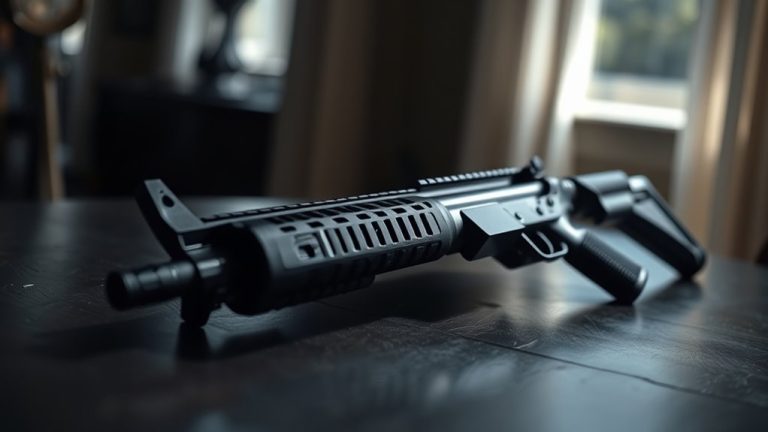
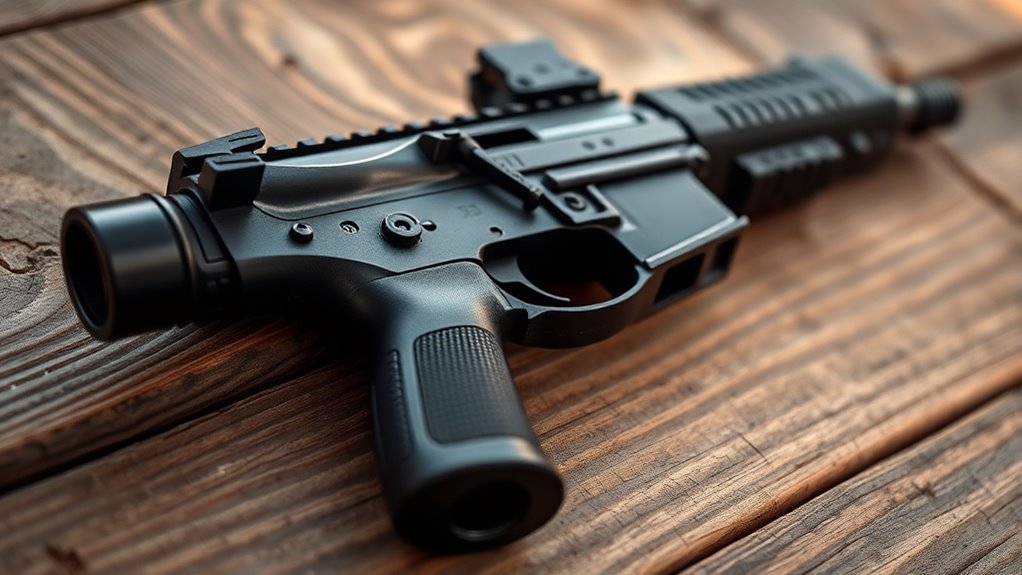
An AR pistol looks a lot like an AR-15 rifle but has a barrel shorter than 16 inches and uses a stabilizing brace instead of a rifle stock. This design keeps it legally classified as a pistol, which is a key difference from traditional rifles.
The shorter barrel makes the AR pistol more compact and easier to handle. However, it can affect velocity and range, especially in popular calibers like 5.56.
You’ll also find that the stabilizing braces help owners avoid SBR (short-barreled rifle) regulations.
If you want to understand how factors like caliber, suppressors, and legal rules come into play with AR pistols, there’s plenty more to explore.
These elements all impact how the pistol performs and what laws apply to owning and using one.
Key Takeaways
- An AR pistol is a firearm similar to an AR-15 rifle but with a barrel shorter than 16 inches. It uses a pistol brace instead of a traditional rifle stock to maintain pistol classification.
- AR pistols typically have barrel lengths between 7.5 and 11.5 inches. This size strikes a good balance between being compact and maintaining solid performance.
- If you add a rifle stock to an AR pistol, it turns into a short-barreled rifle (SBR). That means you’d need approval from the ATF before making the change.
- Common calibers for AR pistols include 5.56 NATO, .300 Blackout, and 9mm. Each caliber affects how the pistol performs and how well it works with suppressors.
What Makes an AR Pistol Different From an AR-15 Rifle?
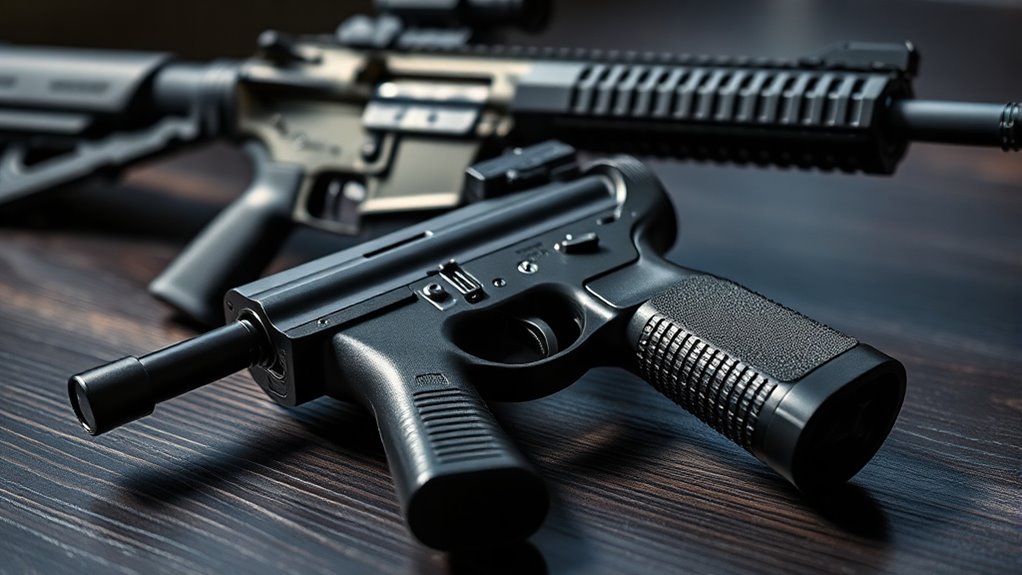
While AR pistols share much in common with AR-15 rifles, their defining feature is a barrel shorter than 16 inches combined with the absence of a rifle stock.
AR pistols are distinguished by barrels under 16 inches and the lack of a rifle stock.
When you handle an AR pistol, you’ll notice it uses a pistol brace or similar stabilizing brace instead of a traditional shoulder stock. This key difference keeps the AR pistol legally classified as a pistol, not a rifle.
You’ll find AR pistols typically have barrel lengths ranging from about 7.5 to 11.5 inches, much shorter than the standard 16 inches or more on AR-15 rifles.
Despite this, they often fire the same cartridges, like 5.56/.223 or .300 Blackout, though the shorter barrel affects velocity.
Why Do AR Pistols Use Braces Instead of Stocks?
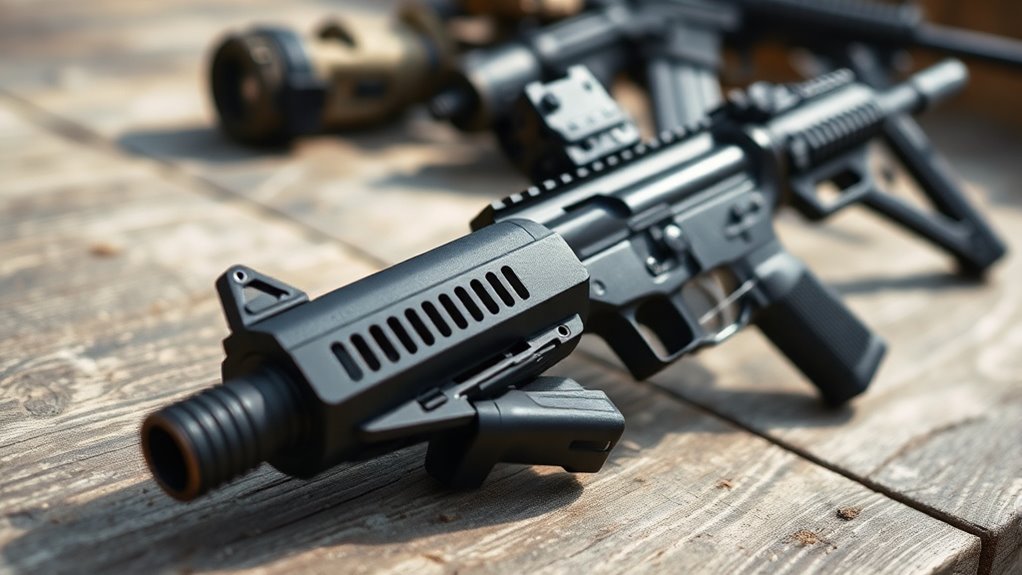
You’ll notice AR pistols use braces instead of stocks to keep their legal classification as pistols, not rifles. This design choice also helps with control, given their short barrels.
At the same time, it avoids complex regulations tied to short-barreled rifles. Understanding these reasons clears up why braces are a key feature in AR pistol setups.
Legal Classification Differences
Because AR pistols have barrels shorter than 16 inches and don’t have a traditional shoulder stock, they’re legally classified as pistols rather than rifles. This classification depends on specific design features, especially using a pistol brace instead of a stock.
Here’s why this matters: AR pistols avoid being classified as rifles by not having a shoulder stock. Using a pistol brace keeps the firearm legal as a pistol under U.S. law.
If you add a traditional stock to a short-barreled AR, it becomes a short-barreled rifle (SBR). That means it requires NFA registration.
And if you want to legally add a stock later, you have to file an ATF Form 1 and get approval before making any changes.
Knowing these legal distinctions helps you stay compliant when selecting or modifying your AR pistol. It’s always better to be safe and follow the rules.
Functional Design Considerations
Although AR pistols share the same AR-15 platform as rifles, they use stabilizing braces instead of traditional shoulder stocks to stay compact and legal. Since AR pistols feature a barrel under 16 inches, adding a rifle stock would classify them as an SBR, requiring NFA registration and an NFA tax.
The Stabilizing Brace is designed to strap to your forearm, improving aim and recoil control without the length of a traditional stock. This design works well with short barrels, often 7.5 to 11.5 inches, where quick, stable handling is essential.
When you handle a pistol with a brace, you get the benefits of a firearm with a barrel optimized for close quarters. It allows for controlled follow-up shots without turning your AR pistol into a rifle under National Firearms rules.
Regulatory Compliance Benefits
The use of stabilizing braces instead of traditional rifle stocks on AR pistols isn’t just about handling and size—it plays a key role in staying within legal boundaries. By choosing braces, you keep your AR pistol classified correctly under National Firearms regulations.
Here’s why this matters: braces keep your AR pistol from being legally reclassified as a short-barreled rifle (SBR), which requires strict National Firearms control. Avoiding an SBR setup means no need to file ATF Form 1 or wait for approval before use.
Starting in 2026, the $200 NFA tax stamp for SBRs is eliminated, but braces help you sidestep NFA restrictions entirely. Plus, braces let you maintain a 7.5–11.5 inch barrel “pistol” build, simplifying compliance with National Firearms laws.
How Barrel Length and Caliber Affect AR Pistol Performance
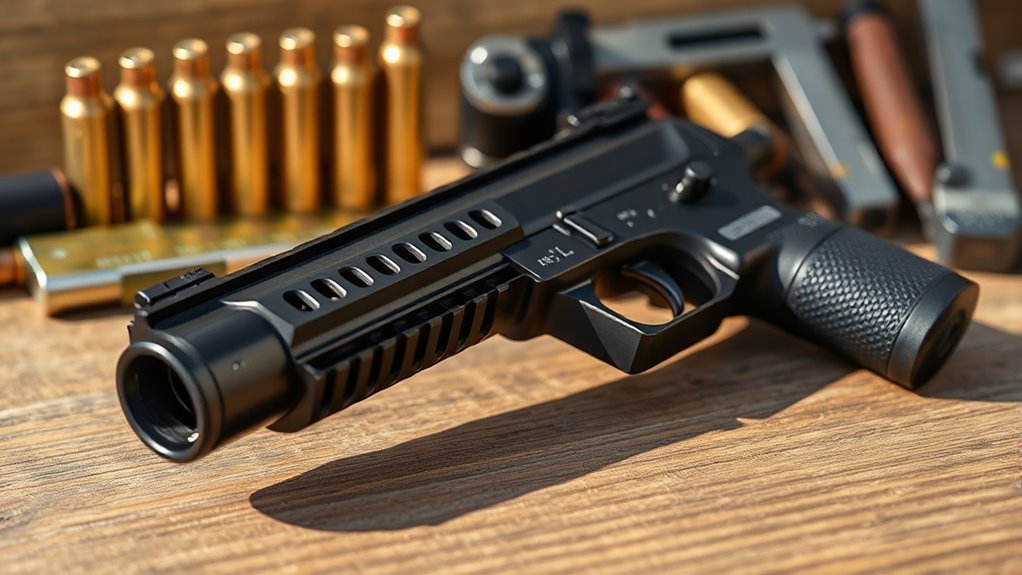
When choosing an AR pistol, you’ll want to balance barrel length with your performance needs—shorter barrels offer compactness but reduce velocity, especially with 5.56/223 calibers.
Picking the right caliber affects not only reliability but also how well your pistol works with suppressors, like .300 Blackout for quieter shots. Understanding these trade-offs helps you tailor your AR pistol to your specific use and preferences.
Barrel Length Trade-Offs
If you want a compact AR pistol, choosing a barrel between 7.5 and 8.5 inches keeps it lightweight and maneuverable. But it does cost you noticeable muzzle velocity—especially with 5.56/.223 calibers. Here’s what to review:
Short barrels (7.5–8.5″) reduce effective range and terminal performance compared to longer barrels. So, you might lose some punch and distance.
A 10.5–11.5″ barrel offers a versatile balance. It improves velocity while staying relatively compact, making it a solid middle ground.
Short barrels paired with calibers like .300 Blackout handle velocity loss better. They also work well with suppressors, which is a nice bonus.
Longer barrels put more distance between the suppressor and your face. This helps enhance sound and flash reduction, making shooting more comfortable.
Choosing barrel length means balancing compactness against performance and suppressor benefits. Think about what fits your needs best.
Caliber Selection Impact
Choosing the right caliber plays a big role in how your AR pistol performs, especially when paired with different barrel lengths. Short barrels (7.5–8.5″) reduce muzzle velocity, impacting 5.56/223 more than .300 Blackout. The .300 Blackout remains reliable even in compact setups.
Mid-length barrels (10.5–11.5″) offer a good balance of velocity and compactness. So, your choice really depends on what you prioritize: flat trajectory and ammo support with 5.56/223, or compactness and cycling reliability with .300 Blackout.
| Caliber | Barrel Length Impact |
|---|---|
| 5.56/223 | Velocity loss in short barrels |
| .300 Blackout | Maintains pressure in short barrels |
| 9mm | Suited for suppressor use |
| 5.56/223 | Best with longer barrels |
| .300 Blackout | Versatile in 7.5–11.5″ barrels |
Suppressor Compatibility Benefits
Since barrel length influences both suppression effectiveness and shooter comfort, you’ll find AR pistols with 7.5 to 11.5-inch barrels are common. Longer barrels (10.5–11.5″) position the suppressor farther from your face, reducing perceived noise.
Caliber choice also matters for suppressor compatibility. Here’s what to evaluate:
- .300 Blackout excels with subsonic 220-grain loads, offering quieter shots and better hearing protection.
- Short barrels (7.5–8.5″) on 5.56 cause velocity loss, impacting suppressed ballistic performance.
- 9mm AR pistols work well with suppressors and use common pistol magazines for convenience.
- Matching the right caliber with barrel length optimizes suppression and reduces back-pressure near you.
Choosing wisely means better performance and a more comfortable shooting experience with your AR pistol.
Choosing Your AR Pistol Caliber: 5.56, .300 Blackout, 9mm, and More
When selecting an AR pistol caliber, you’ll want to examine how each option aligns with your intended use and preferences. The 5.56 NATO stands out for its wide ammo availability and flatter trajectory. It’s ideal if you want a compact rifle with barrels around 7.5 to 11.5 inches.
The .300 Blackout shines if you plan on suppressor use, especially with subsonic 220-grain loads that reduce noise. It’s a solid choice for quieter shooting sessions.
On the other hand, 9mm AR pistols appeal if you prefer common carry ammo and compatibility with Glock or Colt magazines. These often feature shorter barrels near 6.5 to 7.9 inches.
Ultimately, 5.56 suits general-purpose shooting, while .300 Blackout targets suppressed setups. And 9mm offers ammo familiarity and controllability in a compact package. Just choose what fits your shooting style best!
How Suppressors Improve AR Pistols and Which Calibers Work Best
Although AR pistols are known for their compact size and power, adding a suppressor can substantially reduce muzzle blast and gas noise, making them much more comfortable to shoot—especially with shorter barrels around 7.5 to 11.5 inches.
Suppressors place the blast farther from your face on longer barrels, improving sound reduction practically. Here’s what you need to know:
- .300 Blackout excels with subsonic ~220-grain loads, offering quieter, reliable cycling when suppressed.
- 9mm AR pistols work well with common magazines and deliver manageable recoil plus strong suppressed performance.
- 5.56/.223 pistols lose velocity quickly on short barrels, causing more blast even when suppressed—caliber choice matters.
- After 2026, suppressor ownership will be simpler, making compact AR pistol plus suppressor setups more accessible.
AK-Pattern Pistols as Alternatives to AR Pistols
If you’re looking for a compact, pistol-style firearm but want an alternative to the AR platform, AK-pattern pistols offer a compelling option. Often called “ARP guns,” these pistols, like the Century Draco and Micro Draco, pack the powerful 7.62x39mm cartridge in a short-barreled, stockless design similar in purpose to AR pistols.
You’ll appreciate the reliability and proven heritage of the AK platform, especially if you’re familiar with its manual of arms. Compared to AR pistols chambered in 9mm, .300 BLK, or 5.56, AK-pattern pistols deliver different ballistics and ammo options.
They really emphasize the 7.62x39mm’s widespread availability. Choosing between the two mainly comes down to your preferred platform and caliber familiarity. So, AK-pattern pistols make a solid alternative if you want something rugged and compact.
How to Convert an AR Pistol Into a Short-Barreled Rifle (SBR)
Converting your AR pistol into a short-barreled rifle (SBR) requires careful adherence to ATF regulations. You’ll need to start by filing Form 1 through ATF eForms before adding a shoulder stock. Here’s how to do it legally:
First, submit ATF Form 1 (Application to Make and Register a Firearm) online via ATF eForms. Then, wait for ATF approval before making any modifications.
Once you get the green light, attach the shoulder stock to your AR pistol. Usually, these pistols have a barrel length between 7.5 to 11.5 inches.
Keep in mind, since January 1, 2026, the $200 NFA tax stamp is no longer required for qualifying SBRs. So, the process is basically free, aside from filing.
Follow these steps, and your AR pistol will become a registered SBR without any legal headaches.
Where to Find Popular AR Pistols and Accessories in Stock
Finding popular AR pistols and accessories in stock can be a challenge, but knowing where to look makes all the difference. You can find the Panzer Arms ARP9 9mm models with 6.50″ barrels priced between $485.59 and $815.99, depending on finish and receiver.
If you prefer .300 Blackout, check out the Smith & Wesson M&P15 Pistol and Diamondback DB15, priced from $489.00 to $1,320.99. For 5.56/.223 options, the ATI Alpha Maxx AR15 Pistol and Springfield SAINT Victor V2 offer barrels from 7.5″ to 11.5″, priced from $389.99 to $1,389.00.
Accessories for compact 9mm AR pistols may be limited, so always verify current stock. Other notable picks include the Radical RPR AR15 Pistol and CMMG Banshee MK3 Blackout at competitive prices.
Frequently Asked Questions
What Is the Point of an AR Pistol?
You want an AR pistol to get a compact, maneuverable firearm that keeps AR-15 controls and parts. It’s perfect for close-quarters use, easy handling, and offers flexibility with calibers and future upgrades like SBR conversion.
It’s kind of like having the best of both worlds—small size but familiar operation. Plus, you can customize it just like a regular AR-15, which is pretty cool.
ARe AR Pistols Legal to Carry?
You can carry AR pistols, but legality depends on your state and local laws. Some places restrict braces, magazine capacity, or classify them differently.
Always check current regulations before carrying to avoid legal trouble. Better safe than sorry, right?
Why ARe AR Pistols Illegal?
You’d think AR pistols are outlawed everywhere, but they’re illegal because you might unintentionally create a short-barreled rifle or break state laws.
Changing parts or local rules can instantly turn your firearm into forbidden territory.
What Is the Price of an AR Pistol?
You’ll find AR pistols priced anywhere from about $390 for budget models up to nearly $2,500 for premium versions.
Most common options range between $485 and $1,950, depending on caliber, barrel length, and features.
It really just depends on what you’re looking for and how much you want to spend.
Conclusion
When you pick up an AR pistol, you’re holding versatility in the palm of your hand—compact like a sparrow but packing the punch of a hawk. Understanding the differences, from braces to barrel lengths and calibers, helps you tailor your build perfectly.
Whether you want something nimble for close quarters or a platform to suppress, an AR pistol adapts. With the right knowledge, you’ll hit your mark every time, no matter the mission.
Knowing what makes an AR pistol unique—its size, maneuverability, and customization options—lets you choose the best setup for your needs. From personal defense to tactical use, an AR pistol offers flexibility and power in one compact package. Learning the key features ensures you get the most out of your AR pistol every time you take it out.