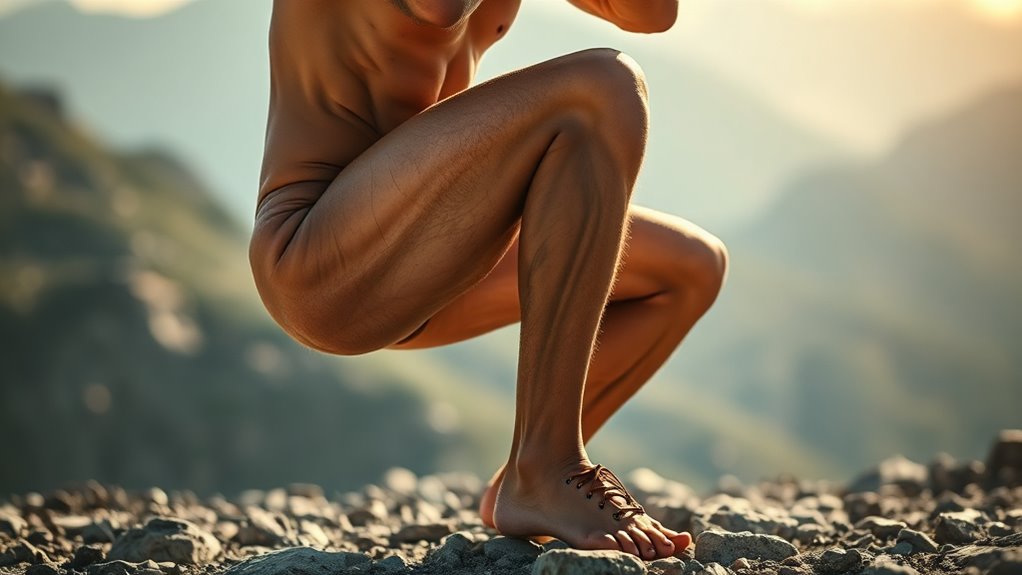
What Muscles Do Pistol Squats Target?
When you do pistol squats, you target several important muscles, making it a fantastic lower-body exercise. Primarily, your quadriceps kick in to control the descent and push you back up.
At the same time, your glutes and hamstrings work hard to stabilize your hip and knee throughout the movement.
Your calves and ankle muscles play a crucial role too. They help keep you balanced by stabilizing your foot and managing those tiny adjustments.
Plus, your core is engaged the whole time to keep your posture upright and prevent any twisting.
Compared to traditional barbell back squats, pistol squats really sharpen your balance and unilateral strength. They offer a unique way to build control and stability, which can be a game-changer for your overall fitness.
Keep reading to see how each muscle gets involved in this challenging move!
Key Takeaways
- Pistol squats primarily target the quadriceps. These muscles are especially important for controlling the descent and pushing back up during the movement.
- The glutes and hamstrings play a big role too. They stabilize the hip and help drive hip extension to lift the body from the deep squat.
- Your calves and ankle stabilizers are working hard as well. They manage balance by controlling ankle movement and preventing inward or lateral collapse.
- Don’t forget about the core muscles. Deep abdominals and obliques stabilize the pelvis and torso, helping you maintain balance during the single-leg squat.
- Since it’s a unilateral movement, it challenges knee and hip stabilizers independently. This helps improve strength, balance, and proprioception in each leg.
Which Leg Muscles Do Pistol Squats Target?
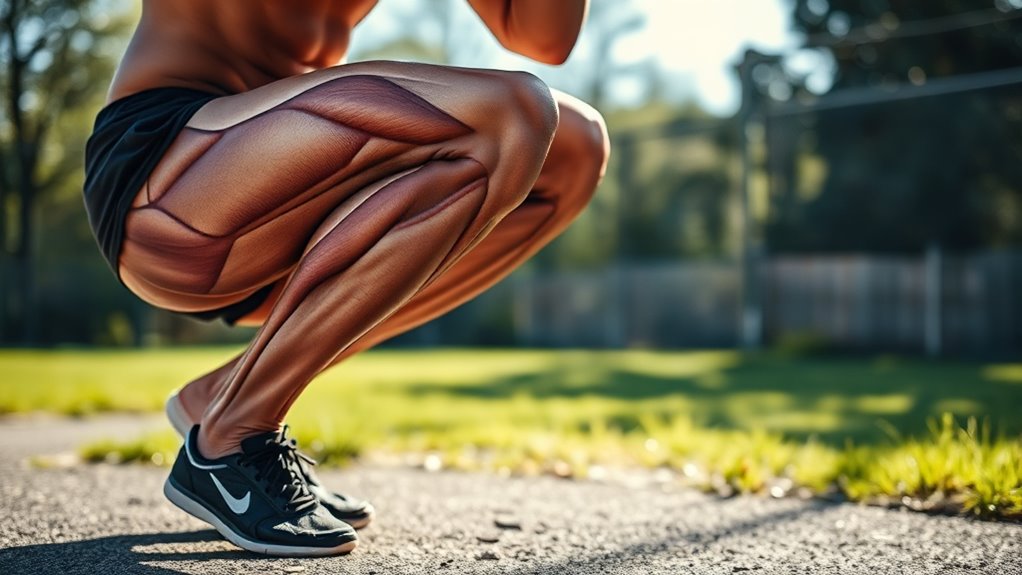
When you perform pistol squats, your quadriceps—especially the rectus femoris and vastus group—work hard to control the single-leg descent and push you back up from a deep knee bend. This intense focus on your lower body doesn’t stop there.
Because you’re balancing on one leg, your calves and ankle stabilizers engage to keep your joints aligned. Muscles like the gastrocnemius, soleus, and peroneals get activated to help with that stability.
While your upper body stays upright, it also contributes by maintaining balance and posture. That’s what makes pistol squats a true whole-body exercise.
Your core and thigh stabilizers, including the adductors, coordinate to keep your knee tracking properly. So, every rep challenges your balance and strength at the same time.
This combination makes pistol squats incredibly effective for building lower body control and stability.
How Pistol Squats Activate Your Glutes and Hamstrings
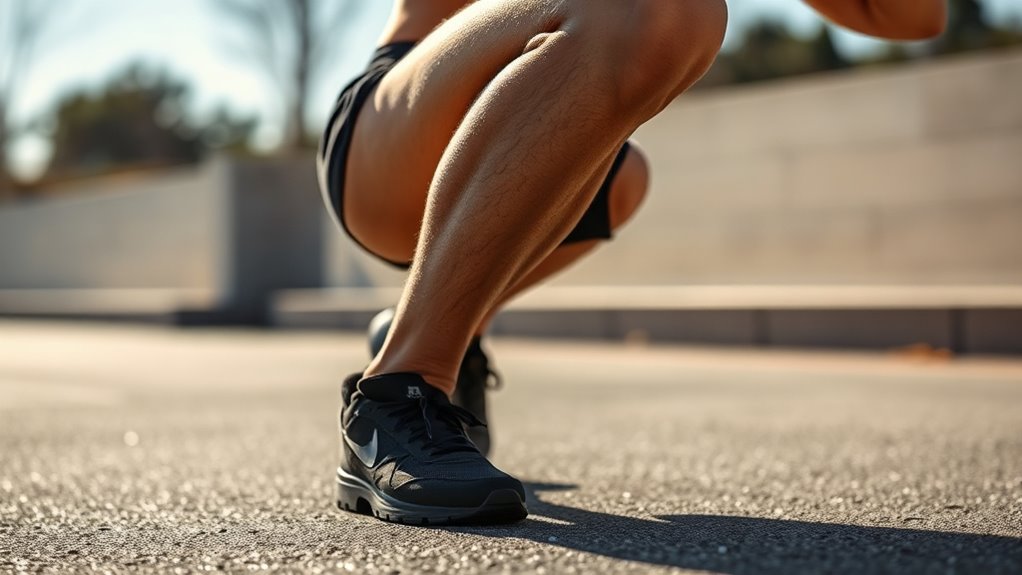
When you perform pistol squats, your glutes drive hip extension to lift you back up, while your hamstrings control the descent by stabilizing your knee. This movement challenges your posterior chain through a deep range of motion.
It’s a great way to build strength and coordination. Plus, adding weight increases this demand, making your glutes and hamstrings work even harder.
Glute Activation Mechanics
Because you drive through a deep hip hinge during the bottom position of a pistol squat, your gluteus maximus powers the movement as you stand up on one leg. Make sure to engage this muscle fully to generate the hip extension needed for the ascent.
Your glute medius and minimus also activate to keep your pelvis level, preventing any hip drop and maintaining lateral stability. This balance challenge increases glute recruitment throughout the motion.
Additionally, since you lift your entire body weight on one leg, your posterior chain carries more load than in regular squats, demanding greater glute activation. If you add weight, like holding a kettlebell, make sure to brace your glutes even harder to maintain hip extension and stability without the support of your other leg.
Hamstring Engagement Benefits
Although pistol squats demand significant balance and strength, your hamstrings play a crucial role in controlling the hip as you lower yourself down, especially the semitendinosus and semimembranosus muscles. They help you “sit back” while keeping your knee aligned over your foot.
Because each leg supports your full body weight, your hamstrings and glutes generate more unilateral force than in regular squats to stabilize and push you back up.
The deep range of motion stretches your hamstrings under load, boosting engagement through a stretch-to-strength phase. Your hamstrings also assist in knee stability during both descent and ascent, reducing knee collapse.
Adding weight, like holding a kettlebell, increases hamstring and glute activation to keep your hip stable and prevent pelvis tipping as the challenge grows.
Posterior Chain Strengthening
As you lower and rise on one leg during pistol squats, your posterior chain—especially the glutes and hamstrings—works intensely to control hip extension and knee flexion. Your glutes power the ascent by extending the hip, while your hamstrings stabilize the pelvis, preventing it from tipping forward.
Performing pistol squats unilaterally forces these muscles to generate force independently, boosting strength and balance between sides. The deep range of motion stretches and contracts your hamstrings and glutes more than many bilateral squats, increasing muscle activation.
Holding tension in the back of your leg at the bottom position further challenges your posterior chain, enhancing control and strength. This makes pistol squats a powerful move for developing both muscular endurance and symmetry in your glutes and hamstrings.
How Calves and Ankle Stabilizers Help You Balance
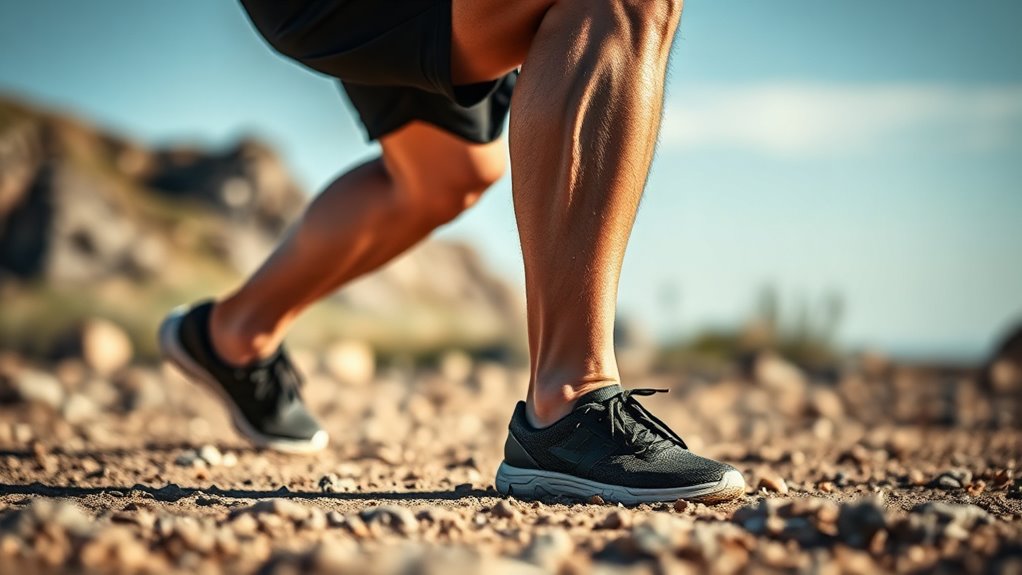
When you perform pistol squats, your calves and ankle stabilizers play a key role in keeping you balanced. Your gastrocnemius and soleus control ankle movement, helping you descend smoothly and push back up.
Meanwhile, the tibialis anterior and peroneals stabilize your foot, preventing ankle wobble and collapse. This stability improves ankle mobility and keeps your center of mass over your midfoot for better balance during the single-leg pause.
These muscles also make constant micro-adjustments to maintain posture, reducing the need to rely on your hips or lower back.
| Muscle Group | Function | Benefit |
|---|---|---|
| Gastrocnemius & Soleus | Control ankle plantarflexion | Smooth descent and ascent |
| Tibialis Anterior | Prevent inward ankle collapse | Stable foot placement |
| Peroneals (fibularis) | Prevent lateral wobbling | Enhanced balance and posture |
| Ankle Stabilizers | Micro-adjust posture | Maintain knee and shin alignment |
How Core Muscles Keep You Steady During Pistol Squats
Why does your core matter so much in pistol squats? Your core muscles, especially the deep abdominals like the transverse abdominis and obliques, brace hard to keep your pelvis stable as you lower and rise. This creates a rigid anti-rotation effect that prevents your torso from twisting while balancing on one leg.
At the same time, your erector spinae and abdominal muscles work together to stabilize your lower back, helping you maintain an upright torso without leaning forward. By keeping your trunk steady and controlled, your core supports smooth ankle and hip movements, ensuring your balance stays centered over the planted foot.
Plus, your core’s proprioception lets you make tiny adjustments during the descent. This reduces wobble and helps you hit consistent depth every time.
How Pistol Squats Differ From Barbell Back Squats
When you do pistol squats, you focus on one leg at a time, which challenges your balance and reduces spinal compression compared to barbell back squats. Back squats let you handle heavier weights but place more axial load on your spine due to the bilateral movement.
Understanding these differences helps you choose the right exercise for your strength and stability goals. It’s all about what fits you best and what your body needs.
Stability And Load Differences
Although both pistol squats and barbell back squats target your lower body, they demand very different stability and load management.
Pistol squats challenge your single-leg stabilizers and balance muscles without the bilateral support a barbell offers. You’ll rely on precise trunk, hip, and ankle control to keep stable under load.
Back squats let you use heavier weights due to whole-body bracing, pushing vertical spinal pressure higher. Meanwhile, pistol squats keep load distributed through your body, reducing axial spinal compression.
| Aspect | Pistol Squat | Barbell Back Squat |
|---|---|---|
| Load Distribution | Body weight + external weight | Barbell weight on shoulders |
| Stability Demand | Single-leg balance & stabilizers | Bilateral support, whole-body brace |
| Spinal Compression | Lower axial compression | Higher axial compression |
Spinal Compression Risks
Since barbell back squats place heavy axial loads on your spine, they increase vertical spinal pressure as the weight rises. This raises the risk of issues like lumbago, muscle strains, sciatica, and disc herniation.
Pistol squats, on the other hand, primarily use your body weight, with optional external loads held near your torso. This greatly reduces spinal compression.
Because you perform pistol squats one leg at a time, each leg moves through a deep range of motion without relying on heavy bilateral loading that stresses your spine. Even when you add weight—like holding a 20 kg kettlebell—the load is anterior and much lighter compared to a heavy barbell on your back.
This lets you build strength with far less risk of spinal injury than traditional back squats. It’s a safer way to get stronger without putting your spine in harm’s way.
Single-Leg Versus Bilateral
Because pistol squats challenge each leg independently, you must produce and stabilize force on one side at a time, unlike barbell back squats where both legs share the load. This single-leg focus reveals and corrects strength and balance imbalances that bilateral squats might mask.
While back squats let you handle heavier weights due to greater overall stability, pistol squats emphasize control, activating stabilizers in your hip, knee, ankle, and core to prevent your torso or knee from collapsing inward.
Also, pistol squats reduce spinal compression compared to heavy back squats since the load is distributed through single-leg control rather than maximal barbell weight. So, if you want to improve unilateral strength and joint stability, pistol squats offer a unique challenge that complements traditional bilateral squatting.
Why Pistol Squats Improve Balance and Proprioception
When you perform pistol squats, your body demands precise coordination from your ankle, knee, and hip joints as each leg supports your full weight independently. This challenges your balance by forcing your stabilizing muscles to work constantly, especially in your core and posterior chain.
Your proprioception sharpens because your body must sense joint position and adjust throughout the movement. Improved ankle mobility helps control your center of mass, making balance more stable.
| Joint | Muscle Focus | Balance Role |
|---|---|---|
| Ankle | Stabilizers | Controls center of mass |
| Knee | Quadriceps | Supports weight independently |
| Hip | Glutes & Hamstrings | Manages forward movement |
| Core | Abdominals & Obliques | Maintains overall stability |
How Weighted Pistol Squats Build Strength Safely
Mastering bodyweight pistol squats builds a solid foundation of balance and joint control, but adding weight takes your strength gains further without overloading your spine. When you hold a kettlebell or dumbbell goblet-style, the added resistance targets stabilizing muscles in each leg while keeping spinal load much lower than heavy barbell back squats.
For example, someone weighing 66 kg can safely pistol squat with a 20 kg kettlebell, applying meaningful external load without the vertical spine compression typical of back squatting. This approach challenges your balance and proprioception under resistance and requires a deep range of motion.
Plus, as you get stronger, you can progressively increase weight to build single-leg strength effectively, minimizing injury risk while maximizing muscle engagement. It’s a smart way to get stronger without putting undue stress on your back.
Fixing Leg Strength Imbalances With Pistol Squats
If you want to correct strength imbalances between your legs, pistol squats offer a highly effective solution by training one leg at a time. This unilateral focus isolates each side, revealing and addressing any strength or balance differences.
Here’s how pistol squats help fix leg strength imbalances:
- They demand strong activation of glutes, hamstrings, and quads independently, improving the weaker side.
- Each leg stabilizes the knee and hip alone, strengthening key stabilizer muscles and reducing compensation.
- The exercise enhances proprioception and core/hip control through constant micro-adjustments for balance.
- Compared to barbell squats, pistol squats reduce spinal load while allowing each leg to master the full range of motion.
Incorporating pistol squats can help you build balanced, stable, and strong legs over time. Give them a try and notice the difference!
Frequently Asked Questions
Is It Impressive to Do a Pistol Squat?
Yes, it’s impressive when you can do a pistol squat. You’re showing serious single-leg strength, balance, and coordination.
It proves your muscles and stability are strong enough to control your full body weight through a deep, challenging movement. Pretty cool, right?
What Are the Downsides of Doing Pistol Squats?
If you try pistol squats like a tightrope walker on a windy day, you risk knee and hip strains, muscle tears, or back pain from poor form, weak stabilizers, or pushing too hard too fast—so pace yourself carefully.
Seriously, take it slow and listen to your body. Rushing in can lead to injuries that might set you back more than you think.
Which Is Better for Me, Lunges or Pistol Squats?
Pistol squats are better if you want to fix strength imbalances and improve balance, but lunges are easier to scale and great for beginners.
Choose based on your stability, mobility, and workout goals.
It really depends on where you’re at and what you want to achieve.
Can an Average Person Do a Pistol Squat?
Yes, you can do a pistol squat if you work on your ankle flexibility, balance, and single-leg strength. Start with easier variations, like chair-assisted squats, and gradually progress to the full movement with practice and patience.
It might feel tricky at first, but don’t get discouraged. Keep at it, and you’ll see improvement over time!
Conclusion
So, you thought pistol squats were just a fancy party trick? Think again. They don’t just torch your quads—they recruit your glutes, hamstrings, calves, and core like a full-leg squadron.
Plus, they challenge your balance and fix strength imbalances without needing a barbell’s ego. Who knew one-legged squats could be such multitasking masters?
Next time you skip them, remember—your legs might just throw a tantrum for all that missed teamwork. Pistol squats target multiple muscle groups, making them an efficient and effective exercise. They build strength, improve stability, and enhance coordination all at once. So, if you want to boost your leg power and overall balance, incorporating pistol squats into your routine is a smart move. Don’t underestimate this single-leg powerhouse—it’s a game changer for your lower body fitness.