

What Is a Rail Gun and How Does It Work?
A railgun uses powerful electric currents running through two parallel rails to create a strong magnetic field. This field interacts with the projectile’s current, producing a Lorentz force that propels the projectile at hypersonic speeds—no explosives needed.
It’s a fascinating technology that combines electromagnetism and physics to launch projectiles faster than traditional methods.
The rails are made from materials like copper or aluminum to handle intense heat and current while minimizing wear. These materials are chosen carefully because they need to withstand extreme conditions during firing.
If you want to understand how design choices and materials affect its performance and durability, there’s more to explore. It’s pretty cool how every detail plays a role in making railguns work efficiently!
Key Takeaways
- A railgun uses electromagnetic forces to launch projectiles at hypersonic speeds without explosives. It sends a strong current through two parallel rails, generating a magnetic field around them.
- This magnetic field interacts with the projectile’s current, creating a Lorentz force that propels it forward. Pretty cool, right?
- Rail materials like copper or aluminum conduct high currents while minimizing wear and heat damage.
- Plus, efficient heat management and erosion-resistant materials improve railgun durability and firing performance. This helps the railgun keep firing without breaking down.
What Is a Railgun and How Does It Use Electromagnetic Forces?
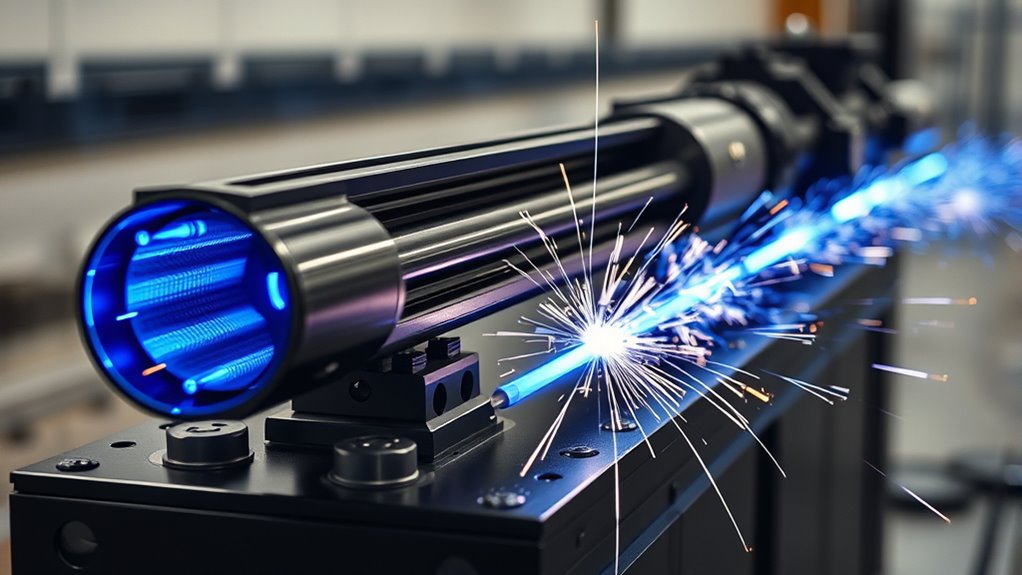
How does a railgun launch projectiles without explosives? A railgun uses electromagnetic forces instead of traditional propellants. When you send a strong electrical current through two parallel conductive rails and into the projectile, it generates a magnetic field around the rails.
This field interacts with the current in the projectile, creating a Lorentz force that pushes it forward. This force acts perpendicular to the rails, causing rapid acceleration. The higher the electrical current, the stronger the magnetic field and Lorentz force, so the projectile reaches hypersonic velocity—often exceeding 2 km/s.
This electromagnetic launch method lets you accelerate the projectile smoothly along the rails. It relies solely on electromagnetic forces for propulsion without any explosive materials.
How Railgun Design and Materials Impact Performance and Durability
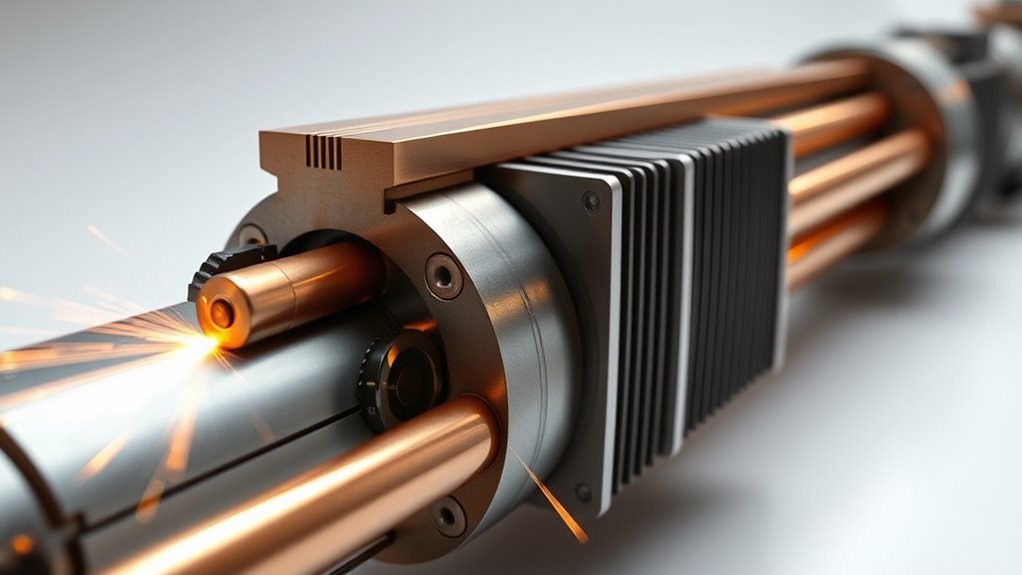
Because railguns generate immense electromagnetic forces and intense heat during firing, choosing the right design and materials is critical to their performance and durability. You need conductive materials like copper or aluminum for the rails to handle high-current firing and minimize rail erosion.
Railgun design also plays a role; optimizing the armature interface improves current conduction and reduces wear. To boost material durability and extend operational lifespan, researchers explore composite materials and ceramics that resist heat-induced damage.
Thermal conductivity and melting point are key factors in dissipating heat efficiently. Innovations like erosion-resistant coatings and even self-healing layers aim to keep rails intact through multiple shots.
Frequently Asked Questions
How Far Can Railguns Shoot?
You can expect railguns to shoot projectiles over 50 miles, with some experimental models reaching up to 100 miles. Future tech improvements might push that range even further, possibly hundreds of miles.
Is a Rail Gun Faster Than a Bullet?
Yes, a railgun is much faster than a bullet. It accelerates projectiles to hypersonic speeds, over 3,000 meters per second, which is several times faster than traditional bullets that travel around 800 to 1,200 meters per second.
Is It Illegal to Own a Rail Gun?
You can’t legally own a railgun in most places because laws classify them as restricted weapons. In the U.S. and many countries, civilian ownership is prohibited or heavily regulated due to their military-grade power.
Can a Rail Gun Stop a Hypersonic Missile?
Stopping a hypersonic missile with a railgun is like trying to catch lightning in a bottle—you can’t. You’d need huge tech leaps in speed, accuracy, and power before a railgun could reliably hit such a fast, maneuverable target.
Conclusion
Now that you know how a railgun uses powerful electromagnetic forces to launch projectiles at incredible speeds, you can appreciate the cutting-edge design and materials that make it all possible. The technology behind railguns is truly fascinating and continues to evolve rapidly.
While the technology is still evolving, it’s clear that railguns are no flash in the pan—they’re reshaping what’s possible in defense and engineering. These electromagnetic weapons offer a new level of precision and power that traditional firearms can’t match.
Keep an eye on this thrilling innovation; it’s just the tip of the iceberg in electromagnetic weaponry. As railgun technology advances, it promises to revolutionize military and industrial applications, making it a key player in future defense systems and engineering breakthroughs.