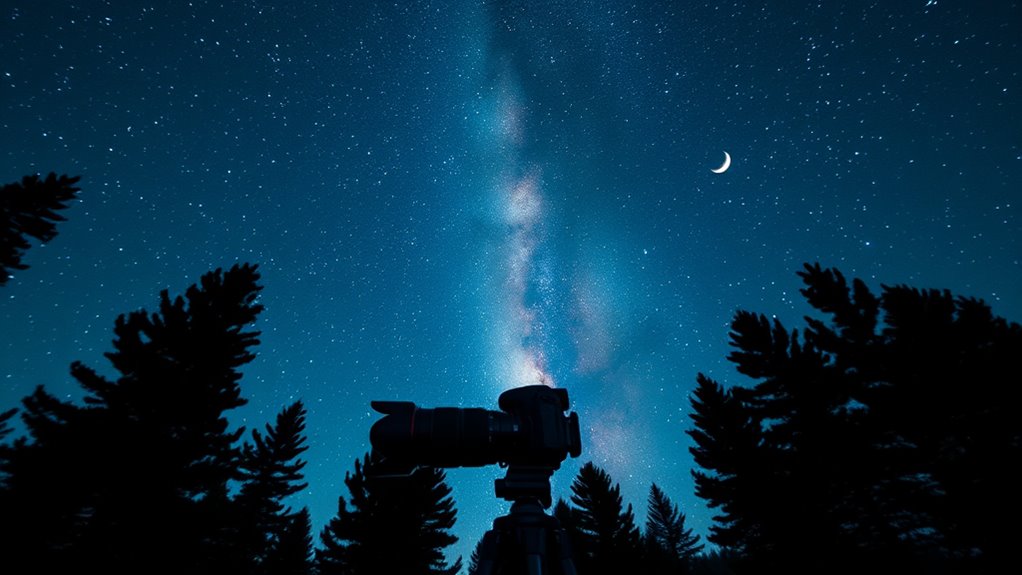
11 Best Cameras for Astrophotography in 2026 to Capture Stars
For astrophotography in 2026, you’ll want a camera with a cooled sensor like the SVBONY SV405CC or ZWO ASI6200MM Pro to reduce noise during long exposures. This feature is crucial for capturing clear and detailed images of stars and deep-sky objects without the interference of unwanted heat signals.
High resolution is another key factor—look for sensors around 20MP to ensure your photos are crisp and full of detail.
Fast USB 3.0 data transfer is also important because it allows for quick image capture and smooth operation when dealing with large files.
Many of the best astrophotography cameras come equipped with specialized filters that help you isolate celestial light and enhance contrast. Plus, app control makes it easy to adjust settings remotely, so you can focus on composing your shot without hassle.
If you’re excited to capture stunning celestial images, exploring these options will set you on the right path. With the right gear, your night sky photography will truly shine!
SVBONY SV105 Telescope Camera, 1.25″ IMX307 CMOS Color Eyepiece Camera
Capture stunning lunar and planetary images with ease using the SVBONY SV105 Telescope Camera. Designed for beginners, this color eyepiece camera offers a simple way to enhance your telescope experience. It delivers clear, real-time views, helping you focus and frame your shots precisely.
The camera features a 1.25-inch IMX307 CMOS sensor that fits most standard eyepieces. Its compatibility with Windows, Linux, Android, and macOS systems ensures broad usability without driver installation. This plug-and-play design minimizes setup time and technical hassles.
Thanks to dark light compensation and 30 fps at 1080p, the camera produces smooth, bright images even in low-light conditions. It excels at lunar, planetary, and terrestrial photography, providing versatility for various observation needs. However, it is less suited for deep-sky imaging and is not compatible with iOS devices.
Maintenance is straightforward—simply keep the lens clean and handle the device carefully to preserve image quality. Its compact design makes it easy to carry and store between uses, supporting a hassle-free astrophotography setup.
Best for: Beginners seeking an easy-to-use, versatile telescope camera for capturing clear lunar, planetary, and terrestrial photos.
What We Like:
- Plug-and-play setup with no driver installation needed
- Supports multiple operating systems including Windows, Linux, Android, and macOS
- Dark light compensation enhances image clarity in low-light conditions
- Smooth 30 fps video at 1080p resolution
- Compact design compatible with standard 1.25-inch eyepieces
Specification:
| Feature | Detail |
|---|---|
| Manufacturer | SVBONY |
| Sensor Type | IMX307 CMOS Color |
| Eyepiece Size | 1.25 inches |
| Video Resolution | 1920 x 1080 (1080p) |
| Frame Rate | 30 fps |
| Operating Systems | Windows, Linux, Android, macOS |
| Color | Black |
ZWO Seestar S30 Pro Smart Telescope, App-Controlled Astrophotography
The ZWO Seestar S30 Pro Smart Telescope transforms how beginners explore the night sky. Instead of complex setups, simply power it on and connect through its dedicated app. The telescope then automatically locates and tracks stars, planets, and galaxies, enabling effortless astrophotography from your smartphone.
Its apochromatic optics and integrated light pollution filters improve image clarity, making it easier to see celestial details even in city environments. This feature helps users overcome common challenges of urban stargazing. Dual 4K cameras combined with AI-powered imaging deliver sharp, high-resolution photos with minimal noise, streamlining the capture process.
Weighing just 3.64 lbs, this telescope is lightweight and portable, perfect for outdoor use and all-night observation sessions. While it excels in convenience, it requires a stable setup for longer exposures and does not offer extensive manual controls, which may limit advanced customization. Battery and durability specifics are not detailed, so consider this for extended remote use.
Best for: Beginners and casual stargazers seeking an easy-to-use, portable smart telescope with app-controlled imaging optimized for urban settings.
What We Like:
- Automatic GOTO system simplifies locating and tracking celestial objects.
- Apochromatic lenses and light pollution filters enhance night sky visibility in bright areas.
- Dual 4K cameras with AI reduce noise and improve photo quality.
- Lightweight design supports portability and ease of setup.
Specification:
| Feature | Details |
|---|---|
| Manufacturer | ZWO |
| Weight | 3.64 lbs (1.65 kg) |
| Optics | Apochromatic |
| Imaging System | Dual 4K Cameras with AI |
| Connectivity | App-controlled |
| Portability | Lightweight, portable |
SVBONY SC571CC Cooled Color Astronomy Camera, IMX571 CMOS APS-C Sensor
Experience the clarity and detail that the SVBONY SC571CC cooled color astronomy camera brings to your deep-sky imaging. Its IMX571 CMOS APS-C sensor captures stunning 26MP images with impressive sensitivity, making faint nebulae and Ha regions visible like never before. This camera is designed to help you reveal the hidden beauty of the night sky with minimal noise and excellent dynamic range.
The camera’s dual-stage TEC cooling lowers the sensor temperature by 35°C below ambient, significantly reducing dark current and noise during long exposures. Maintenance is simplified by the integrated front-window heater that prevents dew buildup, so you can focus on capturing sharp images without interruption.
Designed for medium to long focal length telescopes, this camera suits serious astrophotographers who demand high resolution and low noise. The fast USB 3.0 interface and 512 MB buffer ensure smooth data transfer, minimizing dropped frames and making your imaging sessions more efficient.
Best for: Serious astrophotographers and deep-sky imaging enthusiasts seeking a high-resolution, low-noise camera with reliable dew prevention for capturing faint celestial objects.
What We Like:
- High QE back-illuminated IMX571 APS-C sensor with 26MP resolution and 16-bit ADC
- Dual-stage TEC cooling reduces noise for cleaner long exposures
- Front-window heater prevents dew formation during imaging
- Fast USB 3.0 interface with 512 MB buffer for stable data transfer
Specification:
| Feature | Details |
|---|---|
| Manufacturer | SVBONY |
| Sensor | IMX571 CMOS APS-C |
| Resolution | 26 Megapixels |
| Cooling | Dual-stage TEC (35°C below ambient) |
| ADC | 16-bit |
| Interface | USB 3.0 |
| Buffer Memory | 512 MB |
SVBONY SV405CC Astrophotography Camera, Cooled Telescope Eyepiece IMX294
Experience clear, detailed views of the cosmos with the SVBONY SV405CC astrophotography camera. Its cooled IMX294 sensor excels at capturing faint deep-sky objects by significantly reducing noise during long exposures. This means your images reveal subtle celestial details that might otherwise be lost.
The camera’s 4/3 back-illuminated sensor features 4.63μm pixels and a wide dynamic range, preserving fine contrast in both bright and dark areas of your shots. A two-stage TEC cooling system lowers the sensor temperature by 30°C below ambient, effectively minimizing dark current and enhancing image clarity.
Designed for serious astrophotography, the SV405CC offers a fast USB 3.0 interface with up to 19 frames per second at full resolution. This supports precise focusing and smooth live viewing, helping you capture perfect shots with ease. The compact, lightweight design fits comfortably on most telescopes without adding excessive bulk.
Maintenance is straightforward, with reliable cooling that prevents sensor overheating and reduces the need for frequent adjustments. Compatible with popular astrophotography software, it integrates seamlessly into advanced imaging setups.
Best for: Serious astrophotography enthusiasts seeking a cooled, high-sensitivity camera for capturing detailed deep-sky objects with low noise during long exposures.
What We Like:
- High-sensitivity 4/3 back-illuminated IMX294 sensor preserves image detail.
- Two-stage TEC cooling reduces noise by lowering sensor temperature 30°C below ambient.
- Fast USB 3.0 connection enables up to 19fps for accurate focusing and live view.
- Compact and lightweight design fits easily on various telescopes.
- Compatible with major astrophotography software for flexible use.
Specification:
| Feature | Details |
|---|---|
| Manufacturer | SVBONY |
| Sensor Type | IMX294, 4/3 back-illuminated |
| Pixel Size | 4.63 μm |
| Cooling | Two-stage TEC, -30°C below ambient |
| Interface | USB 3.0 |
| Max Frame Rate | 19 fps (full resolution) |
| Weight | Approx. moderate (specific weight not provided) |
| Design | Compact, lightweight |
SVBONY SV305C Pro Telescope Camera, USB 3.0 High-Speed, 2MP IMX662 Sensor
Experience clear and detailed planetary imaging like never before with the SVBONY SV305C Pro Telescope Camera. Designed to capture fast-moving planets, this camera’s 2MP IMX662 sensor offers exceptional sensitivity and low noise, producing sharp images even in low-light settings.
The USB 3.0 connection ensures fast data transfer, preventing delays during your observation sessions. A built-in 128MB DDR buffer helps avoid image loss during long exposures, while advanced heat dissipation technology keeps the camera running smoothly over extended use.
This camera is intended primarily for computer use, making it ideal for astronomers who require precise control and high-speed image capture. Its compact design requires minimal maintenance, allowing you to focus on your astrophotography without interruption.
While it lacks compatibility with mobile devices and does not include a built-in guiding system, it supports external guiding interfaces for accurate tracking. This makes it a dependable tool for those dedicated to detailed planetary imaging.
Best for: amateur and professional astronomers focused on high-speed, detailed planetary imaging who require low noise and high sensitivity in their astrophotography equipment.
What We Like:
- Ultra-sensitive IMX662 sensor with low noise for clear images in low light
- High-speed USB 3.0 interface and large DDR buffer for smooth data flow
- Efficient heat dissipation technology for stable long exposure performance
- Compact, easy-to-maintain design suitable for extended sessions
Specification:
| Feature | Description |
|---|---|
| Manufacturer | SVBONY |
| Sensor | 2MP IMX662 CMOS |
| Resolution | 1920 x 1080 (Full HD) |
| Frame Rate | Up to 107 FPS |
| Interface | USB 3.0 |
| Buffer Memory | 128MB DDR |
| Weight | Approx. 200g |
| Compatibility | Windows/macOS (PC only) |
DWARFLAB Dwarf 3 Smart Telescope, App-Controlled Astrophotography Camera
Capture the night sky like never before with the DWARFLAB Dwarf 3 Smart Telescope. Designed for those who crave adventure and discovery, this compact device brings the stars within reach wherever you go. Its lightweight design makes it easy to carry on outdoor trips, eliminating bulky equipment hassles.
Switch effortlessly between wide-angle and telephoto views with its dual-lens system, allowing you to photograph everything from sweeping star trails to distant celestial objects. The integrated 4K auto-tracking and Auto GOTO technology keep your target perfectly centered, so you can focus on capturing stunning images rather than manual adjustments.
Controlled entirely through an intuitive app, the telescope requires no complicated setup or additional software. This seamless interface simplifies astrophotography, making it accessible for beginners while still delivering high-quality results for enthusiasts.
Maintenance is straightforward thanks to its durable build and minimal moving parts. Its portability and ease of use make it ideal for spontaneous stargazing sessions, enhancing your experience under the night sky.
Best for: Outdoor enthusiasts and amateur astronomers seeking a portable, easy-to-use smart telescope for high-quality astrophotography on the move.
What We Like:
- Ultra-lightweight and compact for easy travel and quick setup
- Dual-lens options enable versatile imaging from wide views to detailed zoom
- User-friendly app with advanced 4K auto-tracking and Auto GOTO features
Specification:
| Feature | Details |
|---|---|
| Manufacturer | DWARFLAB |
| Weight | 3 lb (1.36 kg) |
| Lens Diameter | 35 mm |
| Imaging Resolution | 4K |
| Control Interface | App-controlled (smartphone required) |
| Color Options | Black |
SVBONY SC715C Telescope Planetary Camera, 1.45μm Micro Pixel IMX715 Color
Discover the precision and clarity that the SVBONY SC715C Telescope Planetary Camera brings to your astrophotography. Designed to capture detailed planetary images, its 1.45μm IMX715 sensor produces sharp 4K resolution photos with minimal noise. This camera enhances your viewing experience by delivering crisp images that reveal fine celestial details.
Equipped with a 512MB DDR3 cache and a fast USB 3.0 interface, it ensures smooth, high-speed image transfer at 45.5 frames per second. This means you can capture fleeting astronomical events without lag or interruption. Its lightweight aluminum alloy body not only provides durability but also dissipates heat efficiently, helping maintain consistent performance during long observing sessions.
The camera supports an ST4 autoguider interface, allowing you to connect it to your equatorial mount for stable long exposures. While the SC715C requires manual focusing through your telescope’s focuser, this setup offers precise control over image sharpness. Operating the camera does require dedicated software, which may take some time to master but unlocks its full functionality.
Maintenance is straightforward due to its sturdy build and efficient heat management. Just ensure your telescope and software are properly configured for the best results. The SC715C is a reliable tool to elevate your planetary and deep-sky imaging projects.
Best for: amateur and professional astronomers seeking high-resolution planetary imaging with reliable autoguiding and fast image transfer.
What We Like:
- High-quality 1.45μm sensor delivers clear 4K images with low noise.
- Fast data transfer at 45.5 fps with 512MB cache and USB 3.0.
- Durable, lightweight aluminum body with excellent heat dissipation.
- ST4 autoguider interface supports stable long exposure shots.
Specification:
| Feature | Details |
|---|---|
| Manufacturer | SVBONY |
| Sensor | 1.45μm IMX715 Color |
| Resolution | 4K |
| Cache Memory | 512MB DDR3 |
| Interface | USB 3.0, ST4 Autoguider |
| Body Material | Aluminum Alloy |
| Dimensions | Not specified |
| Weight | Not specified |
ZWO ASI183MC Pro 20.18MP Color Astronomy Camera
Experience stunning clarity in your astrophotography with the ZWO ASI183MC Pro 20.18MP Color Astronomy Camera. Designed to capture deep-sky objects in vibrant detail, this camera sharpens your celestial imaging with its high-resolution CMOS sensor. Its 5496×3672 resolution and 2.4-micron pixels reveal fine astronomical features that standard cameras often miss.
The built-in TEC cooling system is a game-changer, cutting sensor temperature by up to 45°C. This reduces noise dramatically, allowing for cleaner, crisper images even during long exposure sessions. Fast USB 3.0 data transfer paired with a 256MB buffer ensures stable performance, preventing data loss or lag while capturing the night sky.
Maintenance is straightforward due to its durable, compact design that fits both 1.25” and 2” focusers. Compatible with Mac and Windows, it integrates easily into most astrophotography setups. Note that the TEC cooler requires an external 12V@3A power supply, and solar imaging needs additional filters, which are sold separately.
Whether you’re documenting faint nebulae or intricate star clusters, this camera enhances your ability to capture the universe’s beauty with precision and low noise.
Best for: astrophotography enthusiasts seeking high-resolution, low-noise color imaging of deep-sky objects with advanced cooling and fast data transfer capabilities.
What We Like:
- High-resolution 20.18MP sensor captures detailed celestial images.
- TEC cooling reduces noise by lowering sensor temperature up to 45°C.
- Fast USB 3.0 interface with 256MB buffer for reliable data transfer.
- Compact, durable design fits common telescope focusers.
- Compatible with both Mac and Windows operating systems.
Specification:
| Feature | Details |
|---|---|
| Manufacturer | ZWO |
| Sensor Resolution | 20.18 Megapixels |
| Sensor Type | CMOS Color |
| Pixel Size | 2.4 microns |
| Image Resolution | 5496 x 3672 pixels |
| Cooling System | TEC cooling, up to -45°C |
| Interface | USB 3.0 |
| Buffer Memory | 256MB DDR3 |
| Power Supply for Cooling | External 12V@3A (not included) |
| Focuser Compatibility | 1.25” and 2” |
| OS Compatibility | Mac OS X, Windows |
SVBONY SV605CC 9MP Cooled Astrophotography Camera
Unlock the beauty of the night sky without leaving your urban home with the SVBONY SV605CC 9MP cooled astrophotography camera. This camera tackles common issues like noise and light pollution, which often blur deep sky images captured in cities. Its TEC cooling system lowers the sensor temperature by 30°C below ambient, dramatically reducing noise for clearer, sharper photos.
Equipped with a 9MP IMX533 sensor, it captures fine details of nebulae and galaxies. The integrated SV240 multi-narrowband filter suppresses urban light pollution, enabling you to shoot even in Bortle 8 conditions. This combination ensures vibrant, high-quality astrophotography from your backyard or balcony.
Maintenance is straightforward but requires attention to the cooling system and filter to maintain peak performance. The camera is designed primarily for deep sky imaging, so it may not be the best choice for planetary or lunar photography.
Overall, the SVBONY SV605CC offers unique benefits for city-based astrophotographers seeking clear, detailed images without traveling to remote dark-sky sites. Its cooling and filtering technologies are key to overcoming urban shooting challenges.
Best for: Amateur astronomers wanting to capture detailed deep sky images in light-polluted urban environments.
What We Like:
- High-resolution 9MP IMX533 sensor delivers sharp, detailed images
- TEC cooling system reduces sensor noise for clearer shots
- SV240 multi-narrowband filter effectively blocks urban light pollution
- Enables astrophotography in challenging Bortle 8 conditions
Specification:
| Feature | Details |
|---|---|
| Manufacturer | SVBONY |
| Sensor | 9MP Sony IMX533 |
| Cooling | TEC cooling, -30°C below ambient |
| Filter | SV240 multi-narrowband |
| Resolution | 3008 x 3008 pixels |
| Intended Use | Deep sky astrophotography |
SVBONY SV405CC TEC Cooled Astronomy Camera Bundle
Discover the power of the SVBONY SV405CC TEC Cooled Astronomy Camera Bundle, designed to elevate your deep space imaging. This camera captures stunning details of nebulae, galaxies, and star clusters with its advanced 11.7 MP IMX294 CMOS sensor. The true 4K output at 120 fps ensures smooth, high-resolution videos and images.
The camera’s TEC cooling system reduces noise, allowing longer exposures and clearer shots of faint celestial objects. Its USB 3.0 interface offers fast data transfer, making image processing quicker and more efficient. The included UV/IR cut filter enhances color accuracy by blocking unwanted wavelengths, improving contrast in your astrophotography.
Manual focus gives you precise control over your images, while the water-resistant design adds durability for outdoor use. Compatible with a wide range of telescopes, this camera supports various shooting modes, digital and optical stabilization, and an ISO up to 6400, addressing diverse astrophotography needs.
Maintenance is straightforward, with easy filter replacement and robust build quality designed for regular use under different conditions. While its manual focus requires some skill, the camera’s performance and versatility make it a valuable tool for serious astrophotographers.
Best for: advanced and amateur astrophotographers seeking a high-resolution, cooled astronomy camera for detailed deep space imaging with professional features.
What We Like:
- High-resolution 11.7 MP sensor with true 4K output at 120 fps for detailed images.
- TEC cooling reduces noise for clearer long exposures.
- UV/IR cut filter improves color accuracy and image contrast.
- Water-resistant design enhances durability in various environments.
- Compatible with multiple telescopes and supports high ISO settings.
Specification:
| Feature | Details |
|---|---|
| Manufacturer | SVBONY |
| Sensor | 11.7 MP IMX294 CMOS |
| Cooling | TEC Cooled |
| Output Resolution | True 4K at 120 fps |
| Interface | USB 3.0 |
| Weight | 3.7 lb (1.68 kg) |
| Focus | Manual |
| Filters Included | UV/IR Cut Filter |
| Water Resistance | Yes |
SVBONY SV405CC 11.7MP Cooled Deep Sky Camera
The SVBONY SV405CC 11.7MP Cooled Deep Sky Camera is designed for those who demand crisp and vibrant deep-sky images. Its advanced 11.7 MP CMOS sensor with AR coating enhances image clarity, allowing you to capture stunning celestial details. This camera significantly reduces glare and reflection, improving overall image quality.
Equipped with a professional APO Petzval triplet lens, it effectively eliminates common issues like coma and chromatic aberration. The adjustable aperture from F4.5 to F22 offers flexibility for various shooting conditions, making it easier to adapt to different targets and lighting. This versatility improves your astrophotography results without complicated setups.
The lightweight 90g design makes it highly portable, ideal for astrophotographers who travel or work in the field. It features a precise focuser and supports electronic automatic focusing (EAF), ensuring sharp and accurate framing every time. Maintenance is straightforward with its robust build and easy-to-clean coatings.
While it supports full-frame sensors, some setups might require additional adapters for full compatibility. The included 54mm Petzval APO refractor is perfect for beginners but may feel limiting for those needing larger aperture telescopes.
Best for: astrophotography enthusiasts and professionals seeking high-resolution, versatile deep-sky imaging with a portable, precision-focused setup.
What We Like:
- High-resolution 11.7 MP CMOS sensor with AR coating for enhanced image clarity
- APO Petzval triplet lens with adjustable aperture reduces image distortion
- Lightweight design (90g) facilitates easy transport and field use
- Precise focuser and EAF compatibility for sharp, reliable framing
Specification:
| Feature | Details |
|---|---|
| Manufacturer | SVBONY |
| Sensor Resolution | 11.7 Megapixels |
| Sensor Type | CMOS with AR coating |
| Lens Type | APO Petzval triplet |
| Aperture Range | F4.5 to F22 |
| Weight | 90 grams (0.09 kg) |
| Included Accessories | 54mm Petzval APO refractor |
Factors to Consider When Choosing a Camera for Astrophotography 2026
When choosing a camera for astrophotography in 2026, you’ll want to focus on sensor type and size to capture the faintest stars clearly. Cooling capabilities and noise reduction technology play a big role in improving image quality during long exposures.
Also, consider resolution, pixel size, and how well the camera connects with your existing gear. These factors can make a real difference when you’re out under the night sky.
Sensor Type and Size
Although choosing the right sensor type and size can seem technical, it directly impacts your ability to capture clear, detailed images of the night sky. Larger sensors like APS-C or full-frame gather more light, improving image quality and revealing faint celestial details.
You’ll also want to consider sensor type—CMOS sensors offer high sensitivity and lower noise, especially if they’re back-illuminated (BSI), which boosts photon capture efficiency for brighter, cleaner photos. Pixel size matters, too; larger pixels collect more light, reducing noise in dim conditions.
High-resolution sensors with more megapixels can reveal finer stars and nebulae but demand better lenses and more processing power. Picking the right combination helps you maximize clarity and dynamic range, ensuring your astrophotography stands out with crisp, vivid night sky images.
Cooling Capabilities
Selecting the right sensor helps capture stunning celestial details, but managing sensor heat plays an equally important role in astrophotography. Effective cooling capabilities considerably reduce sensor noise during long exposures, which means clearer, crisper images.
Cameras equipped with TEC or dual-stage cooling can drop sensor temperatures by 30°C to 40°C below ambient, minimizing thermal noise that often ruins deep-sky shots. When you can control and monitor the sensor temperature, you optimize exposure settings and capture more intricate details without artifacts caused by heat fluctuations.
Cooling systems also ensure consistent image quality across varying environments, allowing longer exposures without degradation. So, when choosing your astrophotography camera in 2026, prioritize advanced cooling features to extend usability and maintain the highest image quality on your night sky adventures.
Resolution and Pixel Size
Because capturing crisp, detailed images of the night sky depends heavily on your camera’s resolution and pixel size, you’ll want to understand how these factors influence your astrophotography results. Higher resolution cameras reveal finer details in celestial objects, but smaller pixels can sometimes increase noise, especially without proper cooling.
Larger pixels gather more light, which boosts image quality in low-light conditions common in astrophotography. However, smaller pixels allow for higher magnification, helping you resolve tiny, distant stars and planets better.
You’ll need to balance resolution and pixel size to minimize noise while maximizing sharpness. Picking the right combination depends on the targets you want to capture and the conditions you shoot in, ensuring your images come out both detailed and clean.
Compatibility and Connectivity
How well your camera connects to your computer and telescope can make or break your astrophotography experience. First, verify the camera is compatible with your operating system—be it Windows, macOS, Linux, or Android—to avoid functionality issues.
Check the connection interface; USB 3.0 or USB-C offers fast, reliable data transfer essential during long exposure sessions. Find out if the camera supports plug-and-play or needs extra drivers for smooth setup.
Compatibility with your telescope or mount is vital—look for standard threading sizes and autoguiding support like ST4 or ASCOM. Finally, confirm the camera works seamlessly with popular astrophotography software such as SharpCap, AstroDMx Capture, or PHD2.
This way, you’ll enjoy effective control and precise image capture throughout your stargazing adventures.
Noise Reduction Technology
When you capture faint celestial objects, noise can easily obscure the details you want to reveal. That’s why advanced noise reduction technology is essential in astrophotography cameras.
Many models use thermoelectric cooling (TEC) to lower sensor temperatures, drastically reducing thermal noise during long exposures. You’ll also benefit from digital noise reduction algorithms that smooth graininess by averaging multiple frames or applying precise filters.
Cameras with higher bit-depth, like 14-bit or 16-bit ADC, help you distinguish faint signals from noise with greater tonal gradation. Pay attention to readout noise levels—lower values mean clearer images with less electronic interference.
With effective noise reduction, you’ll capture high-quality, detailed deep-sky images with minimal post-processing, even in light-polluted environments. It really makes a difference when you’re trying to get those perfect shots.
Imaging Speed and Frame Rate
Although longer exposures are common in deep-sky astrophotography, you’ll want a camera with a high frame rate to capture fast-moving objects like planets and satellites without motion blur.
Higher FPS lets you record smooth videos and detailed time-lapse sequences, which are essential for real-time viewing.
Cameras offering multiple frames per second enable you to stack images, improving the signal-to-noise ratio and enhancing the final image quality.
Keep in mind that balancing imaging speed with data transfer rates is critical. High FPS demands fast interfaces like USB 3.0 or Thunderbolt to handle large data streams efficiently.
While slower frame rates work fine for deep-sky shots, prioritizing cameras with solid imaging speed ensures versatility for all your astrophotography needs.
Portability and Durability
Balancing imaging speed with portability guarantees you can capture stunning astrophotography shots wherever you go. When choosing a camera, aim for one under 3 pounds to keep transport and setup hassle-free.
Look for a compact design with built-in handles or carrying cases to make carrying easier and reduce travel damage risks. Durability is key—select models with weather-resistant or waterproof features to protect against moisture, dust, and temperature changes.
A robust cooling system like TEC cooling ensures your sensor stays stable in varying outdoor conditions, preserving image quality. Cameras with reinforced bodies and shock-absorbing mounts withstand accidental bumps or drops, giving you peace of mind during fieldwork.
Prioritizing portability and durability means you’re ready for any astrophotography adventure without compromising performance. It just makes the whole experience smoother and more enjoyable.
Frequently Asked Questions
How Do I Maintain and Clean My Astrophotography Camera?
You should gently clean your camera sensor with a blower, and try to avoid touching it directly. For the lens, using a microfiber cloth works best.
Also, make sure to store your camera in a dry, dust-free case. This helps keep it in top condition for your astrophotography sessions.
What Accessories Improve Astrophotography Results?
You’ll want a sturdy tripod, remote shutter release, and star tracker to reduce blur and capture longer exposures. These help keep your shots sharp and steady.
Also, consider a wide-angle lens, extra batteries, and a dew heater to keep your gear clear and powered all night. These little extras can make a big difference when you’re out under the stars.
Can I Use These Cameras for Daytime Photography?
You can’t judge a book by its cover, and you shouldn’t limit these cameras—they’re versatile!
You can definitely use them for daytime photography; they capture stunning images in various lighting conditions, not just under starry skies.
How Do Weather Conditions Affect Astrophotography Sessions?
Weather conditions greatly affect your astrophotography sessions. Clouds, humidity, and light pollution reduce visibility.
On the other hand, clear, dry nights improve star clarity. Always check forecasts and choose dark, stable nights for the best shots.
It really makes a difference when you pick the right conditions!
What Software Is Best for Processing Astrophotography Images?
You know what they say, “A picture is worth a thousand words.”
You’ll want to use software like Adobe Photoshop, PixInsight, or DeepSkyStacker. They’ll help you enhance details and bring out those stunning starry skies beautifully.
Conclusion
Choosing the right astrophotography camera is like picking the perfect telescope lens to bring distant stars into sharp focus. Just like an amateur astronomer once captured the Andromeda Galaxy in vivid detail with a SVBONY SV405CC, your choice can transform faint starlight into breathtaking images.
With these top cameras for 2026, you’re not just taking pictures—you’re capturing the universe’s story, one star at a time. So, gear up and let your cosmic adventure begin!
When selecting the best camera for astrophotography in 2026, consider factors like sensor sensitivity, noise reduction, and lens compatibility. These features help bring out the brilliance of distant celestial objects in your photos.
Remember, the right astrophotography camera can turn a simple night sky photo into a stunning masterpiece filled with stars, galaxies, and nebulae. Ready to capture the cosmos? Your journey to the stars starts here with the best cameras for astrophotography in 2026!