5 Best 3D Printers for 40k Miniatures in 2026
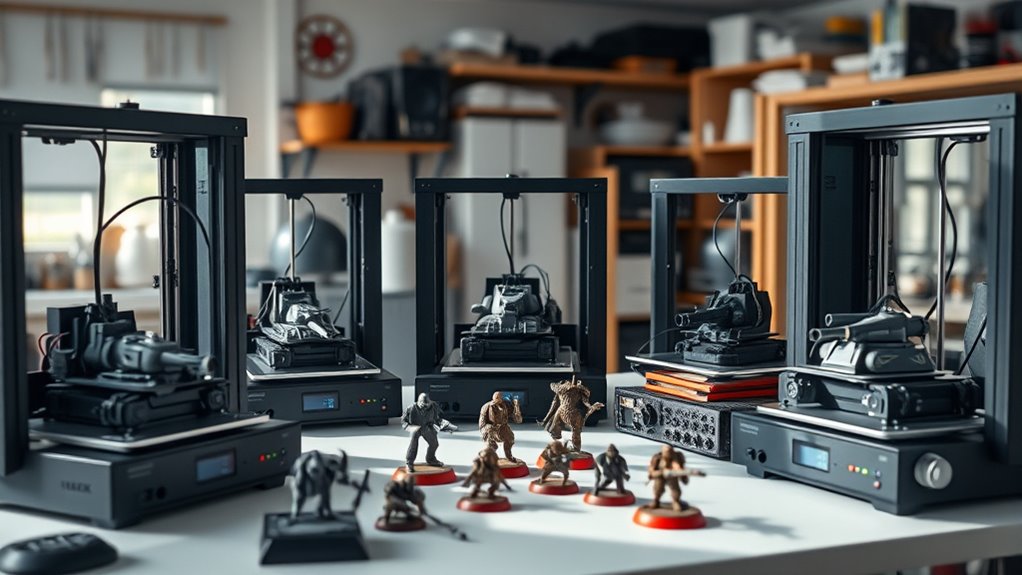
If you’re aiming for crisp, high-detail 40K miniatures in 2026, choosing the right 3D printer is key. Whether you’re a seasoned hobbyist or just starting out, having a reliable printer can make all the difference for your tabletop army.
The FLASHFORGE Adventurer 5M offers fast, precise prints that bring your models to life quickly. On the other hand, the Phrozen Sonic Mighty 4K resin printer delivers unmatched resolution, perfect for those fine details.
For beginners, the Semme Compact and 40mm/s Mini printers provide stable builds and are easy to use. Plus, the TINA2 Plus adds extra convenience with wireless connectivity and auto leveling features.
Each of these printers strikes a balance between speed, detail, and user-friendliness. Take a closer look at their features to find the perfect match for your 40K miniature needs.
FLASHFORGE Adventurer 5M High-Speed 3D Printer
Experience fast, precise 3D printing designed to meet the demands of detailed miniature creation. The FLASHFORGE Adventurer 5M High-Speed 3D Printer heats up quickly in just 35 seconds, allowing you to start your projects without delay. Its printing speeds reach up to 600mm/s, so you can produce high-quality miniatures faster than many standard printers.
This printer’s CoreXY all-metal structure ensures consistent stability, which is vital for maintaining sharp details on small models. Dual fans combined with vibration compensation technology help deliver crisp layers, minimizing imperfections. With one-click automatic printing and easy nozzle swaps, setup and maintenance become straightforward tasks.
Maintenance involves regular cleaning of the nozzle and platform to keep performance optimal, but the design simplifies these processes. The Flash Maker app enables remote print monitoring, giving you control even when away from your workspace. This makes it easier to manage multiple prints or catch any issues early.
While the 220x220x220mm build volume suits most miniatures, it may limit larger projects. Beginners might find the CoreXY system slightly challenging initially but will benefit from the printer’s robust design and functionality once familiar.
Best for: hobbyists and professionals seeking a fast, reliable 3D printer for detailed miniatures and rapid prototyping.
What We Like:
- Rapid heat-up and high-speed printing improve workflow efficiency
- Stable CoreXY all-metal frame enhances print precision
- Easy nozzle changes and one-click printing reduce downtime
- Remote print monitoring via Flash Maker app offers convenience
- Vibration compensation ensures smooth, detailed layers
Specification:
| Feature | Details |
|---|---|
| Manufacturer | FLASHFORGE |
| Build Volume | 220 x 220 x 220 mm |
| Print Speed | Up to 600 mm/s |
| Warm-up Time | 35 seconds |
| Frame Material | All-metal CoreXY |
| Color Options | Not specified |
Semme Compact 3D Printer for Beginners (US Plug)
The Semme Compact 3D Printer for Beginners (US Plug) offers a simple and reliable way to bring your detailed miniatures to life. Its compact size and lightweight design make it easy to set up and monitor, whether you’re printing at home or on the go. This printer addresses the challenge of creating precise small-scale models without the hassle of bulky equipment.
With a 100x100x100mm print volume, it supports intricate projects like 40k miniatures while maintaining stability thanks to its sturdy metal base. The quick-heating feature and magnetic removable bed simplify the printing process and cleanup, saving you time and effort. These thoughtful design elements reduce common frustrations in 3D printing.
The printer works well with PLA and TPU filaments, offering versatility for various creative ideas. Connectivity via USB or memory card and compatibility with CURA software make file transfers straightforward. While the print speed is limited to 40mm/s, it ensures fine layers for detailed results.
Its open-frame design provides easy access but requires a clean environment to avoid dust affecting print quality. Maintenance is straightforward, focusing mainly on bed cleaning and filament changes, making it ideal for beginners.
Best for: Beginners and hobbyists who want an easy-to-use compact 3D printer for crafting detailed miniatures and small prototypes.
What We Like:
- Rapid heating and magnetic removable bed for hassle-free setup and print removal
- Supports popular PLA and TPU filaments, enhancing project flexibility
- Simple connectivity with USB, memory card, and CURA compatibility
- Stable metal base ensures consistent print quality on small models
Specification:
| Feature | Details |
|---|---|
| Manufacturer | Semme |
| Print Volume | 100 x 100 x 100 mm |
| Print Speed | Up to 40 mm/s |
| Filament Types | PLA, TPU |
| Connectivity | USB, Memory Card |
| Software | CURA compatible |
| Frame Design | Open-frame |
| Base Material | Metal |
Phrozen Sonic Mighty 4K Resin 3D Printer
The Phrozen Sonic Mighty 4K Resin 3D Printer is designed to deliver sharp, detailed miniatures with minimal effort. Its high-resolution 52µm XY monochrome LCD ensures every layer is crisp, making it ideal for intricate models like those used in Warhammer 40k. This precision helps reduce print errors and brings your designs to life with fine detail.
Its reinforced dual linear rails offer stable and consistent layering. This stability improves print quality and reliability, so you can spend less time troubleshooting and more time creating. The printer’s compact design fits easily on a tabletop, making it convenient for hobbyists with limited space.
Maintenance is straightforward, thanks to its user-friendly interface and compatibility with most 405nm UV resins. While it requires post-processing for cleanup and curing, it supports a range of resins including standard, high-temp, and engineering types, providing flexibility for different project needs.
This resin 3D printer balances precision and ease of use, making it a solid choice for beginners and enthusiasts who want detailed miniatures without complex setup or frequent failures.
Best for: hobbyists and beginners seeking detailed, reliable resin 3D prints of miniatures and prototypes with ease of use and versatile resin compatibility.
What We Like:
- High-resolution 52µm XY monochrome LCD for clear, detailed prints.
- Stable layering from reinforced dual linear rails.
- Compact, user-friendly design suitable for beginners.
- Supports a variety of 405nm UV resins for flexible printing options.
Specification:
| Feature | Details |
|---|---|
| Manufacturer | Phrozen |
| Build Volume | Compact (exact size not provided) |
| Resolution | 52µm XY monochrome LCD |
| Resin Compatibility | 405nm UV standard, high-temp, engineering resins |
| Design | Dual linear rails, compact tabletop form |
| Intended Use | Miniatures, prototypes |
TINA2 Plus WiFi 3D Printer for Beginners
The TINA2 Plus WiFi 3D Printer is designed to make 3D printing accessible and efficient for beginners and hobbyists. Its fully assembled, compact design means you can start printing detailed miniatures and projects right away, without spending time on setup. This solves the common frustration of complex assembly.
With a maximum print speed of 250mm/s and auto bed leveling, it balances speed and print quality, helping users avoid the usual trial-and-error of manual calibration. The included PLA filament ensures you have everything to begin creating immediately, while the printer’s wireless capabilities simplify the printing process.
Maintenance is straightforward, thanks to its user-friendly interface and open-source software compatibility, which allows for easy customization. The Poloprint Cloud app offers access to thousands of models, making it easy to find inspiration or upload your own designs.
While the printer excels with PLA, it may require slowing down print speed to 150mm/s for optimal results. Some advanced features might need time to master, particularly for those new to slicing software.
Best for: Beginners, hobbyists, and educators seeking a fast, easy-to-use 3D printer with wireless functionality and extensive model customization.
What We Like:
- Ready to use out of the box with minimal setup
- Fast printing speeds with quality auto bed leveling
- Wireless printing via Poloprint Cloud app
- Access to 3,000+ models and open-source software support
Specification:
| Feature | Details |
|---|---|
| Manufacturer | Poloprint |
| Dimensions | Compact footprint |
| Weight | Not specified |
| Material Supported | PLA (included filament) |
| Color Options | Not specified |
40mm/s Mini 3D Printer with Removable Build Plate
Discover the convenience of the 40mm/s Mini 3D Printer with Removable Build Plate, designed for precision and simplicity. This compact printer tackles detailed projects effortlessly, making it ideal for crafting small to medium-sized miniatures and prototypes.
Its removable magnetic build plate allows for easy print removal and quick cleanup. This feature reduces frustration and saves time when handling delicate prints. The printer’s 100°C heated bed reaches operating temperature swiftly, cutting down on wait times and improving print adhesion.
With support for 1.75mm filaments such as PLA and TPU, it offers material versatility to suit your project needs. The lightweight design fits comfortably in tight spaces, while compatibility with both Windows and macOS ensures straightforward setup and use.
Though the build volume is limited to 100x100x100mm and printing speed maxes out at 40mm/s, this printer excels in delivering high-quality detail with quiet operation. Its open frame design is easy to maintain but may require a dust-free environment for optimal results.
Best for: hobbyists, beginners, and students looking for a compact, easy-to-use 3D printer capable of producing detailed miniatures and small models.
What We Like:
- Removable magnetic build plate for hassle-free print handling
- Fast-heating bed reaches 100°C quickly to reduce wait times
- Supports multiple filaments (PLA, TPU) for versatile printing
- Lightweight and quiet, ideal for small workspaces
Specification:
| Feature | Details |
|---|---|
| Manufacturer | Not specified |
| Build Volume | 100 x 100 x 100 mm |
| Filament Diameter | 1.75 mm |
| Supported Filaments | PLA, TPU |
| Heated Bed Max Temp | 100°C |
| Printing Speed | Up to 40 mm/s |
| Compatibility | Windows, macOS |
| Weight | Not specified |
Factors to Consider When Choosing a 3D Printer for 40K Miniatures
When choosing a 3D printer for your 40K miniatures, you’ll want to focus on print resolution to capture fine details and material compatibility to guarantee durability.
Also, consider the build volume to fit your models, along with print speed to keep your workflow efficient.
And don’t forget ease of use, so you spend less time troubleshooting and more time creating.
Print Resolution Importance
Choosing a 3D printer with a high print resolution is essential for capturing the fine details of your 40K miniatures. To get sharp, accurate models, aim for a printer that offers 52µm XY resolution or better.
Lower layer heights, like 0.05mm, help create smoother surfaces but will increase your print time. Resin printers usually outperform FDM models in resolution, making them the preferred choice for detailed miniatures.
Keep in mind that consistent resolution settings across prints ensure uniform quality, which is important if you plan to build a collection or compete. By prioritizing resolution, you’ll preserve the intricate features that bring your 40K miniatures to life, making your finished pieces stand out with impressive visual appeal.
Material Compatibility Options
High print resolution sets the foundation, but the materials your printer can handle truly shape the final look and feel of your 40K miniatures.
Resin-based printers excel here, offering compatibility with various third-party UV resins so you can customize finishes, colors, and strength. This flexibility helps you achieve sharp details and durable models.
While FDM printers can use specialized filaments that mimic resin quality, they often need post-processing to reach the same level of finesse. Some printers even support flexible or high-temp resins, releasing creative options for unique miniature features or enhanced durability.
Make sure your chosen printer supports the resin types you want to use, as material compatibility directly impacts the quality and versatility of your miniatures.
Build Volume Needs
Although print resolution and material compatibility are crucial, you’ll also want to take into account build volume when selecting a 3D printer for your 40K miniatures. Typically, build volumes between 100x100x100mm and 220x220x220mm work best, depending on your desired model size and complexity.
Smaller volumes suit detailed single miniatures, especially with resin printing, offering finer details. Larger volumes let you print multiple miniatures at once or create bigger custom models but may increase print times and require precise calibration.
Think about the typical size of your miniatures and whether you prefer printing individually or in batches. Choosing a build volume that exceeds your largest expected projects gives you flexibility for future needs, ensuring your printer can handle a range of models without limitations.
Print Speed Efficiency
Once you’ve determined the right build volume for your 40K miniatures, speed becomes a key factor in how quickly you can bring your designs to life. Faster print speeds cut down production time, letting you create more miniatures without sacrificing your schedule.
Some high-speed printers reach travel speeds up to 600mm/s, perfect for rapid prototyping and quick assembly. However, you’ll need a printer with a sturdy frame and vibration compensation to keep quality sharp at high speeds.
Striking the right balance between speed and resolution is vital — too fast, and you risk losing fine detail. Look for models with optimized acceleration and precise motion control to ensure your prints remain consistently detailed while saving you valuable time.
Ease of Use
When choosing a 3D printer for your 40K miniatures, ease of use can make all the difference in your printing experience. Look for models with intuitive controls and straightforward setup to minimize your learning curve.
Features like automatic bed leveling and quick filament loading simplify operation and boost print success rates. User-friendly interfaces, such as touchscreens or mobile app compatibility, help you monitor and adjust prints effortlessly.
Clear instructions and accessible troubleshooting resources are essential—they let you fix issues quickly and keep printing consistently with less frustration. Also, consider compact, open-frame designs with minimal assembly requirements; these enhance portability and are especially helpful if you’re new to 3D printing.
Prioritizing ease of use ensures you spend more time creating detailed miniatures and less time battling complex setups. It really makes the whole process smoother and more enjoyable!
Connectivity and Software
After making sure your 3D printer is easy to use, you’ll want to focus on how it connects and handles software. Compatibility with popular slicing software like Cura or PrusaSlicer is essential. It lets you customize and optimize print files for the fine details in 40k miniatures.
Look for printers offering USB and memory card options for flexible file transfers. This fits various workflows and makes things easier. WiFi or cloud connectivity is a bonus, letting you monitor and start prints remotely. That really boosts convenience.
If you’re an advanced user, open-source firmware support is great. It allows tweaking settings for sharper precision. Also, check if the printer supports third-party software and firmware updates. That way, you can keep enjoying new features and improved performance over time.
Connectivity and software can make or break your printing experience. So, it’s definitely worth paying attention to these details.
Frequently Asked Questions
What Types of Resin Are Best for Printing 40K Miniatures?
You’ll want to use high-detail, low-shrinkage resin like standard or tough resin for sharp edges and durability. Flexible resin works for delicate parts, but standard resin usually gives the best balance for 40k miniatures’ intricate details.
Honestly, standard resin is a solid go-to because it captures all those tiny details without warping. But if you’re worried about parts breaking, tough resin adds a bit more strength without losing quality.
And if you have super delicate bits, flexible resin can help prevent snapping. So, it really depends on what you’re printing, but starting with standard resin is usually your best bet.
How Do I Post-Process 3D Printed Miniatures for Painting?
You’ll clean your miniature with isopropyl alcohol, cure it under UV light, then sand any rough spots.
After that, prime it with a thin coat to make certain paint adheres smoothly for the best finish.
Can I Print Multi-Part Miniatures in One Go?
You can kill two birds with one stone by printing multi-part miniatures in one go, but make sure your printer’s build volume fits all pieces.
Use supports wisely to avoid warping and make assembly easier afterward.
It’s a great way to save time, just double-check everything fits before you start printing!
What Safety Precautions Are Needed When Using Resin Printers?
You should always wear nitrile gloves and a mask to avoid skin contact and inhaling fumes. Work in a well-ventilated area to keep fresh air flowing.
Handle resin carefully, and clean spills immediately to stay safe when using resin printers. Taking these steps helps protect you from irritation and exposure.
How Do I Maintain High Detail on Small 40K Miniature Prints?
Want crisp details on your 40k miniatures? You’ll need to fine-tune your printer’s layer height and use high-res settings.
Make sure to guarantee proper curing and clean your prints meticulously. This really helps bring out those tiny details.
Also, don’t forget to keep your resin fresh for the best results! It makes a big difference in the final quality.
Conclusion
Choosing the perfect 3D printer for your 40K miniatures doesn’t have to feel like conquering a galaxy! With options like the FLASHFORGE Adventurer 5M and Phrozen Sonic Mighty 4K, you’ll bring your armies to life with stunning detail and speed.
Remember to contemplate speed, resolution, and ease of use to dominate the battlefield of miniature printing.
Pick the right printer, and watch your collection grow faster than a Space Marine’s battle cry! When searching for the best 3D printers for 40k miniatures, focus on features that balance precision and efficiency. Whether you’re a hobbyist or a seasoned painter, having a reliable printer that delivers high-resolution prints will make your miniatures truly stand out on the tabletop. So, gear up with a top-tier 3D printer and elevate your miniature game to legendary status!